
 Ayu Aulia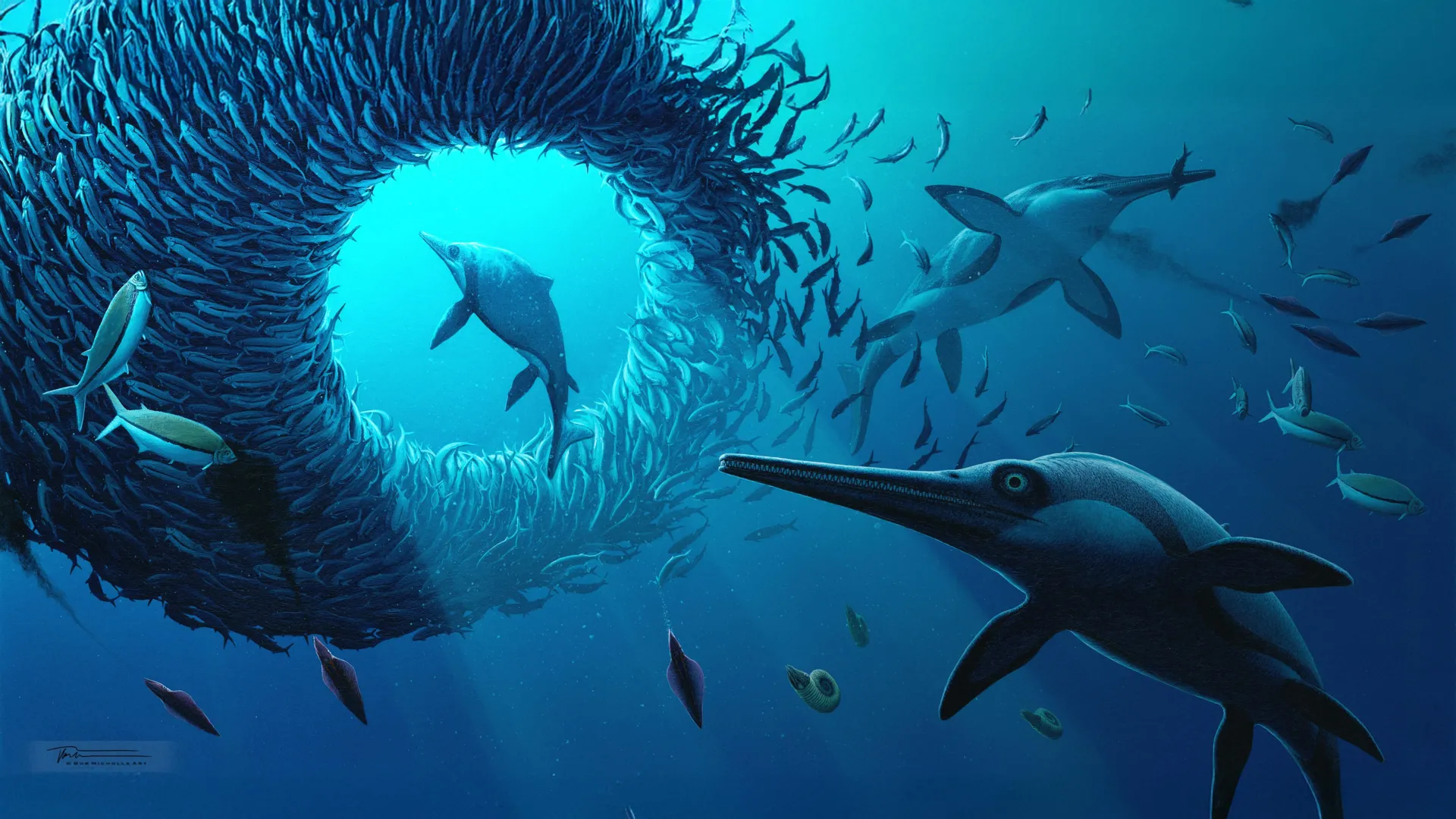
A newly identified species of ichthyosaur, unearthed from the renowned fossil-rich strata of the United Kingdom’s Jurassic Coast, represents a pivotal paleontological find, offering unprecedented insights into a critical period of marine reptile diversification and extinction approximately 190 million years ago. This exceptionally preserved specimen, christened Xiphodracon goldencapensis, addresses a long-standing discontinuity in the fossil record, providing crucial evidence for the timing and nature of a significant evolutionary turnover among these formidable apex predators of the Mesozoic seas.
Ichthyosaurs, often colloquially referred to as "sea dragons," were a highly successful lineage of marine reptiles that converged strikingly in form and ecology with modern dolphins and sharks. Dominating the world’s oceans for over 150 million years during the Mesozoic Era, their fossilized remains offer a unique window into the adaptive capabilities of life returning to the marine environment. The Jurassic Coast, a UNESCO World Heritage Site stretching across 95 miles of coastline in Dorset and East Devon, has been an unparalleled source of ichthyosaur discoveries for centuries, ever since the pioneering efforts of early paleontologists like Mary Anning. Yet, despite this rich legacy, the description of Xiphodracon goldencapensis marks the first new genus of Early Jurassic ichthyosaur from the region to be formally characterized in over a century, underscoring its profound scientific importance.
The fossil, initially uncovered in 2001 by dedicated local collector Chris Moore near the iconic Golden Cap cliff formation, exhibits an astonishing degree of three-dimensional preservation. This remarkable fidelity to the original skeletal structure provides an invaluable resource for detailed anatomical and phylogenetic analysis, far surpassing the typical two-dimensional compression often observed in such ancient remains. The specimen comprises a nearly complete skeleton, including a robust skull featuring an immense orbital cavity – indicative of large eyes, possibly adapted for hunting in low-light conditions – and an elongated, sword-like rostrum. Researchers estimate the animal’s length at approximately three meters, suggesting a swift and agile predator likely preying on fish and cephalopods. Intriguingly, initial examinations indicate potential traces of its last meal within its abdominal cavity, offering rare direct evidence of its diet and paleoecological role. This specimen is currently regarded as the most complete prehistoric reptile recovered from the Pliensbachian stage of the Early Jurassic period.
The rigorous scientific investigation of this fossil was spearheaded by an international consortium of paleontologists, with Dr. Dean Lomax, an Honorary Research Fellow at The University of Manchester and an 1851 Research Fellow at the University of Bristol, leading the study. Their comprehensive findings have been formally peer-reviewed and published in the prestigious journal Papers in Palaeontology. Dr. Lomax vividly recalls his initial encounter with the fossil in 2016, recognizing its inherent uniqueness even then. He emphasizes that its true significance only became apparent through meticulous study, revealing its pivotal role in illuminating a complex faunal transition during the Pliensbachian. This geological epoch represents a crucial interval in ichthyosaur evolution, characterized by the extinction of several prominent lineages and the emergence of new families. Dr. Lomax aptly describes Xiphodracon as a "missing piece" in the intricate ichthyosaur phylogenetic mosaic, demonstrating closer affinities to species typically associated with the later Early Jurassic (Toarcian stage). This evolutionary link suggests that the significant faunal turnover occurred considerably earlier than previously theorized, compelling a re-evaluation of established ichthyosaur evolutionary models.
The Pliensbachian stage, spanning roughly 193 to 184 million years ago, presents a notorious challenge for paleontologists due to the extreme scarcity of ichthyosaur fossils from this specific timeframe. This rarity has long contributed to a significant gap in the understanding of ichthyosaur evolutionary pathways. Scientists have observed a marked divergence between ichthyosaur assemblages preceding and succeeding the Pliensbachian, with distinct species populating similar ecological niches across these temporal boundaries. This abrupt shift, without clear transitional forms, has fueled hypotheses regarding a rapid and profound ecological restructuring. Professor Judy Massare of the State University of New York at Brockport, a co-author on the study, elaborates on this phenomenon: "While thousands of relatively complete ichthyosaur skeletons are documented from strata both before and after the Pliensbachian, the two faunas exhibit distinct compositions, lacking any shared species, despite an overarching ecological similarity. This clearly indicates a substantial shift in species diversity during the Pliensbachian. Xiphodracon is instrumental in pinpointing when this change occurred, though the underlying causal mechanisms remain an open question." The discovery thus provides a critical temporal marker, narrowing the window for potential environmental or ecological triggers that drove this profound evolutionary restructuring.
After its initial collection in 2001, the specimen was acquired by the Royal Ontario Museum (ROM) in Canada, where it became part of one of the world’s most extensive ichthyosaur collections. Despite its inherent scientific value, the fossil remained largely unstudied for a considerable period, awaiting the dedicated research that has now unveiled its secrets. This scenario highlights the often-protracted journey of significant fossils from discovery to full scientific elucidation, a process that relies heavily on museum curation, expert availability, and funding for research.
Beyond its evolutionary implications, Xiphodracon goldencapensis also offers poignant insights into the perilous existence of marine life in the Jurassic period. Co-author Dr. Erin Maxwell of the State Museum of Natural History Stuttgart meticulously analyzed pathological evidence preserved within the skeleton. Her findings indicate several abnormalities in the limb bones and teeth, strongly suggesting that the animal endured serious injury or illness during its lifetime. Such paleopathological evidence provides invaluable data for reconstructing the health, behaviors, and environmental stressors faced by ancient organisms. Furthermore, the skull bears distinct bite marks, consistent with an attack by a considerably larger marine predator – most likely another, more massive ichthyosaur. This grim evidence points to a violent demise, painting a vivid picture of the fierce predator-prey dynamics that characterized the Mesozoic oceans. Dr. Maxwell underscores this point: "This skeleton not only provides vital information for comprehending ichthyosaur evolution but also enriches our understanding of the challenges inherent to life in the Jurassic seas surrounding ancient Britain. The malformations in the limb bones and teeth strongly suggest significant injury or disease during the animal’s life, while the cranial bite marks, likely inflicted by a larger ichthyosaur, provide a clear cause of death for this individual. Surviving in the Mesozoic oceans was undoubtedly a hazardous endeavor."
The unique anatomical characteristics observed in Xiphodracon were fundamental to its identification as a novel genus and species. Among its most striking features is a distinctive bone near the nostril, known as the lacrimal, which exhibits peculiar prong-like projections previously undocumented in any other known ichthyosaur species. Such singular morphological traits are crucial for establishing phylogenetic relationships and differentiating new taxa. Dr. Lomax, also the author of the acclaimed book "The Secret Lives of Dinosaurs," expressed the profound satisfaction inherent in the scientific process of naming a new species. The chosen nomenclature, Xiphodracon, is a thoughtful blend of descriptive accuracy and historical homage. "Xiphodracon" combines the Greek term "xiphos," meaning sword, in direct reference to its elongated, blade-like snout, with "dracon," derived from both Greek and Latin for dragon. This latter component acknowledges the enduring popular association of ichthyosaurs with "sea dragons," a moniker that has persisted for over two centuries, captivating public imagination. The species epithet, goldencapensis, pays tribute to the geological locality of Golden Cap, where this remarkable fossil was unearthed.
The discovery of Xiphodracon goldencapensis holds broad implications for the wider field of paleontology and evolutionary biology. It serves as a compelling reminder of the continuous revelations hidden within Earth’s geological record and the crucial role that previously unstudied museum specimens play in advancing scientific understanding. This ichthyosaur not only refines the temporal framework of a major evolutionary event but also provides a tangible link between disparate ichthyosaur lineages, fostering a more coherent narrative of their adaptive radiation. Future research endeavors will likely focus on even more granular phylogenetic analyses, detailed paleoenvironmental reconstructions of the Pliensbachian, and an intensified search for additional fossil evidence from this enigmatic period. The ongoing significance of the Jurassic Coast as a global paleontological treasure trove remains undiminished, promising further breakthroughs in unraveling the mysteries of ancient life. The public will soon have the opportunity to witness this extraordinary specimen firsthand, as the fossil is anticipated to be featured in a public exhibition at the Royal Ontario Museum in Toronto, Canada, allowing a global audience to appreciate its profound scientific and historical value.



 Aura Kasih
 Lisa Mariana
 Ridwan Kamil


 Safa Marwah