Lisa Mariana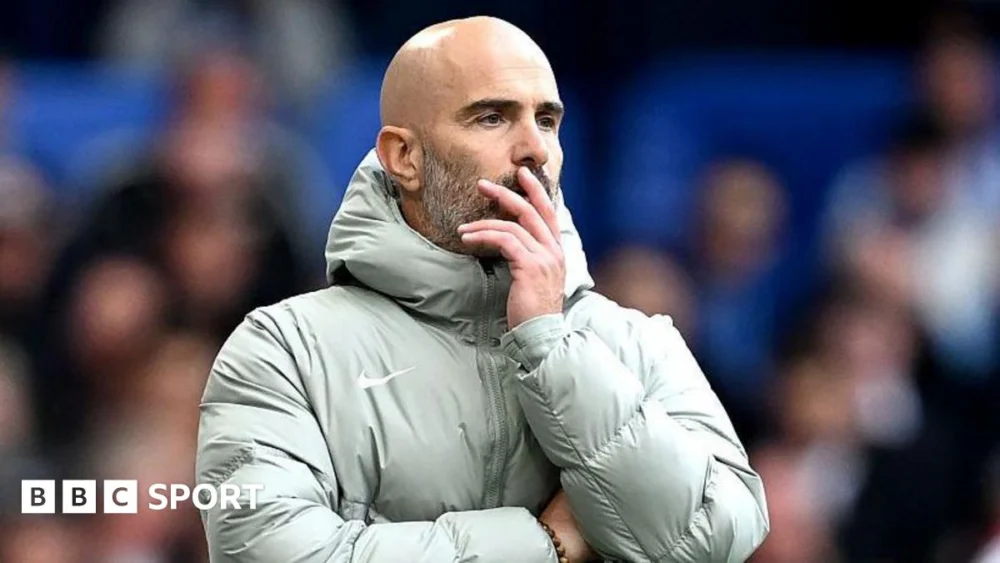
Mounting internal pressures and a visible decline in on-field performance have brought Chelsea Football Club to a critical juncture, with reports indicating that head coach Enzo Maresca’s position is under intense scrutiny and his departure could materialize imminently, potentially before the high-stakes encounter against Manchester City this Sunday. The strained relationship between the Italian tactician and the club’s senior management, exacerbated by a concerning run of results, has plunged the club into a state of acute instability, raising fundamental questions about its strategic direction and leadership cohesion.
The current atmosphere at Stamford Bridge is a stark contrast to the relative calm and optimism that characterized the early months of Maresca’s tenure. While initially lauded for securing Champions League qualification, a Conference League title, and a Club World Cup triumph in his inaugural season—achievements internally recognized as pivotal—the landscape has dramatically shifted. The club’s recent Premier League form, yielding only a single victory in the last seven outings, has seen them slide to fifth place, a significant 15 points adrift of the league leaders, Arsenal. This downturn has not only impacted their standing but has also brought latent tensions within the club’s power structure to the forefront.
A significant incident that underscored the deepening fissures occurred following Chelsea’s 2-2 draw with Bournemouth on December 30. Maresca’s absence from post-match media duties, officially attributed to illness by assistant manager Willy Caballero, is now understood to have been a deliberate choice by the head coach as he weighed his future at the club. This deliberate withdrawal from public engagement signaled a profound internal conflict, hinting at a manager contemplating a dramatic exit rather than merely recuperating from a physical ailment. Such an action by a manager is rarely isolated and typically indicative of a broader dissatisfaction that has reached a breaking point.
Reports circulating suggest a pivotal board meeting scheduled for New Year’s Day, an extraordinary measure reflecting the urgency and gravity of the situation. Such a meeting, occurring outside routine schedules, underscores the immediate need for the club’s hierarchy to address the growing crisis and determine a definitive path forward. The potential outcomes range from an amicable separation to a decisive reaffirmation of support, though the prevailing sentiment points towards an imminent change.
Despite the faltering league campaign, Chelsea’s journey in cup competitions presents a more mixed picture. The team has successfully navigated its way to the semi-finals of the Carabao Cup, is poised to resume its Champions League campaign, and has an FA Cup third-round tie against Charlton Athletic on the horizon. This duality of performance – struggles in the league juxtaposed with progress in knockout tournaments – further complicates the narrative surrounding Maresca’s efficacy and the squad’s overall capabilities. While cup runs offer intermittent successes, the primary objective of Champions League qualification through league performance remains paramount for the club’s long-term financial health and sporting prestige.
The genesis of the current predicament can be traced back to the final weeks of November, a period when Chelsea appeared to be in a harmonious state. The team occupied third place in the Premier League, fresh off a commanding performance that saw them dismantle Barcelona in the Champions League. This promising phase, however, proved to be fleeting. December brought only one league victory, but the deteriorating relationship between Maresca and the club’s hierarchy extends beyond mere results. It delves into fundamental disagreements over control, communication, and the perception of managerial performance.
A particularly telling moment occurred after Chelsea’s solitary December league win against Everton, a 2-0 victory that seemingly came from a position of strength. Maresca’s post-match comments, in which he claimed "many people" had made it his "worst 48 hours" since joining the club, sent shockwaves through Stamford Bridge. These remarks, delivered after a positive result and strong performance, were widely interpreted as a thinly veiled critique of the club’s hierarchy. Such public pronouncements from a manager, particularly when seemingly directed at his employers, are almost universally viewed dimly by club management and are often a precursor to a breakdown in trust and communication.
Initially, the club’s strategy was to conduct an end-of-season review to assess Maresca’s performance and determine his long-term future. However, the rapid escalation of internal dissent has clearly accelerated this timeline. Individuals with close knowledge of Maresca’s perspective indicate that he is actively considering walking away from his post. His unhappiness reportedly stems from a multitude of factors, including perceived interference in team selection – specifically, "encouragement to pick certain players" – and a profound sense of a lack of protection from the club regarding external criticism of his work. These issues, if accurate, represent significant breaches of the traditional manager-club relationship, where autonomy and support are foundational.
The current instability has created an unsettling environment for Chelsea, whose players are set to return to training on Friday amidst this managerial uncertainty. The club’s league position, closer in points to 15th place than to third, underscores the precariousness of their standing. The upcoming fixture against Manchester City marks the beginning of a daunting January schedule, which also includes challenging encounters against Arsenal and Napoli. It is entirely plausible that Maresca will not be at the helm for this potentially defining period, leaving the squad and supporters facing an uncertain future.
Chelsea’s overarching objective for the current season remains securing Champions League qualification. While the fifth-place position they currently occupy may prove sufficient for a return to Europe’s elite competition in the 2026-27 season due to potential league coefficient changes, relying on such external factors is a precarious strategy. The club also aims for deep runs in domestic cup competitions, balancing the pursuit of silverware with the primary goal of top-tier European football.
The initial satisfaction with Maresca at the conclusion of the previous season was rooted in his delivery of Champions League qualification, deemed his most critical achievement internally, alongside success in the Conference League and a surprising Club World Cup triumph. While victory in the third-tier European competition was largely anticipated, overcoming Paris Saint-Germain to be crowned ‘world champions’ was a significant bonus that delighted key figures at Stamford Bridge, including sporting directors Paul Winstanley and Lawrence Stewart, and influential co-owner Behdad Eghbali.
Maresca’s appointment in 2024, for which Chelsea paid Leicester City a reported £10 million, was aligned with an agreed strategic framework. Under this model, Maresca was expected to primarily focus on coaching the team, while the club’s hierarchy would oversee crucial areas such as backroom staff management, the medical department, and transfer policy. The transfer strategy, centered on acquiring the world’s most promising young players from ‘lesser’ leagues to cultivate the Premier League’s youngest squad, remains firmly in place. This long-term vision emphasizes player development and future value, a characteristic of the current ownership’s philosophy.
Maresca, by all accounts, was aware of the specific parameters of his role upon joining. His current discontent, therefore, is not reportedly rooted in the quality of the players or the overarching club strategy, but rather in the perception of his work with this notably young group. He is said to feel that his performance is being undervalued, particularly when considering the squad’s age and relative inexperience. He has expressed a desire for stronger protection from the club against external criticism, believing that the club should publicly champion his efforts more robustly.
A point of friction has been the club’s encouragement for Maresca to rotate his squad, a policy he believes often leads to dropped points in the Premier League. This highlights a potential conflict between the club’s desire for squad development and load management, and the manager’s pragmatic need for consistent results in a highly competitive league. Maresca has also taken the unusual step of openly urging reporters to direct their questions towards the club’s hierarchy, an action indicative of a manager feeling unsupported and perhaps wishing to deflect pressure onto those above him.
Beyond on-field matters, Maresca’s frustrations have manifested in other ways. He reportedly sought to engage in external activities following the club’s recent successes, including proposing to publish a book, a request that was blocked by the club. Furthermore, he spoke at Il Festival dello Sport, an event in Italy organized by La Gazzetta dello Sport newspaper, without obtaining prior club permission, signaling a desire for greater personal autonomy that may conflict with corporate directives.
Another significant disagreement arose when Maresca publicly expressed his dissatisfaction with the club’s decision not to sign a central defender after Levi Colwill sustained an anterior cruciate ligament injury in pre-season. The club’s hierarchy countered that acquiring another defender could potentially prompt academy prospect Josh Acheampong to seek a transfer, a rationale that ultimately led Maresca to back down. This incident underscores a tension between immediate squad needs, as perceived by the manager, and the club’s broader strategy of nurturing academy talent and protecting future assets.
In a move that often precedes a significant career decision, Maresca has reportedly switched agents from the Wasserman agency to the influential Jorge Mendes. Mendes, known for his extensive network and ability to facilitate high-profile transfers and managerial appointments, could be positioning Maresca for future opportunities. Indeed, Maresca has already been mooted as a potential successor to Pep Guardiola at Manchester City, a speculation he has publicly dismissed as "100% speculation." Furthermore, his increasingly frequent choice to forgo club tracksuits in favor of his own clothing items is a subtle but noticeable sign of disengagement from the club’s corporate identity.
Chelsea faces a truly packed January schedule across four competitions, a period that will undoubtedly test the resilience of the squad and the efficacy of its leadership, whoever that may be. The month commences with the daunting Premier League trip to the Etihad Stadium to face Manchester City. This is followed by a series of demanding London derbies – home and away fixtures against Fulham, Crystal Palace, Brentford, and West Ham United. In addition to these league commitments, the club must navigate an FA Cup third-round tie away to Charlton Athletic, a Carabao Cup semi-final first leg against Arsenal, and two crucial Champions League fixtures: a home tie against Pafos and an away encounter with Napoli.
Realistically, Chelsea needs to secure victories in both European games to avoid the play-off round and ensure a top-eight finish in the league phase of the Champions League. The current fifth-place position in the Premier League, while not guaranteeing automatic qualification, may be enough to secure a return to the Champions League for the 2026-27 season, depending on the performance of English clubs in European competitions and the expanded format. However, relying on external factors is not a strategy for a club with Chelsea’s ambitions. The looming specter of a managerial change at such a critical juncture only amplifies the uncertainty surrounding Chelsea’s prospects for the remainder of the season, marking a period of profound introspection and potential upheaval at Stamford Bridge.

 Ridwan Kamil
 Aura Kasih
 Safa Marwah