
 Safa Marwah
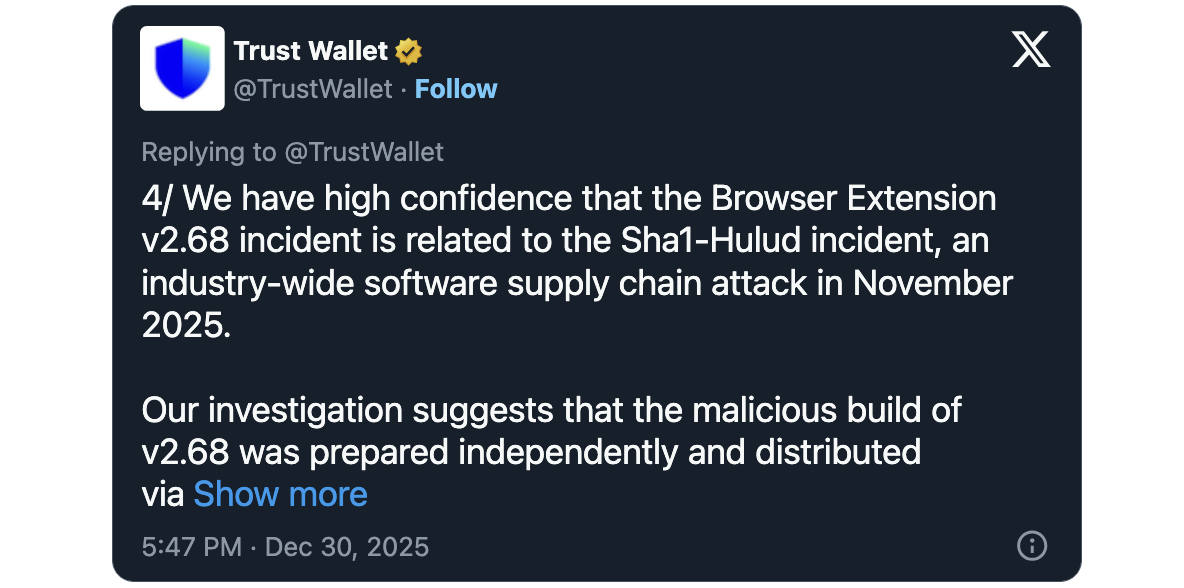
A recent security incident impacting Trust Wallet, resulting in the theft of approximately $8.5 million from over 2,500 cryptocurrency wallets, is now believed to be a direct consequence of or closely related to the "Shai-Hulud" supply chain attack that extensively targeted the npm software registry. This sophisticated breach underscores the escalating dangers within the software development ecosystem, particularly concerning the compromise of developer credentials and the integrity of publicly distributed software packages, posing significant threats to digital asset security.
Trust Wallet, a prominent cryptocurrency wallet provider serving a vast user base exceeding 200 million individuals, facilitates the secure storage, transfer, and reception of a wide array of digital assets, including Bitcoin, Ethereum, Solana, and numerous other cryptocurrencies and tokens. Its services are accessible via both a popular web browser extension and dedicated mobile applications. The incident, first identified in late December, involved a systematic compromise of the platform’s browser extension, leading to unauthorized access and depletion of user funds. Initial reports indicated substantial financial losses, which have since been quantified at $8.5 million, highlighting the severe financial repercussions for affected users.
The forensic analysis conducted by Trust Wallet revealed a multi-stage attack vector, meticulously executed by the threat actors. The initial point of compromise centered on the exposure of critical GitHub developer secrets. These secrets, akin to digital master keys, are highly sensitive credentials that grant privileged access to an organization’s repositories, internal tooling, and deployment pipelines. Their illicit acquisition provided the attackers with unfettered access to Trust Wallet’s browser extension source code, a foundational component of their web-based offering. Crucially, this breach also yielded the attackers the Chrome Web Store (CWS) API key, a pivotal credential that governs the publishing and updating of extensions within Google’s official marketplace.
With the CWS API key in hand, the adversaries gained comprehensive control over the extension’s distribution mechanism. This unprecedented access allowed them to circumvent Trust Wallet’s established internal release processes, which typically mandate stringent internal approvals and manual security reviews before any new version is deployed. The attackers effectively bypassed these crucial safeguards, enabling them to upload malicious builds directly to the Chrome Web Store without detection or authorization from Trust Wallet’s security teams. This level of access to a public distribution channel for software represents a critical failure point in the software supply chain, demonstrating how compromised credentials can undermine even robust security protocols.
Following the initial compromise, the threat actors proceeded to establish their own malicious infrastructure. They registered a new domain, metrics-trustwallet.com, and a corresponding subdomain, api.metrics-trustwallet.com. These domains were specifically purposed to host the malicious code that would later be embedded within the trojanized version of the Trust Wallet extension. This strategic move provided a clandestine command-and-control channel for the attackers, allowing them to deliver and manage their payload.
The next critical phase involved the creation of a modified version of the official Trust Wallet extension. Leveraging the previously obtained source code through the exposed GitHub developer secrets, the attackers seamlessly integrated malicious JavaScript code directly into the extension’s core functionality. This method of embedding malicious logic directly into the legitimate source code is particularly insidious, as it allows the malicious components to operate with the appearance of legitimate functionality, making traditional code injection detection mechanisms less effective. This trojanized extension was engineered to covertly collect sensitive wallet data from unsuspecting users and facilitate the execution of unauthorized transactions, directly siphoning funds from their compromised accounts.
The final act of the deployment involved publishing this malicious version, identified as 2.68, to the Chrome Web Store. Due to the compromised CWS key, the extension passed through the automated review process and was released to the public, appearing as a legitimate update. This enabled the wide distribution of the tainted software, affecting a substantial number of users who updated their browser extension or installed it anew. The entire sequence highlights a sophisticated understanding of software development pipelines and distribution channels, characteristic of advanced persistent threat (APT) actors or highly organized cybercriminal groups.
In response to the incident, Trust Wallet initiated immediate and decisive mitigation actions. All release APIs were promptly revoked to prevent any further unauthorized updates or new version releases by the attackers. Furthermore, the malicious domains (metrics-trustwallet.com and api.metrics-trustwallet.com) were reported to their registrar, NiceNIC, leading to their swift suspension. These actions were critical in halting the exfiltration of additional wallet data and disrupting the attackers’ command and control infrastructure. Simultaneously, Trust Wallet has commenced a comprehensive reimbursement program for all affected users, demonstrating a commitment to restitution. However, the company has also issued urgent warnings regarding a subsequent wave of opportunistic scams, where threat actors are impersonating Trust Wallet support personnel, disseminating fake compensation forms, and running fraudulent advertisements, particularly on platforms like Telegram, to exploit the ongoing crisis for further financial gain.
The profound connection between the Trust Wallet breach and the "Shai-Hulud" malware campaign, also known as Shai-Hulud 2.0, illuminates a pervasive and escalating threat within the broader software supply chain. Shai-Hulud is characterized as a large-scale supply chain attack specifically targeting the npm software registry, a critical repository housing over 2 million JavaScript packages that are foundational to countless applications and services worldwide.

The initial phase of the Shai-Hulud outbreak, observed in early September, saw threat actors compromise more than 180 npm packages. This was achieved through a self-propagating payload designed to infiltrate development environments. Once embedded, the malware leveraged tools such as TruffleHog to systematically scan for and exfiltrate developer secrets and API keys. These credentials are vital for accessing various online services, cloud platforms, and internal systems, making their compromise incredibly valuable to attackers.
The campaign rapidly escalated into Shai-Hulud 2.0, demonstrating exponential growth and a significantly expanded impact. This more aggressive iteration affected over 800 packages and involved the deliberate injection of more than 27,000 malicious packages into the npm repository. These packages contained sophisticated malicious code designed to harvest an even wider array of developer and CI/CD (Continuous Integration/Continuous Deployment) secrets. Crucially, the stolen data was then publicly exposed and published across over 30,000 GitHub repositories, transforming a private compromise into a public data leak of staggering proportions. In total, the Shai-Hulud campaign is estimated to have exposed approximately 400,000 raw secrets, with an alarming 60% of the leaked NPM tokens reportedly still valid as of early December. This prolonged validity underscores the difficulty in rapidly revoking compromised credentials across such a vast attack surface.
Security researchers from Wiz, who have closely tracked the Shai-Hulud campaign, issued stern warnings regarding the increasing sophistication of credential harvesting operations leveraging the npm ecosystem and GitHub. They prognosticated a continuation of such attacks, not only through similar tactics, techniques, and procedures (TTPs) but also through the direct exploitation of the immense trove of credentials already harvested. The strong correlation between the methods employed in the Shai-Hulud campaign — specifically the targeting of developer secrets and the exploitation of software distribution channels — and the Trust Wallet incident suggests a direct lineage or at least a shared playbook among threat actors operating in this space.
This incident serves as a stark reminder of the inherent vulnerabilities within the modern software supply chain, where reliance on third-party packages and the interconnectedness of development tools create numerous entry points for malicious actors. The compromise of developer credentials, as demonstrated by both Shai-Hulud and the Trust Wallet breach, can have cascading effects, undermining the security of entire platforms and directly impacting end-users. For the cryptocurrency ecosystem, which relies heavily on trust and robust security, such breaches erode user confidence and highlight the imperative for enhanced security postures across all layers.
To mitigate such pervasive threats, organizations must adopt multi-layered security strategies. For developers and companies, this includes implementing stringent secret management practices, utilizing dedicated secret vaults, and ensuring environment variables are securely configured. Universal adoption of multi-factor authentication (MFA) for all development accounts, including GitHub, npm, and CWS, is non-negotiable. Regular and automated security audits of all third-party dependencies are essential, coupled with the deployment of advanced supply chain security tools designed to detect anomalous behavior and malicious injections. Secure CI/CD pipelines, robust code signing protocols, and rigorous integrity checks must become standard practice. Furthermore, the principle of least privilege access should be strictly enforced, limiting access to critical systems and data only to those who absolutely require it.
For users, vigilance remains paramount. This includes exercising extreme caution regarding unsolicited communications, verifying the authenticity of all security alerts, and avoiding suspicious links or forms. For significant digital asset holdings, the use of hardware wallets is strongly recommended, as they provide an additional layer of physical security, isolating private keys from internet-connected devices. Minimizing the amount of cryptocurrency exposed on browser extensions and staying informed about official security advisories are also crucial preventative measures.
In conclusion, the Trust Wallet breach, intricately linked to the Shai-Hulud NPM attack, represents a critical juncture in understanding the evolving landscape of cyber threats. It underscores the profound risks associated with compromised developer credentials and the integrity of the software supply chain. As cybercriminals continue to refine their tactics, leveraging sophisticated supply chain attacks to target foundational components of digital infrastructure, the collective industry must respond with enhanced vigilance, proactive security measures, and a collaborative approach to safeguarding digital assets and maintaining user trust. The financial and reputational ramifications of such breaches necessitate a continuous re-evaluation and strengthening of security protocols across the entire software development and deployment lifecycle.




 Ridwan Kamil
 Aura Kasih


 Lisa Mariana