Lisa Mariana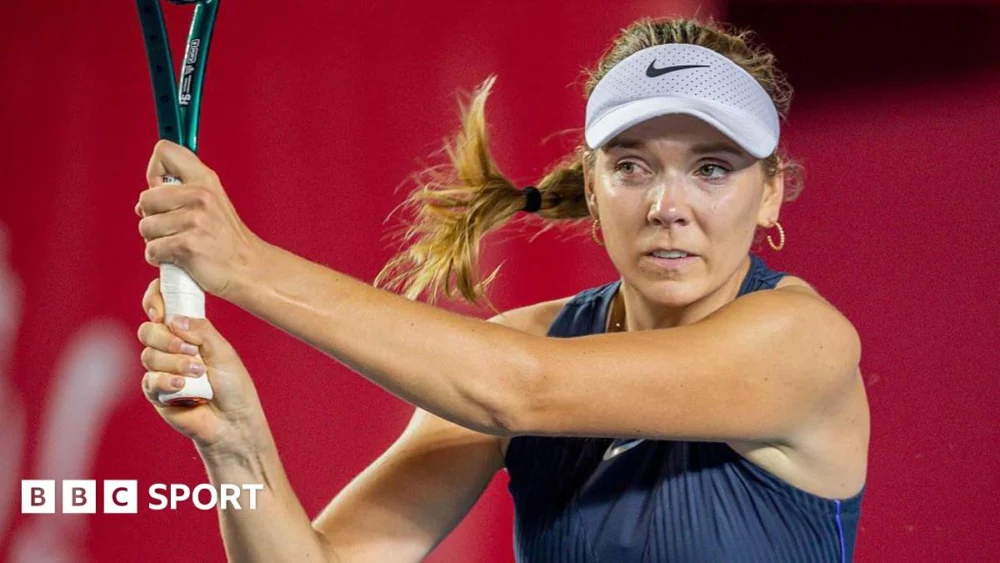
British tennis professional Katie Boulter has initiated a significant strategic shift in her coaching team, enlisting the expertise of American mentor Michael Joyce, a figure renowned for guiding athletes to the apex of the sport, most notably Maria Sharapova during her Grand Slam triumphs and ascent to world number one. This pivotal collaboration signals Boulter’s determined pursuit of reclaiming and surpassing her previous career benchmarks, commencing with the upcoming ASB Classic in Auckland, where she holds a main draw wildcard.
The engagement of Michael Joyce, a respected veteran within professional tennis coaching circles, represents a calculated move by Boulter to inject a new dimension of high-level experience and strategic insight into her developmental trajectory. Joyce, aged 52, brings a formidable pedigree to the partnership, distinguished by a coaching career punctuated by profound successes with some of the sport’s most prominent figures. His tenure with Maria Sharapova spanned a crucial six-year period, during which the Russian superstar secured both the US Open and Australian Open titles and achieved the coveted world number one ranking, a testament to Joyce’s capacity for fostering elite performance and strategic acumen.
Beyond his celebrated work with Sharapova, Joyce’s coaching portfolio includes collaborations with other high-profile athletes, underscoring his versatility and adaptability across different player styles and temperaments. He has lent his expertise to two-time Grand Slam champion Victoria Azarenka, contributed to the development of Britain’s former top-ranked player Johanna Konta, and most recently guided American talent Ashlyn Krueger to her breakthrough into the top 30 in June of the preceding year. This diverse experience across different player profiles and career stages positions Joyce as a coach adept at identifying and cultivating the specific requirements for individual success at the elite level. His own playing career, which saw him reach a respectable world ranking of 64, provides him with an intrinsic understanding of the competitive pressures and psychological demands placed upon professional athletes, further enriching his coaching methodology.
The initial agreement between Boulter and Joyce is structured as a probationary period, encompassing the ASB Classic in Auckland and potentially extending through the Australian Open later this month. This arrangement suggests a mutual evaluation phase, allowing both parties to assess the synergy and efficacy of their collaboration before committing to a longer-term partnership for the remainder of the year. Such trial periods are not uncommon in professional sports, providing a pragmatic framework for aligning expectations and ensuring a foundational fit between coach and athlete, a critical element for sustained success in the demanding world of professional tennis. The implications of this short-term agreement are significant; it places immediate pressure on the partnership to demonstrate tangible progress and a positive working dynamic, particularly as Boulter navigates a challenging phase of her career.
Boulter’s decision to seek a new coaching direction follows her recent separation from Biljana Veselinovic, concluding a three-year partnership that yielded three WTA titles. While the previous collaboration saw notable achievements, Boulter’s recent performance trajectory has indicated a need for a fresh perspective. Currently ranked as the British number four, she has experienced a decline from her previous standing, falling outside the world’s top 100. The latter half of the preceding year proved particularly challenging for Boulter, marked by a struggle for consistency and physical setbacks. She managed to secure only three tour-level victories since Wimbledon and sustained an abductor injury during her final event of the year in Hong Kong. This injury, coupled with her ranking dip, resulted in her narrowly missing out on direct entry into the main draw of the Australian Open, placing her as the third alternate and necessitating a potential path through the arduous qualifying rounds at Melbourne Park should insufficient withdrawals occur.
These recent difficulties underscore the critical juncture at which Boulter finds herself, making the integration of a coach of Joyce’s caliber particularly timely. Her expressed ambitions, articulated in a November interview, align precisely with Joyce’s proven track record. Boulter emphatically stated her criteria for a new coach: "Going forward with a new coach, one thing I’m very clear on is that they are going to be someone who has a lot of experience in how to make it to the very top level of this game." She further asserted her belief in her inherent ability, stating, "I’ve been ranked as high as 23 and I know I can get back there. I don’t think my level has gone anywhere, I think the consistency needs to improve." Her ultimate goal is unequivocally ambitious: "My goal is not to be ranked 50, 40, 30, 20 – we’ve been there. The goal is to be inside 20."
This clear articulation of intent to break into the top echelon of women’s tennis directly correlates with Joyce’s background in guiding players to Grand Slam titles and world number one rankings. His experience in fine-tuning the games of Sharapova and Azarenka, both known for their mental fortitude and aggressive baseline play, could prove invaluable in addressing Boulter’s stated need for improved consistency and tactical refinement. The transition from being a strong contender to a consistent top-20 player often requires a nuanced understanding of match management, pressure handling, and strategic adjustments that a coach with Joyce’s extensive high-stakes experience can provide.
The mental aspect of professional tennis is paramount, and Boulter’s public declarations reflect a robust and forward-looking mindset. Her Instagram post welcoming 2026 as "the best year of her life," coinciding with her impending marriage to world number seven Alex de Minaur, and her decisive dismissal of the previous year – "Adios 2025. Don’t let the door hit you on the way out" – illustrate a clear intent to move past recent setbacks and embrace future opportunities with renewed vigor. This psychological resilience and aspirational outlook are critical assets that a new coaching partnership can harness and direct towards tangible on-court results.
The immediate challenges for the new partnership are manifold. Boulter must regain full physical fitness, navigate the competitive landscape of the early season tournaments, and potentially endure the rigors of Australian Open qualifying. Beyond these immediate hurdles, the long-term objective will be to translate her undeniable talent into consistent performances against the world’s elite. This involves not only refining her technical game but also enhancing her strategic approach to matches, optimizing her physical conditioning, and fortifying her mental resilience under pressure. Joyce’s role will extend beyond mere technical instruction to encompass holistic player development, a hallmark of successful coaching at the highest levels.
The broader implications of such a high-profile coaching change within professional tennis are always significant. A new voice, a different perspective, and a refreshed training regimen can often provide the catalyst needed to unlock untapped potential or to reignite a career that has plateaued. For Boulter, this partnership represents an investment in her long-term ambition, a clear signal of her commitment to reaching the very pinnacle of the sport. The tennis world will keenly observe the outcomes of this strategic alliance, particularly as Boulter endeavors to fulfill her stated goal of breaking into the world’s top 20, a feat that would solidify her status as a genuine force in women’s tennis. The road ahead is undoubtedly challenging, but with Michael Joyce’s experience now at her side, Katie Boulter has positioned herself to embark on a potentially transformative phase of her career.




 Ridwan Kamil
 Aura Kasih

 Safa Marwah