
 Aura Kasih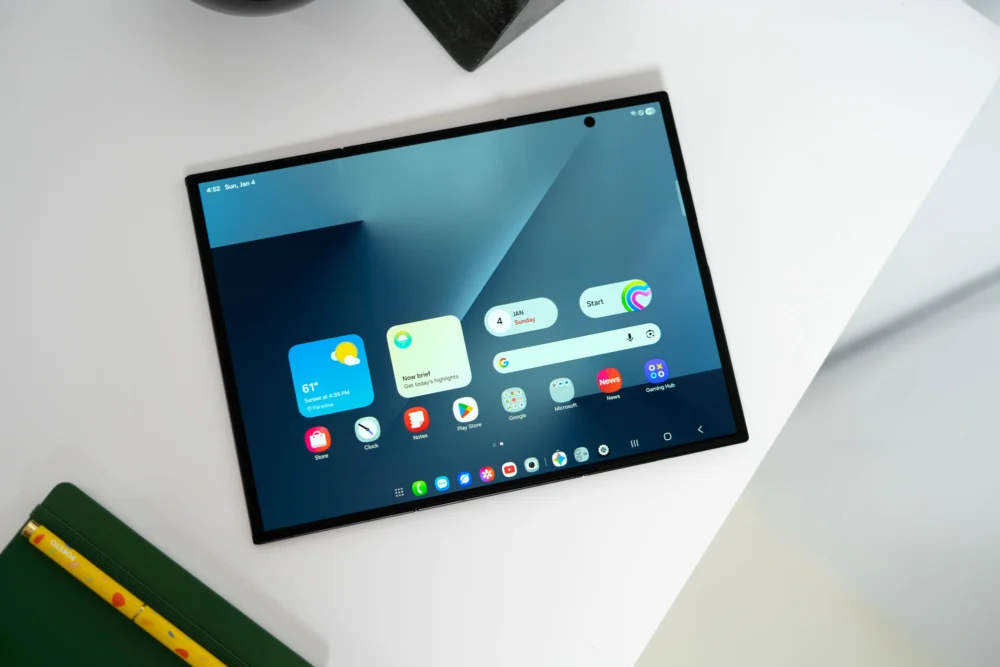
Samsung’s much-anticipated Z Trifold device represents a bold leap forward in the evolution of personal technology, blurring the lines between smartphone, tablet, and even laptop functionality. This innovative foldable, observed in a hands-on preview, moves beyond the conventional single-fold design, offering a multi-faceted mobile experience that hints at a future where device portability and powerful computing converge.

Unfolding the Future: Initial Impressions of the Z Trifold
The initial encounter with the Samsung Z Trifold confirms its ambitious design philosophy. It presents itself as a substantial device when closed, reminiscent of earlier iterations of Samsung’s foldable technology, yet its true potential is unlocked through its complex folding mechanism. The device features a dual-hinge system that allows for inward folding, a configuration that distinguishes it from other dual-folding concepts and promises a unique user interaction. While its official US availability and pricing remain unconfirmed, early indications suggest a premium market positioning, potentially aligning with or exceeding the $2,000 mark of its single-hinge predecessors. This price point, however, may be justified by the device’s promise of enhanced versatility and a novel computing paradigm.

The physical design of the Z Trifold is characterized by its surprising springiness. In demonstrations, the device exhibited an almost self-actuating opening motion, smoothly transitioning from a partially folded state to a fully extended display. The closing mechanism also demonstrates thoughtful engineering. Users are guided to fold the left panel first, a directive reinforced by haptic feedback and on-screen prompts to prevent potential damage, particularly due to the camera module’s placement on the opposite side. This attention to user guidance underscores the complexity of the device and Samsung’s commitment to a refined user experience.
When fully collapsed, the Z Trifold adopts a form factor that echoes the initial aesthetic of the Galaxy Z Fold series. The external display, while functional, leans towards a longer, narrower aspect ratio compared to traditional smartphone screens. This shape is designed to fit comfortably within the ample pockets of more relaxed apparel, though its presence might feel less discreet in slimmer or more form-fitting garments. Despite the usability of the cover screen, the inherent allure of unfolding the larger internal display is a powerful draw, suggesting that the primary intended use case leverages its expanded screen real estate.

Beyond the Fold: A Tablet-Like Experience in Your Pocket
The Z Trifold’s internal display transforms the device into a compact tablet. This expansive screen invites a different kind of engagement than a standard smartphone. The experience feels less like using a phone and more akin to interacting with a dedicated tablet, albeit one that can be folded for greater portability. The thinness of the device when fully unfolded is particularly striking, a testament to the advancements in flexible display technology and hinge engineering.

The appeal of the Z Trifold extends to its potential as a productivity hub, especially when paired with external accessories. The prospect of using a compact Bluetooth keyboard and mouse in conjunction with the device is highly compelling. This combination could offer a viable alternative to carrying a traditional laptop for many mobile professionals. The memory of struggling with a work computer while managing other responsibilities, as experienced during holiday travel, highlights the potential of such a device to streamline workflows and reduce the burden of carrying multiple gadgets. The Z Trifold, with its integrated tablet-like capabilities, appears poised to address this need for a singular, highly capable mobile device.
Samsung DeX: The Engine of Mobile Productivity

A significant factor contributing to the Z Trifold’s potential as a game-changer is its integration with Samsung DeX. DeX, Samsung’s proprietary desktop experience, elevates the Z Trifold beyond a mere foldable phone. When connected to an external display, DeX transforms the device into a full-fledged desktop environment, complete with multi-window support and a familiar user interface. However, the Z Trifold’s implementation of DeX appears to offer a more integrated, standalone experience even without an external monitor. This suggests that the device’s internal folding mechanism is designed to facilitate a desktop-like workflow directly on its expanded screen.
The strategic inclusion of specific software, such as a tailored version of Adobe Lightroom for the Z Trifold, further solidifies its position as a device engineered for productivity. This specialized software indicates Samsung’s intent to create an ecosystem where professional applications can be optimized for the unique form factor and capabilities of the Z Trifold. The convergence of powerful hardware, flexible display technology, and optimized software creates a compelling proposition for users seeking a device that can seamlessly transition between communication, content consumption, and content creation.

A New Frontier in Mobile Computing
The Samsung Z Trifold is not merely an incremental upgrade; it represents a fundamental rethinking of mobile device architecture. By integrating the functionality of a smartphone and a tablet into a single, foldable unit, Samsung is pushing the boundaries of what is possible in personal computing. The dual-hinge design, combined with the robust DeX platform and optimized software, creates a device that is both versatile and powerful. This evolution is particularly significant in an era where the demands placed on mobile devices are continuously increasing, requiring them to perform tasks previously reserved for more substantial computing hardware. The Z Trifold stands as a testament to this ongoing trend, offering a glimpse into a future where our primary computing device is not only portable but also adaptable to a wide range of user needs and scenarios. The ability to switch between a compact phone form factor and a larger, tablet-like display, all while retaining powerful desktop-class functionality, positions the Z Trifold as a potentially category-defining device.




 Ridwan Kamil

 Safa Marwah
 Lisa Mariana