Aura Kasih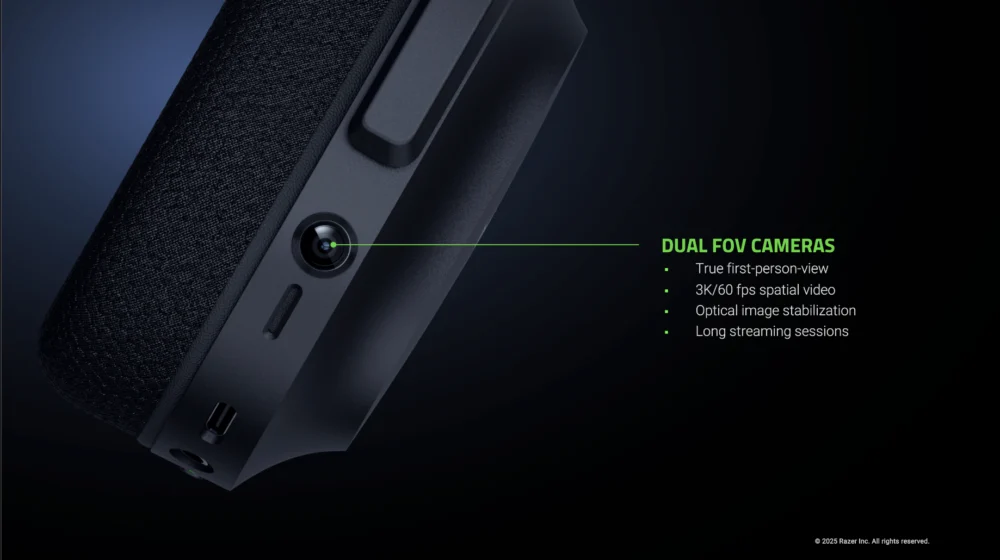
At the forefront of technological innovation, Razer has unveiled a compelling concept device, codenamed "Project Motoko," that reimagines the integration of artificial intelligence into our daily lives through an unexpected form factor: a pair of headphones equipped with advanced camera technology. This ambitious project, showcased at a major industry event, positions AI as a seamless, ever-present companion, embedded within a device that is already a ubiquitous part of modern personal technology.
Project Motoko represents a significant departure from the prevalent trend of AI wearables, which have largely focused on wristbands or smart glasses. Razer’s approach leverages the inherent familiarity and broad adoption of headphones, suggesting a strategic understanding of user comfort and acceptance. The concept device integrates dual first-person-view (FPV) cameras directly into the earcups, strategically positioned to capture the wearer’s field of vision. This design choice is not merely aesthetic; it is fundamental to the device’s core functionality, enabling it to perceive and interpret the user’s environment in real-time.
The underlying technology powering Project Motoko is described as a Qualcomm Snapdragon chip, a choice that signifies a commitment to robust performance and efficient processing. This powerful silicon is tasked with processing the visual data from the FPV cameras, alongside input from an array of integrated microphones. These microphones are designed to capture not only voice commands and ambient dialogue but also the broader sonic landscape of the user’s surroundings, contributing to a richer contextual understanding for the AI. The inclusion of hands-free controls further enhances the device’s intuitive operation, allowing users to manage audio settings and AI interactions without physical manipulation, thereby promoting an uninterrupted user experience.
A key aspect of Project Motoko’s design philosophy is its commitment to broad AI model compatibility. Razer explicitly states that the wearable is engineered to interface with leading artificial intelligence frameworks, including those developed by OpenAI, Google Gemini, and Grok. This interoperability is crucial, as it allows the device to harness the rapidly evolving capabilities of different AI models, ensuring its longevity and adaptability. The overarching goal is to create a "full-time AI assistant" that can offer instantaneous interpretation and response, proactively adapting to the user’s evolving schedules, preferences, and habitual behaviors. The emphasis on "instant" contextual understanding suggests a sophisticated level of real-time data processing and AI inference.

The rationale behind adopting a headphone form factor for an AI wearable is multifaceted. Headphones are already widely accepted and worn in public without drawing undue attention, offering a level of social unobtrusiveness that other wearable designs might struggle to achieve. Furthermore, the internal volume of a headphone chassis provides ample space for integrating advanced components, including cameras, processors, batteries, and audio hardware, without compromising on comfort or aesthetics. Razer’s market analysis suggests an immense, largely untapped potential within the estimated 1.4 billion global headset users, positioning Project Motoko as a gateway to a new era of pervasive AI integration.
However, it is imperative to contextualize Project Motoko as a concept. The technology industry is replete with groundbreaking ideas that, while impressive in their initial unveiling, may never transition from the laboratory or exhibition floor to mass-market availability. Razer itself has a history of introducing ambitious concepts, some of which have eventually been realized as commercial products, while others have remained intriguing demonstrations of future possibilities. The successful commercialization of Project Motoko will depend on a confluence of factors, including further technological refinement, manufacturing scalability, consumer demand, and a clear articulation of its unique value proposition in a competitive landscape.
The implications of Project Motoko, should it come to fruition, are profound and far-reaching. Imagine a world where your AI assistant is not confined to a smartphone or a smart speaker but is an active participant in your immediate sensory experience. The FPV cameras could offer real-time visual context to AI queries. For instance, a user could point to an object and ask, "What is this?" or hold up a document and request a summary. The AI could then process both visual and auditory cues to provide a more accurate and nuanced response. This could revolutionize tasks ranging from learning and information retrieval to navigation and even social interaction, where the AI could potentially offer real-time social cues or translation.
The integration of multiple microphones also opens up possibilities for sophisticated environmental awareness. The AI could monitor ambient noise levels and adjust audio output accordingly, or it could detect conversational patterns to facilitate more natural human-AI dialogue. Furthermore, the ability to capture environmental audio could be used for personalized health and wellness applications, such as monitoring sleep patterns or detecting potential hazards in the environment.
The technical challenges associated with such a device are substantial. Power consumption will be a critical factor, given the continuous operation of cameras, processors, and AI inference. Battery life will need to be competitive with existing premium headphones to ensure user adoption. Data privacy and security will also be paramount concerns. With cameras constantly capturing visual information, robust encryption and transparent data handling policies will be essential to build and maintain user trust. The ethical considerations surrounding pervasive visual recording, even in a personal context, will undoubtedly be a significant area of discussion and development.

From an AI development perspective, Project Motoko presents a unique platform for innovation. The ability to process real-world, multi-modal data streams in real-time offers unprecedented opportunities for training and refining AI models. The device could learn from a user’s interactions, environment, and preferences to become increasingly personalized and predictive. This could lead to AI assistants that are not just reactive but truly proactive, anticipating needs and offering assistance before being prompted.
The competitive landscape for AI wearables is rapidly evolving. While Project Motoko is a concept, other companies are also exploring ways to integrate AI into personal devices. The success of Razer’s endeavor will depend on its ability to differentiate itself through unique features, superior user experience, and a compelling ecosystem of AI services. The partnership with major AI model providers suggests a strategy to leverage the strengths of various AI paradigms, rather than relying on a single proprietary solution.
Looking ahead, the potential applications for Project Motoko extend beyond personal assistance. In professional settings, it could be used for on-site diagnostics, remote expert guidance, or even augmented reality training simulations, where the AI could overlay information or instructions onto the user’s field of view, triggered by their environment. For accessibility, it could provide real-time assistance for individuals with visual or hearing impairments, translating spoken words into text or describing visual elements of their surroundings.
The journey from concept to commercial reality is often long and arduous. Razer’s Project Motoko, however, represents a bold and visionary step towards a future where artificial intelligence is not an abstract concept or a tool confined to screens, but an integrated and intuitive aspect of our everyday existence. The success of this initiative will depend on its ability to navigate the complex interplay of technological feasibility, user acceptance, ethical considerations, and market dynamics, ultimately shaping how we interact with AI in the years to come. The headphone form factor, combined with advanced camera and AI capabilities, presents a compelling proposition for a new generation of personal computing.




 Ayu Aulia
 Ridwan Kamil
 Safa Marwah
 Lisa Mariana