Lisa Mariana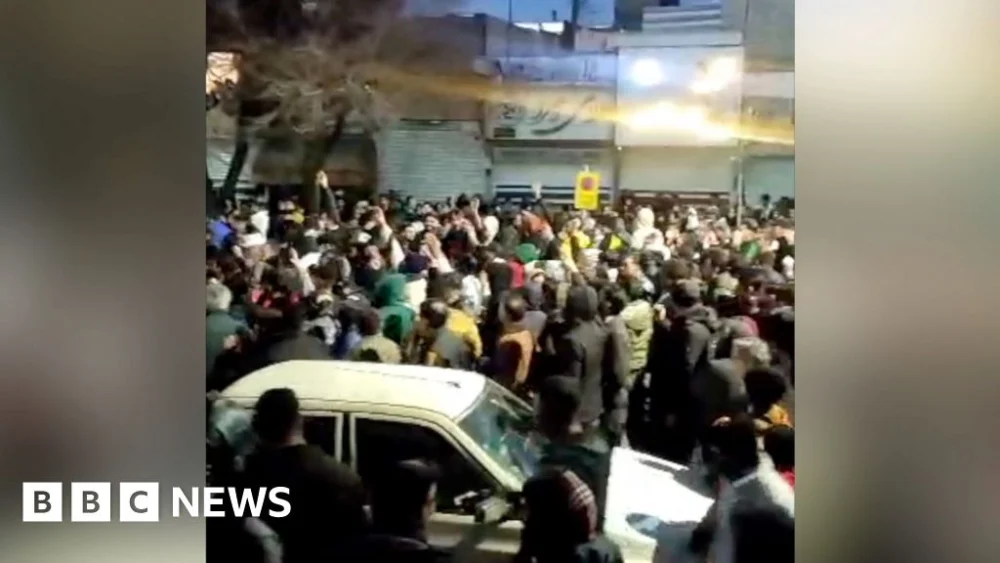
Across Iran, a wave of intense confrontations between anti-government demonstrators and state security forces has expanded, marking an eleventh consecutive day of widespread unrest fueled by profound economic grievances and growing political discontent. The pervasive turmoil, captured in numerous unverified reports and video accounts, underscores a deepening crisis of legitimacy for the clerical establishment, as protests now encompass a significant portion of the nation’s urban and provincial centers.
The intensifying civil unrest witnessed violent clashes on Wednesday, with reports from the semi-official Fars news agency, often associated with the Islamic Revolutionary Guard Corps, indicating that two police officers were fatally shot by armed individuals amidst disturbances in the southwestern town of Lordegan. Eyewitness accounts and social media footage from various locations depict tense stand-offs, the pervasive sound of gunfire, and security forces deploying firearms and tear gas against crowds, who in turn retaliated with stones and other projectiles. These developments signal a perilous escalation in the confrontation between a disillusioned populace and a regime determined to maintain control.
The geographic scope of the demonstrations has been particularly notable, with the US-based Human Rights Activist News Agency (HRANA) reporting that the movement has spread to an astonishing 111 cities and towns across all 31 of Iran’s provinces. This widespread dispersion distinguishes the current wave of protests, demonstrating a nationwide breadth of frustration rather than isolated pockets of dissent. HRANA further estimates a grim toll, with at least 34 protesters and four security personnel reported killed, alongside the arrests of approximately 2,200 individuals. While independent verification remains challenging due to stringent reporting restrictions, other sources, including BBC Persian, have corroborated the deaths and identities of at least 21 civilians, with Iranian authorities acknowledging the fatalities of five security personnel.
The genesis of this latest eruption of public anger can be traced to December 28, when local merchants in Tehran initially took to the streets. Their primary grievance was the precipitous decline in the value of the Iranian rial against the US dollar, a currency depreciation that has eroded savings and purchasing power. This economic distress quickly coalesced with broader political dissatisfaction, drawing in university students and subsequently spreading rapidly beyond the capital to other major urban centers. A recurring theme in the demonstrations has been the direct challenge to the authority of Supreme Leader Ayatollah Ali Khamenei, with chants of "Death to the dictator" echoing through the streets. Concurrently, a surprising undercurrent of monarchist sentiment has emerged, with some demonstrators expressing support for Reza Pahlavi, the exiled son of Iran’s last Shah, a stark rejection of the 1979 Islamic Revolution’s foundational principles.
The current economic plight gripping Iran is multifaceted and severe. Over the past year, the rial has plummeted to unprecedented lows, while inflation has soared to an alarming 40%. This dire situation is largely attributed to a combination of international sanctions, primarily those targeting Iran’s nuclear program, which have severely constrained its oil exports and access to global financial markets. Compounding these external pressures are pervasive internal issues, including persistent government mismanagement and rampant corruption, which have further debilitated the national economy and exacerbated the suffering of ordinary citizens. The cumulative effect is a population increasingly impoverished and devoid of economic prospects, forming a fertile ground for social unrest.
Verified video evidence from Wednesday’s events offers a glimpse into the intensity and diverse nature of the protests. In Qazvin, northwest of Tehran, crowds were observed chanting "Death to the dictator" and "Long live the shah," directly challenging the current clerical leadership and invoking a historical alternative. From the Gulf port of Bandar Abbas, footage showed demonstrators appealing to "Police force, support, support," indicating an attempt to sway elements of the security apparatus, before being dispersed by state forces. In the revered Shia holy city of Mashhad, located in the country’s northeast, protesters were seen engaging in direct clashes with security forces, compelling their retreat – a powerful symbolic victory for the demonstrators. Further videos from Mashhad showcased explicit support for the Pahlavi dynasty, signaling a profound ideological schism with the Islamic Republic.
As the day progressed, a substantial demonstration reportedly unfolded in Abadan, a southwestern city strategically positioned near the Iraqi border. Verified footage from this locale captured protesters chanting slogans such as "Cannon, tanks, firecrackers! Mullahs must get lost," a blunt demand for the removal of Iran’s clerical elite. Disturbing images filmed from a balcony in Abadan appeared to show security forces discharging firearms as they retreated from advancing protesters, who were seen hurling stones and other objects. The descent of night did not quell the unrest; in Aligudarz, another western city, security forces were filmed deploying tear gas to disperse a gathering that had coalesced in a central square, chanting "People’s uprising, Viva!" These scattered yet widespread incidents paint a picture of a nation teetering on the edge of a broader confrontation.
The Fars news agency’s report on the killing of two police officers, identified as Hadi Azarsalim and Moslem Mahdavinasab, in Lordegan, described them as having been shot by "armed individuals" within a group it labeled as "rioters." The challenge of independently verifying such reports is significant, as international media organizations like the BBC face severe restrictions on reporting from within Iran, often operating without permission or under highly controlled conditions. Nevertheless, Lordegan has been identified as a flashpoint for violent clashes, with two protesters reportedly killed there just a week prior.
In the aftermath of a cabinet meeting on Wednesday, Mohammad Jafar Qaempanah, the Vice-President for Executive Affairs, stated that President Masoud Pezeshkian had issued directives against taking "security measures" targeting peaceful protesters. However, he drew a critical distinction, asserting that "Those who carry firearms, knives and machetes and who attack police stations and military sites are rioters, and we must distinguish protesters from rioters." This rhetorical framing is a common tactic employed by the Iranian state to delegitimize the broader protest movement by categorizing violent elements separately. Simultaneously, state media announced that the government had begun distributing a new monthly allowance, equivalent to $7 (£5), to 71 million citizens, an apparent attempt to mitigate the economic hardship fueling the unrest.
Contradicting the conciliatory tone regarding "peaceful protesters," judiciary chief Gholamhossein Mohseni Ejei issued a stern warning to police commanders, stating that "rioters" would face "rapid" prosecution and punishment, intended to serve as a deterrent. These conflicting messages highlight the internal dilemmas facing the Iranian leadership: how to address legitimate grievances without appearing weak, while simultaneously suppressing outright dissent. Supreme Leader Khamenei himself weighed in on Saturday, advocating for authorities to "speak with the protesters" but unequivocally stating that "rioters should be put in their place."
The geopolitical context further complicates the regime’s response. These comments from Khamenei followed a direct threat from US President Donald Trump, who declared that the US was "locked and loaded" and would intervene if Iranian security forces resorted to killing peaceful protesters. Such external pressure adds another layer of calculation for Tehran, potentially influencing the severity and swiftness of its crackdown.
Expert analysis underscores the deep-seated nature of the current unrest. Dr. Sanam Vakil, director of the Middle East program at Chatham House, emphasized that the protests quickly transcended their initial economic origins to become profoundly political, driven by pervasive public anger. "People are fed up. They have no prospects for the future. Day-to-day life is becoming much more difficult," Vakil noted, adding that a sustained momentum with increased participation would render the protests more serious, inevitably leading to a more violent government response. This assessment suggests a critical juncture where the scale of public participation will determine the trajectory of the confrontation.
Sadegh Zibakalam, a professor of political science at the University of Tehran, offered insight into the regime’s potential caution, suggesting that Trump’s threats might be a factor in restraining a harsher crackdown. "Some Iranian leaders – Revolutionary Guard commanders and security forces – maybe they are a bit more cautious and are not in a hurry to suppress the crowd this time fearing it may create an American intervention," Zibakalam observed. This indicates a potential strategic calculus within the Iranian establishment, weighing the risks of domestic repression against the specter of external interference.
The current protests represent the most widespread demonstrations since the major uprising in 2022, which was ignited by the death in custody of Mahsa Amini, a young Kurdish woman detained by morality police for an alleged improper wearing of her hijab. That earlier wave of unrest, while brutally suppressed, demonstrated the latent capacity for widespread dissent. Human rights organizations reported over 550 fatalities and 20,000 detentions during the violent crackdown by security forces in 2022. The echoes of that crackdown undoubtedly inform the calculations of both protesters and the regime in the present crisis.
The long-term implications of this sustained unrest are profound. For the Iranian regime, the challenge is existential. The protests reveal a significant erosion of public trust and a deepening chasm between the state and large segments of society. The dual strategy of limited concessions (like the allowance) coupled with stern warnings of prosecution reflects an attempt to de-escalate without capitulating to demands for fundamental change. However, the geographic spread and the explicit political slogans, particularly those challenging the Supreme Leader and invoking pre-revolutionary symbols, suggest that economic relief alone may be insufficient to quell the underlying discontent.
Internationally, the protests present a complex scenario. While the US has expressed support for the protesters, direct intervention remains a high-stakes proposition. Other global powers watch cautiously, concerned about regional stability and the potential for a humanitarian crisis. The protests also serve as a barometer of the effectiveness of international sanctions, demonstrating their capacity to inflict economic pain but also highlighting the potential for unintended consequences in the form of widespread social unrest.
Moving forward, several scenarios are plausible. The regime could intensify its crackdown, leveraging its powerful security apparatus to suppress the protests through force, as it has done in the past. This would likely lead to further casualties and detentions but might restore a semblance of order in the short term. Alternatively, a sustained, decentralized protest movement, perhaps less prone to a single, decisive crackdown, could emerge, continuing to chip away at the regime’s authority. The critical factors will be the continued resolve of the protesters, the unity and discipline of the security forces, and the degree to which the regime is willing to tolerate dissent or offer genuine reforms. The current trajectory suggests a deepening confrontation, with no clear end in sight, leaving Iran in a state of precarious volatility.

 Ridwan Kamil
 Aura Kasih
 Safa Marwah