
 Aura Kasih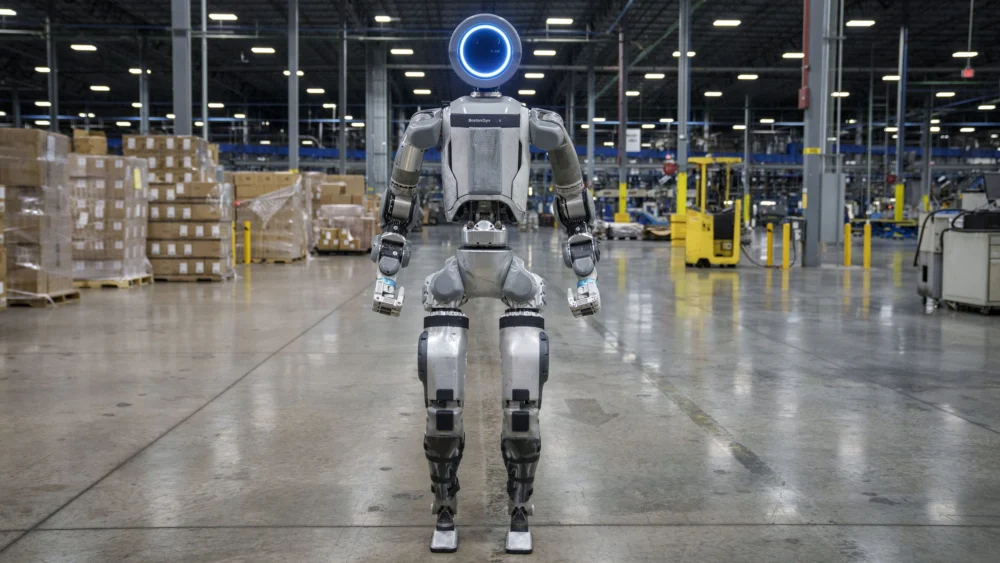
In a significant stride towards the future of industrial automation, Hyundai Motor Group, through its subsidiary Boston Dynamics, has officially unveiled the latest iteration of its highly advanced humanoid robot, Atlas. This revolutionary machine, showcased at CES in Las Vegas, is not merely a technological marvel but a harbinger of transformative changes within the automotive sector. With its fully electric, battery-powered chassis, dexterous 360-degree rotating joints, and a sophisticated, illuminated circular facial interface, Atlas is engineered to move beyond demonstration floors and into the heart of automotive production lines, working in tandem with human counterparts by 2028.
The strategic vision articulated by Hyundai is ambitious: to transition Atlas from a cutting-edge research platform to a mass-produced, "production-ready humanoid robot" specifically designed for the demanding environment of car manufacturing. The initial deployment is slated for the Hyundai Motor Group Metaplant in Savannah, Georgia, a state-of-the-art facility that already exemplifies the company’s commitment to advanced manufacturing. The ambitious production target of 30,000 Atlas units annually, commencing in 2028, signals a profound shift in how vehicles will be assembled in the coming years. This move positions Hyundai at the forefront of a new era where human ingenuity and robotic capability converge.
The phased integration of Atlas into Hyundai’s operations is meticulously planned. In 2028, the robots will be introduced to tasks where their contributions to safety and quality are immediately demonstrable, such as intricate parts sequencing. By 2030, Atlas is expected to undertake more complex operations, including handling repetitive motions, managing heavy loads, and executing other demanding physical tasks that currently pose ergonomic challenges or safety risks for human workers. This gradual rollout underscores a commitment to a "harmonious collaboration between humans and robots," a vision that seeks to address widespread societal concerns regarding job displacement due to increasing automation.
The unveiling event itself offered a glimpse into Hyundai’s broader robotics ambitions. The keynote commenced with a dynamic K-pop dance performance featuring the company’s quadrupedal Spot robots, a testament to their agility and integration capabilities. However, the undisputed star of the show was the remotely-piloted Atlas prototype, making its public debut with remarkable fluidity. Accompanying this live demonstration was a static display of a future production model, offering attendees a tangible look at the refined design that will soon be entering mass production.

The production-ready Atlas boasts a suite of enhancements designed for industrial robustness. It is engineered to be water-resistant and capable of operating within a broad temperature range, from -4 to 104 degrees Fahrenheit (-20 to 40 degrees Celsius). A key advancement is the integration of tactile sensing in its hands, enabling a more nuanced interaction with its environment and the components it handles. To ensure continuous operation, the robot is equipped with an automated battery-swapping system, minimizing downtime. Visually, the production model features a cleaner aesthetic with less exposed wiring and sleek, baby blue panels adorning its body, conveying a sense of advanced engineering and operational readiness.
Boston Dynamics, the innovator behind Atlas, has a rich history rooted in advanced robotics research. Founded in 1992 as a spin-off from the Massachusetts Institute of Technology, the company gained significant traction with funding from DARPA, leading to the development of iconic robots like BigDog. While its early work focused on military and research applications, Boston Dynamics achieved widespread public recognition through viral demonstrations of its robots’ extraordinary capabilities. Atlas, its flagship humanoid robot, became renowned for its dynamic movements, including running and performing backflips, showcasing unprecedented levels of bipedal locomotion. Alongside Atlas, the quadrupedal Spot robot has also garnered significant attention, finding applications in diverse fields ranging from agricultural tasks like sheep herding to assisting healthcare professionals during the COVID-19 pandemic.
The commercialization of Boston Dynamics’ technology began in June 2020 with the sale of Spot robots, priced at $74,500 each. These robots were initially targeted at businesses seeking automated solutions for patrol and inspection in warehouses and industrial settings. Despite the viral fame and the potential applications, Boston Dynamics has historically faced financial challenges, consistently incurring substantial annual losses. This financial trajectory underscores the inherent difficulties and significant investment required to bring highly advanced robotics to market.
Hyundai’s acquisition of Boston Dynamics in 2021 for an estimated $1.1 billion marked a pivotal moment, signaling the automaker’s deep commitment to integrating robotics into its long-term manufacturing strategy. Hyundai has long anticipated a future where robots play an increasingly integral role in its production facilities. The unveiling of Atlas as a production-ready industrial robot is a direct manifestation of this foresight, aiming to establish a benchmark in humanoid robot capabilities that surpasses contemporary rivals, notably Tesla’s Optimus robot. While Tesla has capitalized on significant AI hype to achieve a market capitalization far exceeding Hyundai’s, the latter’s tangible advancements in industrial robotics suggest a different, perhaps more grounded, approach to the commercialization of humanoid machines.
The transition of Atlas from a sophisticated research project to a commercially viable industrial asset represents a monumental achievement for both Boston Dynamics and its parent company. The path to mass production is undoubtedly fraught with significant financial hurdles for Hyundai. While the precise manufacturing cost of Atlas has not been disclosed, it is widely estimated to be substantially higher than its sibling, Spot, which retails for approximately $75,000 per unit. The complexity and advanced engineering of Atlas suggest a price point that could reach hundreds of thousands of dollars per robot.

Hyundai’s strategic advantage in this endeavor is attributed to its robust supply chain, access to cutting-edge manufacturing infrastructure, and extensive experience in developing AI-driven software and software-defined vehicles. The company believes these elements will enable it to scale robot production efficiently while mitigating costs. The latest iteration of the all-electric Atlas robot showcases a significant increase in degrees of freedom (DoF), now standing at 56, an enhancement from the 50 DoF reported in April 2025. This increased articulation, combined with human-scale hands equipped with tactile sensing, allows Atlas to perform a wider array of intricate physical tasks autonomously. The robot’s capacity to learn "most tasks" within a single day, coupled with its automatic battery-swapping capability for continuous operation and a lifting capacity of up to 110 pounds (50 kg), positions it as a formidable asset for industrial applications. Its resilience, demonstrated by water resistance and operability in extreme temperatures, further enhances its suitability for diverse manufacturing environments.
For years, Boston Dynamics has captivated global audiences with mesmerizing demonstrations of its humanoid robots executing complex physical feats such as cartwheels, breakdancing, and barrel rolls. The announcement of Atlas’s impending integration into Hyundai’s factories could potentially reshape public perception of these seemingly advanced machines. As automation continues to advance, concerns about job displacement are escalating. For instance, leaked strategy documents suggest Amazon aims to replace over 600,000 jobs in the U.S. by 2033 through automation. In contrast, Hyundai has projected that its $21 billion investment in the U.S. will directly create 14,000 jobs by 2028, with an additional 100,000 indirect jobs anticipated. This juxtaposition highlights differing approaches and potential outcomes of widespread automation.
Further bolstering its AI and robotics capabilities, Hyundai is forging a strategic partnership with Google’s DeepMind AI research laboratory. This collaboration aims to synergize Boston Dynamics’ unparalleled expertise in robotic hardware with Google’s advanced AI foundation models. Additionally, the company is securing critical AI chips and software from NVIDIA, a leading provider in artificial intelligence hardware. These strategic alliances underscore Hyundai’s comprehensive approach to developing and deploying sophisticated AI-powered robotic systems.
The monumental challenge for Hyundai and Boston Dynamics lies in translating impressive technological demonstrations into a commercially viable product that justifies its substantial investment. The current landscape of humanoid robotics is characterized by considerable hype, with tangible evidence of their cost-effectiveness and practical utility in large-scale production still emerging. The successful deployment of Atlas in automotive manufacturing will serve as a critical test case, potentially setting a precedent for the future of human-robot collaboration across various industries. The coming years will be crucial in determining whether Atlas can indeed fulfill its promise of revolutionizing car production and ushering in a new era of industrial automation.




 Lisa Mariana
 Ridwan Kamil

 Safa Marwah