Safa Marwah
In a strategic move to counter the escalating sophistication of smartphone-related criminal activities, Google has unveiled a comprehensive suite of enhanced authentication mechanisms and robust device recovery utilities for its Android platform. These critical updates represent a significant fortification of the operating system’s defenses, designed to render mobile devices considerably less appealing and accessible targets for malicious actors seeking to exploit personal data and financial assets. This latest iteration builds upon a foundational layer of anti-theft measures previously deployed in the autumn of 2024, signaling an ongoing, adaptive commitment to user security in an increasingly challenging digital landscape.
The modern smartphone transcends its role as a mere communication tool; it functions as a digital vault containing an individual’s financial instruments, personal identifiers, sensitive communications, and access to countless online services. Consequently, the theft of such a device extends far beyond the material loss, transforming into a potent vector for identity theft, financial fraud, and profound personal vulnerability. Criminal syndicates have become adept at exploiting not only physical device acquisition but also leveraging stolen hardware to compromise associated digital identities. This evolving threat landscape necessitates a proactive and multi-layered security posture, which Google aims to deliver through its latest advancements.
Google’s sustained investment in Android security reflects a broader industry imperative to safeguard users against a spectrum of threats, from opportunistic street theft to more organized criminal enterprises employing social engineering tactics. Prior to these latest enhancements, Google had already established a baseline of protection, including its "Find My Device" service and initial anti-theft protocols. However, the persistent innovation among cybercriminals, coupled with real-world incident data, has driven the development of these more granular and resilient security features. The urgency of these updates is underscored by the explicit recognition from the Android Security Team that "Phone theft is more than just losing a device; it’s a form of financial fraud that can leave you suddenly vulnerable to personal data and financial theft." This perspective frames the enhancements not merely as technical upgrades but as crucial interventions in protecting users’ overall digital and financial well-being.

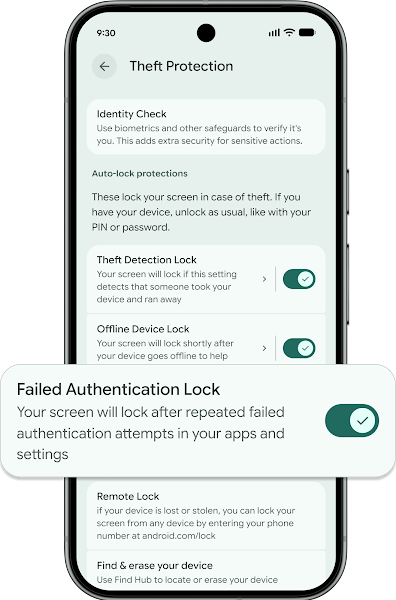
Among the core enhancements is the significant refinement of the Failed Authentication Lock feature. This mechanism is engineered to automatically secure a device’s screen following a predetermined number of unsuccessful unlock attempts. Crucially, Google has now introduced granular user controls, allowing individuals to activate or deactivate this safeguard via a dedicated settings toggle. This balances robust security with user autonomy, enabling those with specific usage patterns or accessibility needs to tailor the feature accordingly. Furthermore, the system now intelligently distinguishes between deliberate, repeated incorrect guesses and inadvertent entries, such as those made by a curious child, preventing legitimate users from being locked out due to accidental input. Concurrently, to further deter brute-force attempts by thieves, the lockout duration following consecutive failed authentication tries has been progressively extended, thereby increasing the time and effort required to bypass a device’s primary access controls. This sophisticated approach significantly raises the bar for unauthorized access.
A pivotal upgrade has also been applied to Identity Check, a feature designed to mandate biometric authentication for sensitive actions performed outside of trusted, predefined geographical locations. Previously, its scope was more limited; now, this safeguard has been comprehensively expanded to encompass virtually all features and applications that leverage the Android Biometric Prompt API. This critical expansion means that highly sensitive applications, including Google Password Manager—a repository of users’ most vital online credentials—and a wide array of third-party banking applications, are now automatically shielded by this biometric requirement. The implication is profound: even if a thief manages to gain access to an unlocked device, they would still encounter a formidable biometric barrier when attempting to access financial accounts or password vaults, drastically reducing the potential for immediate financial exploitation. This proactive defense fundamentally diminishes the "trophy value" of a stolen, unlocked device for criminals focused on monetary gain.
The suite of recovery tools has also received critical enhancements, particularly affecting the Remote Lock functionality. This indispensable tool allows users to remotely secure a lost or stolen device from any web browser by navigating to android.com/lock. Recognizing the potential for misuse or the need for heightened assurance, Google has integrated an optional security challenge into this process. This additional verification step requires users to confirm device ownership through a secondary authentication method before initiating a remote lock. This layer of verification serves to prevent malicious actors who might gain unauthorized access to a user’s Google account (but not the device itself) from arbitrarily locking the device, ensuring that only the legitimate owner can exercise this powerful recovery function. This update instills greater confidence in the integrity of the remote management process.

In a targeted response to specific regional crime patterns, Google has implemented a default activation policy for two of its most potent theft-protection features for all new Android devices activated within Brazil. These include Theft Detection Lock, an innovative capability that automatically secures a device if it discerns a "snatch-and-run" theft scenario through contextual cues and sensor data, and the aforementioned Remote Lock. This strategic deployment in Brazil underscores Google’s commitment to adapting its security solutions to address localized threats where smartphone theft, particularly opportunistic grab-and-dash incidents, poses a disproportionately higher risk. By enabling these features by default, Google aims to provide an immediate and robust defense layer for users in high-risk environments, potentially setting a precedent for similar default activations in other vulnerable regions globally. This localized approach demonstrates a data-driven strategy to enhance user safety where it is most critically needed.
The rollout of these comprehensive security updates is tiered, reflecting the inherent complexities of the Android ecosystem’s fragmentation. The advanced authentication safeguards, including the refined Failed Authentication Lock and expanded Identity Check, are available on devices running Android 16 or later. This requirement ensures that these cutting-edge features leverage the latest architectural improvements and security primitives embedded within the newest Android iterations. Conversely, the enhanced recovery tools, such as the updated Remote Lock, have a broader compatibility, extending to devices operating on Android 10 or later. This wider accessibility for recovery functions ensures that a vast majority of active Android users can benefit from improved device retrieval and protection capabilities, acknowledging the longer lifecycle of many Android devices in the market. The Android Security Team explicitly confirmed this tiered availability, stating, "We’ve expanded our security to protect you against an even wider range of threats. These updates are now available for Android devices running Android 16+." They further added, "We’re also enhancing our recovery tools to make them even more helpful. This update is now available for Android devices running Android 10+."
These theft protection measures are not isolated developments but are part of a broader, interconnected security strategy. In late 2025, Google significantly expanded the reach of its Android in-call scam protection feature within the United States. This crucial safeguard was extended to cover a multitude of prominent financial institutions and applications, including widely used platforms like Cash App, which serves over 57 million users, and the JPMorgan Chase mobile banking application, downloaded by more than 50 million individuals. Originally unveiled in May 2025 and introduced with Android 16, this in-call scam protection mechanism is designed to proactively alert users to potential risks. It triggers warnings when a financial application is launched and the screen is being shared during an active call with a number not stored in the user’s contact list. This feature directly addresses sophisticated social engineering tactics where scammers attempt to guide users into granting remote access or divulging sensitive information while on a call. By integrating these anti-scam measures with robust anti-theft protocols, Google is constructing a holistic defense framework that tackles both physical device compromise and digital manipulation.
The ongoing evolution of cyber threats necessitates a continuous cycle of security innovation. As malicious actors invariably adapt their techniques, Google’s commitment to fortifying the Android ecosystem remains paramount. These latest updates represent a significant step forward in making Android devices more resilient against theft and the subsequent financial fraud and data compromise. By providing more granular controls, expanding biometric protections, enhancing recovery tools, and implementing targeted regional defenses, Google is empowering users with stronger safeguards. Ultimately, the effectiveness of these advanced features also hinges on user awareness and adoption, reinforcing the need for individuals to utilize the security tools available to them and practice diligent digital hygiene. The trajectory of Android security points towards increasingly intelligent, adaptive, and user-centric protections designed to safeguard the digital lives of billions worldwide.




 Lisa Mariana
 Aura Kasih

 Ayu Aulia