
 Ridwan Kamil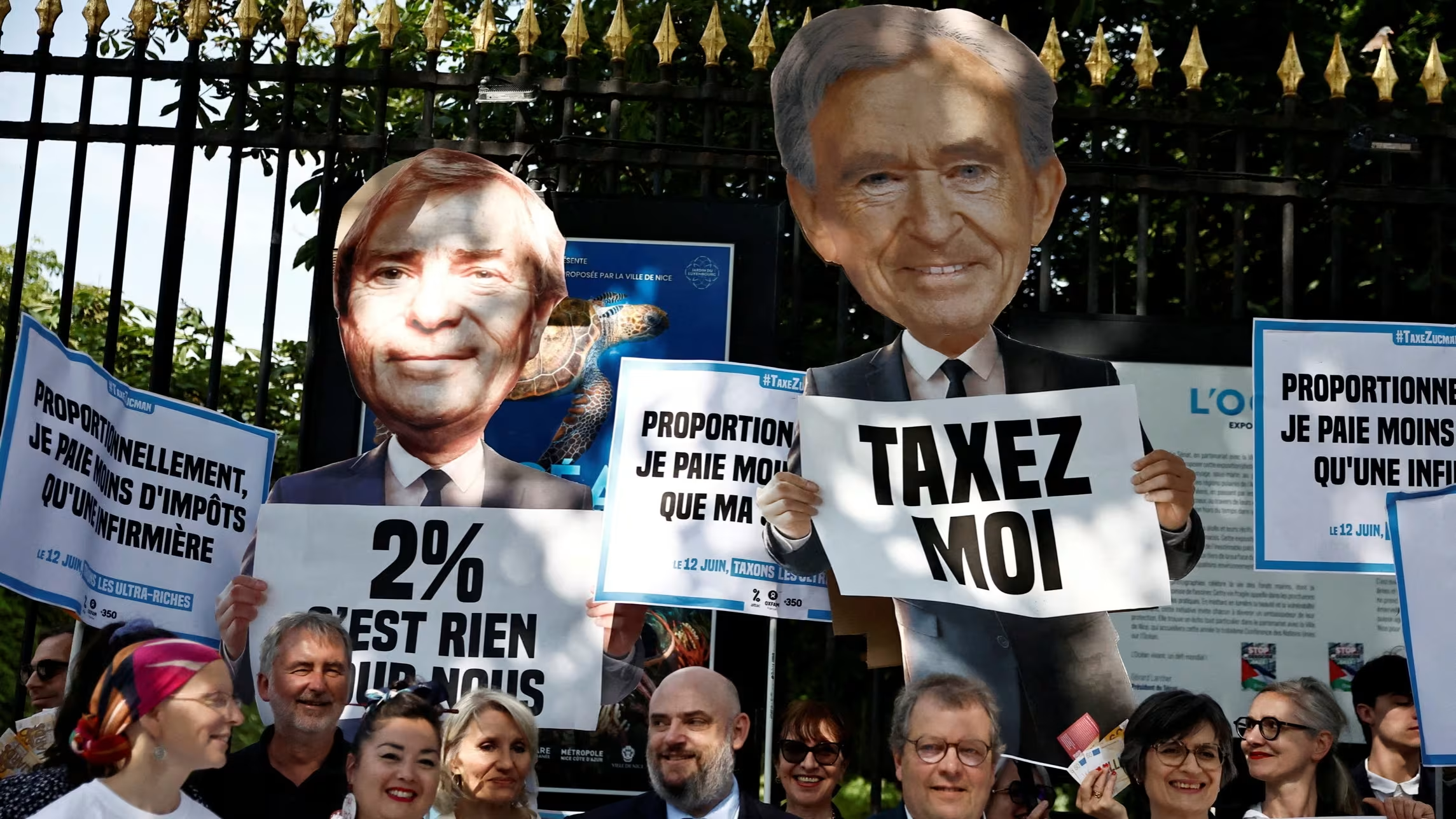
A cornerstone of France’s recent fiscal policy, a special levy targeting its wealthiest citizens, has generated only a fraction of the anticipated revenue, raising critical questions about its efficacy and the broader implications for economic strategy. The tax, introduced with the stated aim of bolstering public finances and promoting greater wealth redistribution, has instead become a focal point for discussions on tax policy effectiveness, capital flight, and the challenges of taxing high net worth individuals in a globalized economy.
The "super-tax" on the nation’s wealthiest individuals, designed to capture a larger contribution from those with substantial assets, has demonstrably failed to meet its revenue targets, bringing in approximately a quarter of the amount initially projected by the French government. This disappointing financial outcome has initiated a period of introspection within policy circles, prompting a re-evaluation of the mechanisms employed and the underlying assumptions that guided its implementation. The discrepancy between projected and actual revenue is not merely a statistical anomaly; it represents a significant shortfall that will necessitate adjustments to fiscal planning and potentially alter the trajectory of future tax initiatives.
Genesis of the Wealth Tax: A Bid for Fiscal Equity and Social Cohesion
The introduction of this specific wealth tax was not an isolated fiscal maneuver but rather emerged from a broader political and economic context. France, like many developed nations, has grappled with the persistent challenge of managing public debt and funding essential public services while simultaneously addressing growing concerns about income inequality and wealth concentration. The policy was conceived, in part, as a response to public sentiment demanding greater fiscal responsibility from the most affluent segments of society. Proponents argued that a dedicated tax on substantial fortunes would not only generate much-needed revenue but also serve as a symbolic affirmation of social solidarity and a commitment to a more equitable distribution of economic gains.
The rationale underpinning the tax was multifaceted. Economically, the government sought to tap into a perceived reservoir of untapped wealth, believing that a targeted levy could provide a stable and significant stream of income to address pressing fiscal needs, such as investments in infrastructure, education, or social welfare programs. Socially, the tax was intended to assuage public concerns about a widening gap between the ultra-rich and the rest of the population, fostering a sense of fairness and shared sacrifice. It was presented as a tool to ensure that those who had benefited most from the economic system also contributed proportionally to its upkeep and to the well-being of society as a whole. The political discourse surrounding its enactment was often framed around principles of social justice and the need for the wealthy to bear a greater share of the national burden, particularly in times of economic austerity or increased public spending demands.
Operationalizing the Levy: Design and Implementation Challenges
The design of the wealth tax involved intricate considerations regarding which assets would be subject to taxation, the specific thresholds for inclusion, and the applicable rates. The French government aimed to create a system that was both robust in its revenue-generating potential and defensible against legal and economic challenges. This involved defining the scope of taxable assets, which typically include real estate, financial investments, and other valuable holdings, while also considering exemptions for certain types of assets or primary residences to mitigate potential negative impacts on productive investment or personal living standards.
However, the practical implementation of such a sophisticated fiscal instrument proved to be fraught with complexities. Determining the precise valuation of diverse and often fluctuating assets presented an administrative challenge. Furthermore, the mobility of capital and individuals in a globalized world meant that the effectiveness of the tax was inherently linked to international tax regulations and the potential for tax avoidance. Wealthy individuals often possess the resources and expertise to structure their financial affairs in ways that minimize their tax liabilities, including relocating their domicile or shifting assets to jurisdictions with more favorable tax regimes. This inherent tension between national tax policy and international financial flows has been a recurring theme in the debates surrounding wealth taxation globally.
The Revenue Gap: Unpacking the Discrepancy
The stark contrast between the projected revenue and the actual collection figures points to a series of factors that likely contributed to the shortfall. One primary driver is the phenomenon of capital flight. As the tax was being debated and subsequently implemented, there were observable patterns of wealthy individuals and families reassessing their financial and residency arrangements. This could involve relocating their primary domicile to countries with no or lower wealth taxes, restructuring their asset holdings to fall below taxable thresholds, or engaging in sophisticated tax planning strategies to reduce their exposure.
Another significant factor may be the inherent difficulty in accurately assessing and taxing the full spectrum of wealth. The valuation of certain assets, particularly complex financial instruments or privately held businesses, can be subjective and open to interpretation. Moreover, the informal economy and undeclared assets can represent a portion of wealth that is inherently difficult for tax authorities to capture. The administrative burden and cost associated with meticulously tracking and taxing all forms of wealth for a select group of individuals are substantial and may not always yield commensurate returns.
Furthermore, the economic environment itself can play a role. Fluctuations in asset values, market volatility, and overall economic performance can impact the actual amount of taxable wealth in any given year. If asset values decline, the tax base shrinks, leading to lower revenue collection than might have been anticipated during periods of economic expansion.
Expert Analysis and Economic Implications
Economists and tax policy experts have offered varied interpretations of the wealth tax’s underperformance. Some argue that the fundamental design of the tax was flawed from the outset, failing to account adequately for the behavioral responses of the wealthy in a highly mobile global capital market. The principle of taxing wealth, as opposed to income or consumption, inherently faces the challenge of being avoidable by those with the means to do so. This perspective often highlights the potential for such taxes to be more of a symbolic gesture than a substantial revenue-generating tool, potentially leading to unintended consequences such as reduced investment or economic stagnation.
Conversely, other analysts suggest that while the revenue shortfall is undeniable, the tax may still have had some positive, albeit less quantifiable, impacts. It may have contributed to a broader public discourse on wealth inequality and fiscal fairness, potentially influencing other policy decisions. Additionally, even if some individuals relocated, the wealth that remains within France continues to be subject to other forms of taxation, such as income and capital gains taxes, albeit at different rates and under different frameworks. The debate also centers on the trade-offs between revenue generation and the potential for discouraging investment and entrepreneurship, which are vital for long-term economic growth.
The underperformance of the French wealth tax also serves as a cautionary tale for other nations considering similar measures. It underscores the need for meticulous design, robust enforcement mechanisms, and a comprehensive understanding of international tax dynamics. Simply imposing a tax without adequately addressing potential avoidance strategies or the economic incentives for relocation is likely to yield disappointing results.
Broader Context: The Global Debate on Wealth Taxation
France’s experience is not an isolated incident but is part of a larger, ongoing global debate about the merits and feasibility of wealth taxation. Many developed countries have experimented with various forms of wealth taxes in the past, with mixed results. Some, like Sweden and Germany, have phased out their wealth taxes due to concerns about capital flight and administrative complexity. Others, like Switzerland, maintain cantonal wealth taxes, but these are often integrated into a broader tax system with different structures and enforcement.
The resurgence of interest in wealth taxation in recent years, particularly in the United States and across Europe, has been fueled by rising levels of income and wealth inequality. Proponents argue that existing tax systems are insufficient to address the concentration of wealth at the very top and that a dedicated wealth tax is necessary to ensure a more equitable distribution of economic resources. However, opponents continue to raise concerns about its economic impact, its potential for capital flight, and the administrative challenges it presents. The French experience provides valuable empirical data for this ongoing international discussion, highlighting the practical hurdles that must be overcome for such a policy to achieve its intended objectives.
Future Outlook and Policy Repercussions
The underperformance of the French wealth tax will undoubtedly have repercussions for future fiscal policy decisions. The government may need to reconsider its approach to wealth taxation, potentially exploring alternative strategies such as higher inheritance taxes, increased capital gains taxes, or more robust measures to combat tax avoidance and evasion. There will likely be increased scrutiny of the administrative and economic costs associated with such levies.
Furthermore, the outcome may prompt a broader discussion about the fundamental role of taxation in addressing wealth inequality. Policymakers will need to weigh the potential benefits of wealth redistribution against the risks of capital flight, reduced investment, and administrative complexity. The French experience suggests that a successful wealth tax requires not only a clear intent but also a meticulously crafted and globally coordinated approach to ensure its effectiveness and to avoid unintended negative consequences for the national economy. The quest for fiscal equity and robust public finances continues, and the lessons learned from this ambitious, yet underperforming, levy will undoubtedly shape the future of tax policy in France and beyond.




 Safa Marwah
 Aura Kasih
 Lisa Mariana
 Ayu Aulia