Aura Kasih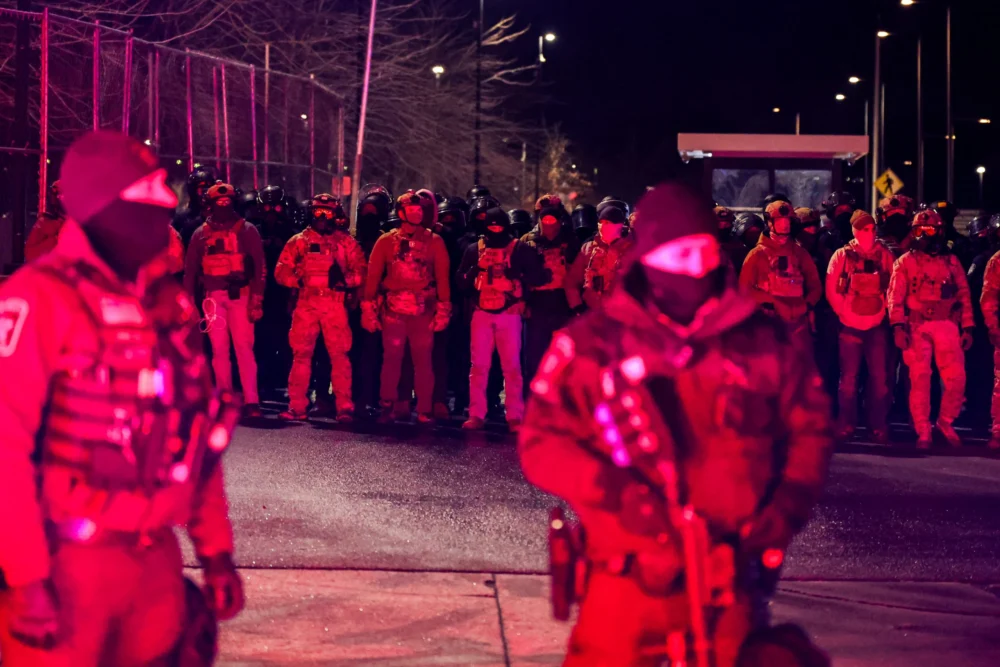
The recent fatal encounter involving Alex Pretti and federal law enforcement in Minneapolis has ignited a critical examination of official narratives, the use of force by government agents, and the escalating tensions between federal authorities and civilian populations. While initial reports from the Department of Homeland Security (DHS) characterized the incident as a justified response to an armed and dangerous individual, subsequent analysis of available video evidence, including that from Bellingcat and reporting by The New York Times, has cast significant doubt on these claims, suggesting Pretti was unarmed and potentially surrendering at the time of his death. This discrepancy between official pronouncements and emerging evidence underscores a pattern of narrative control and raises profound questions about accountability, the interpretation of rights, and the very role of federal agencies in domestic policing.
The Second Amendment, a cornerstone of American civil liberties, guarantees the right to bear arms, a principle particularly cherished by conservative segments of the population. Minnesota’s legal framework permits open carry of firearms with a permit, adding another layer to the complex legal and social landscape surrounding firearms. Pretti resided in a city grappling with instances of violent crime, often perpetrated by unidentified and armed individuals. Against this backdrop, the intense focus on the precise actions and perceived culpability of Pretti, the deceased, appears disproportionate when contrasted with the overwhelming power wielded by the federal agents involved. This persistent emphasis on victim behavior, particularly in the context of encounters with law enforcement, raises a disturbing question: is it now standard practice for those tasked with upholding the law to engage in lethal force against citizens, with the subsequent societal discourse primarily dedicated to justifying the victim’s demise?
This pattern of federal intervention and its consequences is not isolated to Minneapolis. In July 2020, the city of Portland, Oregon, experienced a significant deployment of federal officers from various agencies, ostensibly to quell civil unrest. The deployment was marked by the widespread use of crowd control agents, including tear gas, which saturated urban areas and, according to observations, exacerbated rather than diffused tensions. This strategy appeared to inflame the populace, prompting some residents to deliberately engage with the deployed agents and the chemical agents, not necessarily as a form of escalation, but as a defiant response to what was perceived as an unwarranted and provocative federal presence.
During this period in Portland, a significant portion of the public and media discourse centered on categorizing the events as either "protests" or "riots." This categorization was often predicated on the behavior of the demonstrators, with their actions dissected and judged as if they occurred in a vacuum, devoid of the preceding context of federal intervention. From the perspective of those on the ground, this framing often missed the broader societal and political implications. The line between nonviolent protest and more confrontational tactics became blurred, with participants employing gas masks and shields as protective measures against federal agents. The act of redirecting tear gas back towards law enforcement using leaf blowers, or pelting agents with water bottles, while not indicative of an intent to inflict lethal harm, represented a departure from traditional, strictly nonviolent demonstrations.
However, the argument can be made that if such actions constituted a "riot," the federal agents themselves played a significant role in instigating and escalating the situation. The preemptive deployment of force, including rubber bullets, pepper balls, and tear gas canisters – agents whose designation as "nonlethal" is increasingly contested and often demonstrably contradicted by their actual effects – created an environment ripe for conflict. The use of these weapons, which can cause serious injury and psychological distress, blurred the boundaries of what constitutes acceptable law enforcement tactics, particularly in response to demonstrations that, while occasionally unruly, were largely driven by deep-seated grievances.
These disparate standards of engagement—where civilians are expected to exercise a higher degree of restraint than heavily armed federal agents—appear to have been applied with even greater intensity and severity in Minneapolis. The presence of agencies like Immigration and Customs Enforcement (ICE) in Minnesota has undeniably contributed to an atmosphere of apprehension and conflict. As federal agents introduce an element of disruption and fear, Minnesotans, often lacking the training, equipment, or legal protections afforded to federal officers, are seemingly expected to de-escalate situations involving armed agents who are ostensibly present to maintain order.
Early accounts of the Alex Pretti incident suggest a violent confrontation initiated by federal agents against an individual who was not actively resisting. Video evidence reportedly depicts Pretti being apprehended by his legs and wrestled to the ground by agents, with shouts of him possessing a firearm only emerging after he was subdued. This sequence of events raises a critical question regarding the burden of de-escalation: why should individuals subjected to state violence be tasked with preventing further escalation, especially when they are not operating under the auspices of a government salary, benefits, or pension?
The immediate circumstances surrounding the alleged presence and location of Pretti’s firearm in the moments preceding his death, while significant for official reporting, arguably pale in comparison to the broader context of the federal presence and its impact on the Twin Cities. In the face of what many perceive as federal aggression, the specific demeanor or attitude of an individual confronting federal agents becomes a secondary concern. The expectation that victims of state force must consistently manage their own behavior to avoid provoking further violence, particularly when they lack the resources and authority of the state, represents a profound imbalance. This creates a scenario where citizens are effectively tasked with the dual responsibility of self-preservation and the pacification of armed federal personnel, a burden that can be characterized as a form of punitive taxation, where public funds are used to support agencies that then engage in confrontational tactics against the very populace they are meant to serve.
The tragic incident involving Renee Good, who was fatally shot by ICE agents while in her vehicle, exemplifies this untenable situation. Her reported statement, "That’s fine, dude, I’m not mad at you," moments before her death, suggests an attempt at placation and de-escalation directed at the agents. The question arises whether her demise was a consequence of an insufficient effort to manage the emotional state of armed federal officers.
The tactics employed by agencies such as ICE, Customs and Border Protection (CBP), and the Border Patrol, including the use of restraints followed by the application of pepper spray, appear to serve little purpose beyond provoking public outrage and justifying a subsequent escalation of force. These agencies have demonstrated a persistent inability to adhere to legal protocols, let alone enforce them impartially. Their capacity for self-regulation appears severely limited, raising doubts about their ability to maintain public order. In essence, these federal entities seem to have evolved from a purported solution to a problem into a problem that demands a definitive resolution. Their continued operation, characterized by a pattern of excessive force and disregard for civilian rights, suggests a fundamental dysfunction that necessitates serious reconsideration of their existence and role within the United States. The perpetuation of such tactics not only erodes public trust but also poses a significant threat to the principles of democratic governance and the protection of individual liberties.




 Lisa Mariana
 Ayu Aulia
 Safa Marwah