Aura Kasih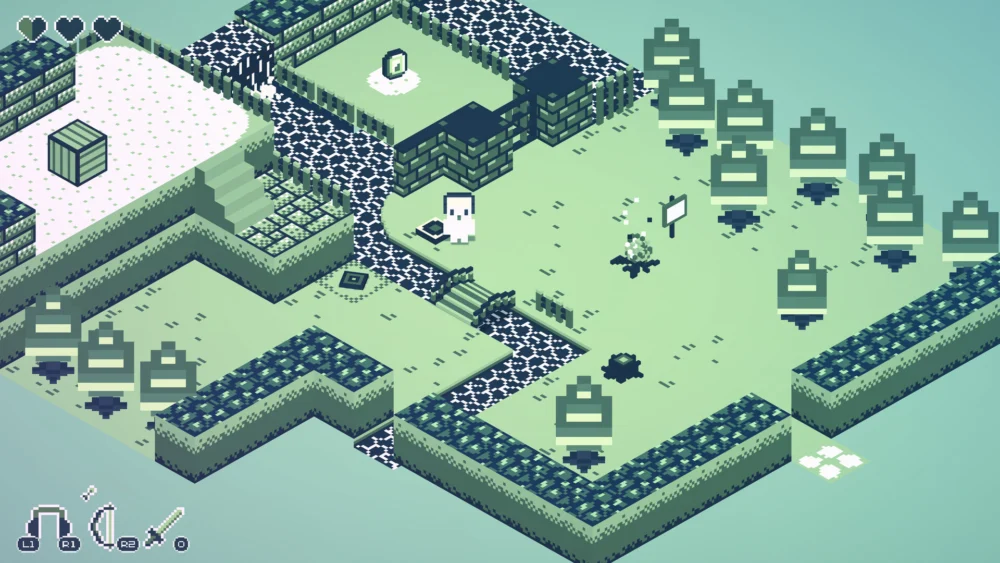
In a landscape saturated with remakes and nostalgia-driven titles, "Cassette Boy" emerges as a compelling and genuinely innovative adventure game that transcends mere homage, offering a profound re-examination of player interaction and environmental engagement. This top-down exploration experience, while undeniably steeped in the foundational principles of beloved classics like "The Legend of Zelda," crafts a distinct identity through its audacious core mechanic, pushing players to fundamentally alter their perception of the game world to solve intricate puzzles and navigate challenging encounters.
At its heart, "Cassette Boy" is a meticulously constructed ode to the golden age of adventure gaming. The familiar top-down perspective and the overarching goal of exploration immediately call to mind the foundational adventures of Hyrule, while the player’s humble hometown, complete with a nurturing maternal figure, evokes the comforting familiarity of early "Pokémon" titles. This sense of established comfort is further enhanced by the game’s visual presentation. Its blocky, voxel-inspired 3D aesthetic conjures the boundless creative potential of "Minecraft," creating a world that is both nostalgic and uniquely stylized. The act of saving the player’s progress at crackling campfires, a mechanic that mirrors the world-resetting nature of FromSoftware’s notoriously challenging titles, adds another layer of established genre resonance. Even the pervasive green tint that bathes the entirety of "Cassette Boy’s" environments serves as a deliberate and effective callback to the monochromatic magic of playing on an original Game Boy, a subtle yet powerful nod to gaming’s past.
However, to categorize "Cassette Boy" solely as a collection of homages would be a disservice to its groundbreaking design. Beneath this veneer of retro familiarity lies a deeply intelligent and original gameplay loop, centered on a mechanic that is both simple to grasp and endlessly complex in its application. The game draws inspiration from the counterintuitive principles of quantum mechanics, specifically the concept of observation affecting reality. In "Cassette Boy," objects and entities that are not directly within the player’s field of view cease to possess physical presence. This "observer effect" is not merely a thematic flourish; it is the very engine of the game’s puzzle design and strategic combat.
This unique mechanic manifests in several critical ways. For instance, a block that is pushed behind a wall, rendering it unseen, effectively "vanishes" from the game’s physics engine. The player can then pass through the space where the block once stood unimpeded. Similarly, enemies that retreat behind an obstacle and are no longer visible become intangible and immobile. They cease to exist in a tangible sense, rendering them immune to attack and incapable of inflicting damage. This creates a fascinating dynamic where strategic positioning and, crucially, the manipulation of the game’s camera become paramount.
The game grants players precise control over the camera, allowing it to be rotated to eight distinct cardinal and intercardinal points, akin to selecting a direction on a compass. By shifting the camera’s perspective, players can reintroduce unseen elements back into the game world. An enemy, previously phased out of existence by being obscured by a wall, can be made corporeal once more by simply rotating the camera to a viewpoint where it is once again within the player’s line of sight. This fundamental principle underpins the entirety of "Cassette Boy’s" challenge, forcing players to think not just about what they can do, but how their perception of the game world directly influences its reality.
The implications of this perceptual mechanic are far-reaching, transforming familiar puzzle archetypes into entirely novel challenges. Consider a scenario where a player encounters a pressure plate that activates a bridge, but the plate is located across a chasm. Adjacent to the plate is a heavy boulder. The intuitive "Zelda-esque" solution would be to push the boulder onto the plate to keep it depressed. However, in "Cassette Boy," direct manipulation of such heavy objects might be impossible. Instead, the ingenious solution lies in a demonstration of the core mechanic. The player steps on the pressure plate, activating the bridge, and then strategically rotates the camera to position the boulder in such a way that it completely obscures the activated plate. From the game’s perspective, the plate is now "unseen" and therefore frozen in its activated state, allowing the player to traverse the now-stable bridge. This is just one example of how "Cassette Boy" consistently subverts player expectations, demanding lateral thinking and a deep understanding of its unique rules.
Beyond the camera manipulation, players are equipped with a suite of tools that further expand the possibilities for interaction. A bow and arrow allow for the engagement of distant switches and enemies, adding a layer of ranged strategy. Crucially, the titular "cassette tapes" function as power-ups, granting abilities such as the perception of hidden bombable walls or the temporary ability to shrink the player character, opening up new pathways and puzzle solutions. When all these elements coalesce, "Cassette Boy" delivers a profoundly satisfying gameplay experience. The moments of clarity, when a complex puzzle unravels through clever application of the game’s mechanics, are immensely rewarding. The meticulous exploration of each meticulously crafted room, in pursuit of hidden treasures and secrets, becomes an addictive endeavor. The game also features engaging boss battles against imposing, blocky adversaries, each encounter serving as a culmination of the player’s mastery over the game’s perceptual puzzles, all in the service of collecting the coveted "moon fragments," the game’s primary narrative objective.
However, the deliberate design of "Cassette Boy" occasionally veers into territory that can be perceived as obtuse, a characteristic that, while potentially frustrating, is also a testament to its commitment to its retro inspirations. The absence of a traditional in-game map, a common feature in modern adventures, necessitates a deep engagement with the environment and a keen sense of spatial awareness. The progression of the main quest often hinges on interacting with specific non-player characters at precise moments, with the primary indicator being a subtle speech bubble above their heads. This can lead to periods of aimless wandering and repeated conversations within the game’s central hub town, particularly after the collection of a moon fragment, when the player is returned to town without explicit direction. This aspect of the game, while intentionally designed to foster exploration and discovery, can sometimes lead to moments of bewilderment and a reliance on external guidance. The complexity of some puzzles can also prove exceptionally challenging, necessitating the use of walkthroughs for players seeking to maintain momentum through the approximately eight-hour playthrough.
Yet, it is precisely this intentional obtuseness that imbues "Cassette Boy" with its unique charm and its profound connection to its predecessors. The challenges encountered echo the experiences of players navigating the vast, often directionless landscapes of early "Legend of Zelda" and "Pokémon" titles. The satisfaction derived from finally overcoming an obstacle after a period of struggle, the eventual understanding of the game’s internal logic, and the resultant feeling of accomplishment are potent motivators. This sentiment is even echoed by developers of contemporary titles; the creative team behind "The Legend of Zelda: Breath of the Wild" has publicly acknowledged that the experience of getting lost can, in fact, be a "very positive thing," fostering a deeper connection with the game world.
"Cassette Boy" masterfully recaptures this old-school spirit of discovery. Even in moments of frustration, the underlying struggle often leads to a deeper understanding of the game’s intricate design and the player’s own evolving capacity for problem-solving. The realization that the path forward frequently requires not brute force or conventional logic, but rather a fundamental shift in perspective, becomes a recurring and ultimately rewarding revelation. This approach fosters a more profound and lasting engagement with the game, encouraging players to internalize its mechanics and world in a way that more guided experiences often fail to achieve.
The game’s ambition extends beyond mere mechanical innovation; it represents a thoughtful exploration of how player perception can be weaponized as a tool for both puzzle-solving and narrative immersion. By forcing players to actively question what is real and what is merely a perceived reality, "Cassette Boy" creates a unique psychological engagement. The implications of this are significant for the future of puzzle design, suggesting new avenues for creating challenges that are not merely about logic but about a fundamental understanding of the interactive medium itself. The success of "Cassette Boy" could inspire a new wave of titles that leverage player perception as a core gameplay element, moving beyond traditional environmental puzzles to explore more abstract and mind-bending challenges.
In conclusion, "Cassette Boy" stands as a remarkable achievement in the contemporary gaming landscape. It successfully synthesizes the nostalgic appeal of retro adventure games with a truly original and intellectually stimulating core mechanic. While its deliberate design choices may present a learning curve, the rewards of overcoming its challenges are substantial, fostering a deep sense of accomplishment and a unique appreciation for the power of perspective. The game is a testament to the enduring appeal of thoughtful design and a bold assertion that innovation can, and should, emerge from a deep understanding and creative subversion of established genre conventions.
Cassette Boy is currently available on PC, PlayStation, Xbox, and Nintendo Switch.


 Ridwan Kamil
 Safa Marwah
 Lisa Mariana
 Ayu Aulia