Ayu Aulia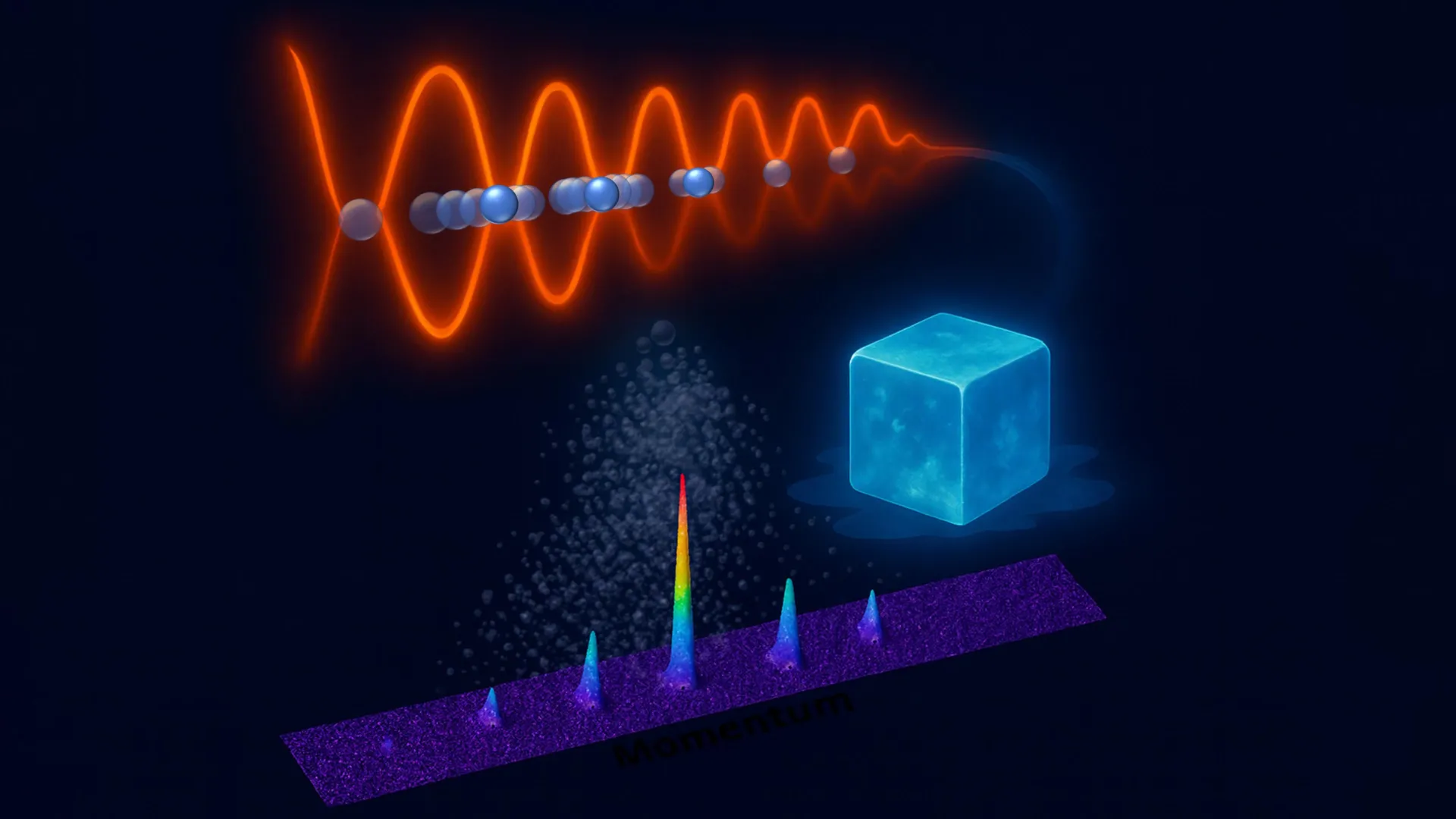
The pervasive experience of energy dissipation as heat from repeated mechanical action forms a cornerstone of macroscopic physics. From the simple friction generated by rubbing hands to the caloric output of industrial machinery, the principle holds true: continuous exertion of force upon a system invariably leads to an increase in its internal energy, manifested as a rise in temperature. This fundamental observation extends beyond the macroscopic realm, informing much of our understanding of microscopic and even quantum systems, where the expectation persists that ceaseless external agitation or "driving" will result in a steady accumulation of energy, ultimately driving the system towards a state of thermal equilibrium with its surroundings. This process, known as thermalization, is a central tenet in statistical mechanics and is generally anticipated in complex, interacting quantum matter. However, a groundbreaking experimental investigation has now revealed a stunning exception to this rule, pushing the boundaries of what is considered possible at the quantum scale.
A collaborative team of researchers, operating at the forefront of experimental quantum physics, embarked on a mission to rigorously test this entrenched assumption within a highly controlled quantum environment. Their objective was to determine whether a quantum system, subjected to strong and continuous external forces, would inexorably succumb to heating. The outcome of their meticulous work has provided an unequivocal and astonishing negative, demonstrating a novel pathway for quantum matter to resist energy absorption even under persistent driving.
A Novel Quantum State: Resisting Energetic Accumulation
The experimental setup involved the creation of a unique quantum fluid: a one-dimensional array of strongly interacting atoms, meticulously cooled to temperatures mere nanokelvin above absolute zero. Such extreme temperatures are crucial for suppressing classical thermal fluctuations and revealing purely quantum mechanical behaviors. These ultracold atoms were then subjected to a dynamic lattice potential, generated by precisely tuned laser light. This optical lattice was designed to switch on and off rapidly and repeatedly, effectively delivering a series of periodic "kicks" to the atoms. In conventional physics, this continuous, repetitive perturbation would be expected to impart kinetic energy to the atoms without limit, causing them to spread out and thermalize, much like a ball continuously bouncing higher on a trampoline with each successive jump.
Yet, the experimental observations painted a drastically different picture. Following an initial, brief phase of energy absorption, the system exhibited a profound and unexpected shift. The spread of the atoms’ momentum distribution, a direct indicator of their kinetic energy, abruptly ceased its expansion and stabilized. Despite the ongoing, vigorous driving forces and the persistent strong interactions between the constituent atoms, the system’s kinetic energy plateaued, indicating that it had entirely stopped absorbing additional energy.
This remarkable state, where a driven, interacting quantum system ceases to absorb energy, has been identified as Many-Body Dynamical Localization (MBDL). In MBDL, the particles’ motion becomes "locked" or localized not in real space, as in the well-known phenomenon of Anderson localization, but rather in momentum space. This implies that while the particles continue to move and interact, their collective momentum distribution remains confined and stable, effectively preventing the runaway energy absorption characteristic of thermalization. The intricate interplay of quantum coherence and the complex entanglement between the many interacting particles actively conspire to resist the diffusive spread of energy, maintaining an ordered state even under sustained external perturbation.
Challenging Theoretical Paradigms: An Orderly Anomaly
The emergence of MBDL in a strongly driven, interacting quantum system presented a significant surprise, even to the very scientists who conceived and executed the experiment. The prevailing theoretical frameworks for non-equilibrium quantum systems, particularly the Eigenstate Thermalization Hypothesis (ETH), generally predict that complex quantum systems with many interacting particles, when driven, will eventually thermalize. ETH posits that a small subsystem, when coupled to a larger, complex system, will eventually come to equilibrium with it, with its observable properties resembling those predicted by statistical mechanics. The discovery of MBDL offers a compelling counter-example, demonstrating that under specific conditions, quantum systems can actively resist this inexorable march towards thermalization, maintaining a non-equilibrium steady state.
The lead experimentalists openly acknowledged that the observed behavior defied their initial predictions. Instead of chaotic, unbounded particle movement, the system displayed an astonishing degree of order and stability. Theoretical collaborators further emphasized the profound implications, highlighting that the persistence of many-body coherence in a system undergoing strong driving and strong interactions runs directly contrary to classical intuition. This stability, they noted, is deeply rooted in the unique principles of quantum mechanics, particularly the ability of quantum states to maintain phase relationships over time and space. Replicating and predicting such intricate behavior using classical computational methods remains an exceedingly difficult task, underscoring the critical role of experimental exploration in uncovering novel quantum phenomena.
The Indispensable Role of Quantum Coherence
To rigorously ascertain the robustness and underlying mechanisms of this unusual localized state, the researchers introduced a controlled perturbation into their experiment: randomness in the driving sequence. Even a minute degree of disorder proved sufficient to profoundly alter the system’s behavior. The introduction of randomness immediately shattered the localized state. The atoms’ momentum spread rapidly and uncontrollably, their kinetic energy surged, and the system reverted to the conventional mode of continuous energy absorption, exhibiting the expected thermalizing behavior.
This crucial control experiment unequivocally demonstrated that quantum coherence—the maintenance of precise phase relationships between quantum states—is not merely incidental but absolutely indispensable for the prevention of thermalization in such driven many-body systems. Coherence acts as a protective shield, enabling the system to resist the entropic forces that would otherwise drive it towards disorder and thermal equilibrium. Its disruption, even subtly, dismantles this protective mechanism, allowing classical-like diffusive behavior to resume. This finding resonates deeply with the challenges faced in maintaining quantum states in emerging technologies, where decoherence due to environmental noise is a primary obstacle.
Far-Reaching Implications for Future Quantum Technologies
The revelation of Many-Body Dynamical Localization holds profound implications extending far beyond the realm of fundamental physics, offering potential solutions to some of the most formidable challenges in developing advanced quantum technologies. Unwanted heating and the subsequent loss of quantum coherence (decoherence) represent critical impediments in the design and operation of quantum simulators, quantum computers, and highly sensitive quantum sensors. These devices rely on the precise manipulation and preservation of delicate quantum states, which are extraordinarily vulnerable to energy buildup and environmental interactions.
-
Quantum Computing: In quantum computing, maintaining the integrity of qubits—the basic units of quantum information—is paramount. Current quantum processors often require elaborate and energy-intensive cryogenic cooling systems to minimize thermal noise and preserve quantum coherence. The discovery of MBDL suggests a potential paradigm shift: engineering quantum systems that inherently resist heating even under operational driving. If this principle can be harnessed, it could lead to more robust, stable, and potentially less energy-intensive quantum hardware, mitigating the pervasive issue of decoherence and enabling longer coherence times for complex quantum algorithms.
-
Quantum Simulation: Quantum simulators aim to model complex quantum phenomena that are intractable for classical computers. However, unwanted heating can distort the simulated dynamics, rendering the results inaccurate. MBDL offers a pathway to stabilize these simulators, allowing for the exploration of non-equilibrium quantum matter over extended periods without the corruption of thermalization. This opens new frontiers for understanding exotic phases of matter, quantum phase transitions, and the behavior of complex many-body systems far from equilibrium.
-
Fundamental Quantum Thermodynamics and Non-Equilibrium Physics: Beyond technological applications, this discovery fundamentally challenges long-held assumptions within quantum thermodynamics and non-equilibrium statistical mechanics. It compels a re-evaluation of the conditions under which quantum systems thermalize or resist thermalization. The ability to precisely tune a system into or out of an MBDL state provides an unprecedented experimental platform for exploring the intricate interplay between driving forces, interactions, coherence, and the emergence of macroscopic thermodynamic properties from microscopic quantum dynamics. It offers new insights into how quantum systems can maintain stability and order even when pushed far from equilibrium, providing crucial data for refining theoretical models of quantum chaos and thermalization.
Outlook and Future Research Directions
This seminal research marks a significant milestone, opening numerous avenues for future investigation. Researchers will undoubtedly seek to explore the universality of MBDL: can it be observed in higher-dimensional systems, in different types of quantum matter, or under varying driving protocols? A deeper theoretical understanding of the precise mechanisms by which coherence and entanglement conspire to produce such robust localization is also critical. Furthermore, the practical engineering challenges of translating this fundamental discovery into tangible technological advantages will be a key focus. Developing methods to robustly induce and control MBDL in diverse quantum architectures could pave the way for a new generation of quantum devices that are inherently more stable against environmental perturbations and operational heating.
In conclusion, the experimental realization of Many-Body Dynamical Localization represents a monumental leap in our understanding of non-equilibrium quantum matter. By demonstrating that quantum systems can fundamentally defy the classical imperative of heating under continuous driving, this work not only reshapes our theoretical landscape but also provides a tantalizing glimpse into a future where quantum technologies can operate with unprecedented stability and fidelity, unlocking their full transformative potential. The ability of quantum coherence to halt the pull of chaos offers a powerful new tool in the ongoing quest to harness the most enigmatic forces of the universe.




 Ridwan Kamil
 Safa Marwah
 Aura Kasih
 Lisa Mariana