Ayu Aulia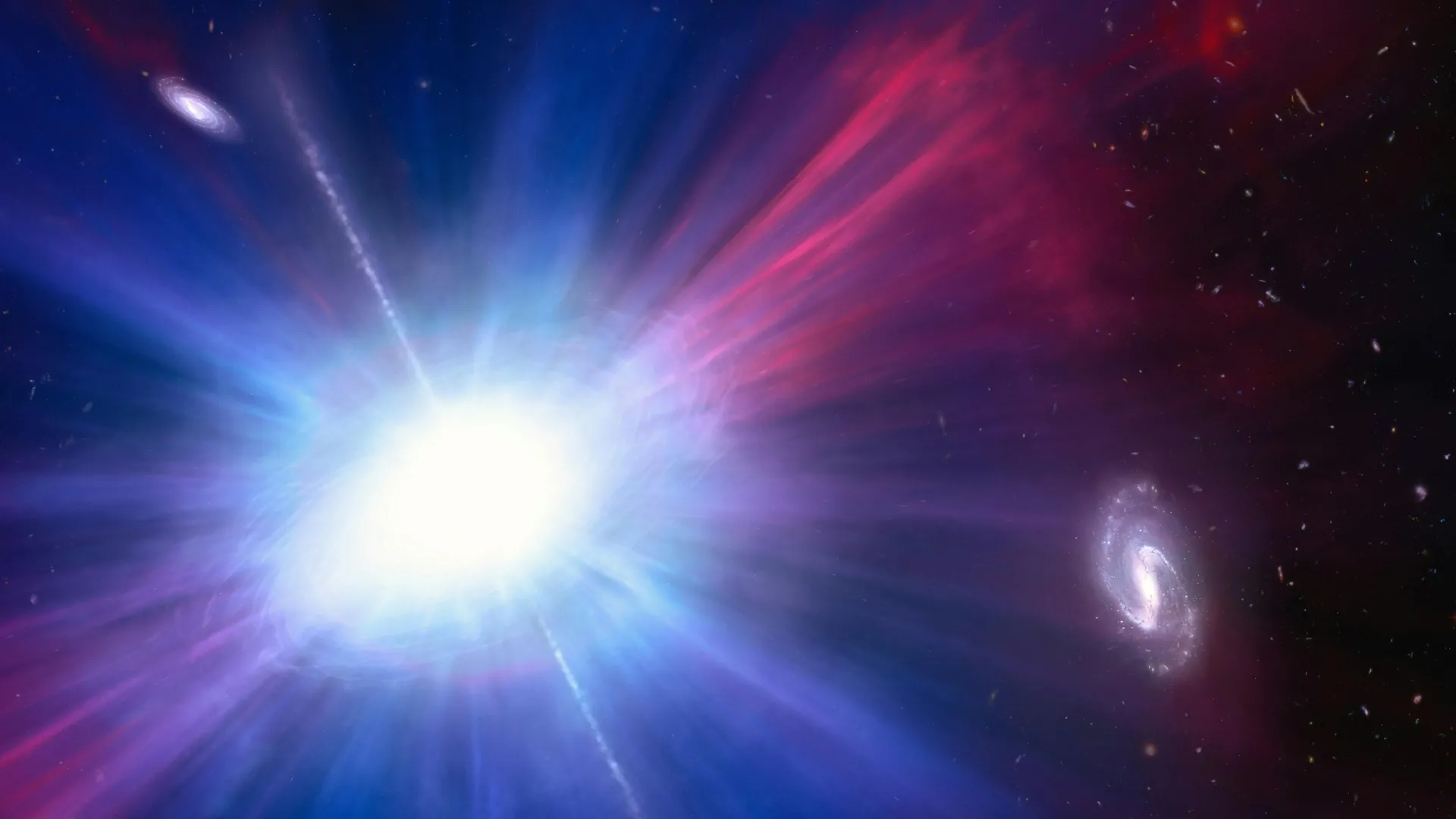
Astronomers have achieved a profound insight into the nascent stages of the cosmos, utilizing the unparalleled capabilities of the James Webb Space Telescope (JWST) to detect a supernova – the cataclysmic end-stage of a massive star – at an unprecedented distance. This singular observation provides a direct window into the fundamental processes of stellar evolution during the universe’s formative era, offering critical empirical data where previously only theoretical constructs existed. The discovery marks a significant advance in our understanding of the cosmic dawn, a pivotal epoch when the first luminous objects began to ionize the neutral hydrogen fog pervading the early universe.
The colossal stellar explosion, designated SN in GRB 250314A, unfolded approximately 730 million years after the Big Bang. This temporal placement firmly situates the event within the reionization period, a transformative phase characterized by the emergence of the inaugural generations of stars and galaxies. During this epoch, the universe transitioned from a dark, opaque state to one increasingly illuminated and transparent, laying the groundwork for the complex cosmic structures observed today. Direct observation of such an ancient event offers invaluable empirical data on the characteristics and demise of massive stars in an environment vastly different from the present-day universe.
Supernovae represent some of the most energetic phenomena in the cosmos, serving as cosmic beacons that illuminate distant galaxies and as the primary engines for the creation and dispersal of heavy elements crucial for planetary formation and life itself. The specific type of supernova observed in this instance is a core-collapse supernova, an explosion resulting from the gravitational collapse of a massive star’s core. These events are intimately linked with long-duration Gamma-Ray Bursts (GRBs), which are brief, intensely luminous flashes of high-energy radiation thought to originate from rapidly rotating, massive stars (often termed ‘collapsars’) that undergo core collapse into a black hole. The GRB acts as a powerful directional beacon, signalling the location of these otherwise undetectable, extremely distant supernovae.
The initial detection of this extraordinary event commenced with a potent burst of high-energy radiation. On March 14, 2025, the space-based multi-band astronomical Variable Objects Monitor (SVOM) registered a powerful, long-duration Gamma-Ray Burst (GRB), alerting the global astronomical community to a transient phenomenon of immense energy. GRBs, particularly the long-duration variety (lasting more than two seconds), are recognized as the brightest electromagnetic events in the universe, making them uniquely identifiable across vast cosmic distances. This initial detection by SVOM provided the crucial coordinates for subsequent, more detailed investigations.
Following the GRB alert, ground-based observatories swiftly focused their instruments on the designated celestial coordinates. Astronomers leveraging the European Southern Observatory’s Very Large Telescope (ESO/VLT) in Chile were instrumental in confirming the extreme cosmological redshift of the source. Redshift, a phenomenon where light from distant objects is stretched to longer, redder wavelengths due to the expansion of the universe, is the primary method for determining cosmic distances. The VLT’s spectroscopic measurements unequivocally placed the GRB’s host galaxy at an unprecedented distance, underscoring the extraordinary nature of the event and its profound implications for understanding the early universe.
The decisive observations, however, were conducted approximately 110 days after the initial GRB detection, leveraging the superior infrared capabilities of the James Webb Space Telescope. JWST, with its optimized infrared sensitivity and exceptional angular resolution, targeted the region using its Near-Infrared Camera (NIRCam) instrument. This strategic timing was critical: while the GRB itself is transient, the associated supernova takes time to brighten, peak, and then gradually fade. By waiting for the initial burst to subside, JWST was able to meticulously isolate the fading light signature of the supernova from the much fainter, more diffuse glow of its diminutive host galaxy. This separation was a technical tour de force, enabling researchers to confirm the distinct spectral and photometric characteristics of the explosion itself, independent of its galactic environment.
Dr. Antonio Martin Carrillo, an astrophysicist affiliated with the UCD School of Physics and a co-author on the foundational academic paper detailing this discovery, underscored the profound significance of these findings. He emphasized that the definitive "smoking gun" evidence linking the demise of massive stars to gamma-ray bursts is the empirical observation of a supernova emerging precisely at the location of a GRB. While thousands of supernovae have been meticulously studied, the vast majority have occurred in relatively nearby galaxies. The identification of such an event at an extreme cosmological distance presented an unparalleled opportunity to directly interrogate the conditions and stellar populations prevalent in the very early universe. This direct observational access to stellar death at cosmic dawn offers empirical data that transcends theoretical speculation, allowing astronomers to deduce the properties of progenitor stars and their explosive mechanisms from an era otherwise inaccessible.
Dr. Carrillo further elucidated the methodological approach: "Leveraging established models derived from the population of GRB-associated supernovae in our local cosmic neighborhood, we formulated precise predictions regarding the expected emission characteristics. These predictions, in turn, guided our proposal for a targeted observation campaign with the James Webb Space Telescope. To our collective astonishment, our predictive models demonstrated remarkable fidelity, with the observed supernova’s characteristics aligning exceptionally well with the expected signatures of stellar deaths we routinely witness in the proximate universe. Furthermore, these observations provided an initial glimpse into the properties of the galaxy that harbored this progenitor star." This meticulous interplay between theoretical modeling and advanced observational capabilities highlights the scientific rigor underpinning the discovery.
A particularly striking and counterintuitive aspect of this discovery is the unexpected familiarity of the distant supernova. Detailed photometric and spectroscopic measurements reveal that SN in GRB 250314A closely mirrors the brightness evolution and spectral features of SN 1998bw, a well-studied supernova intrinsically linked to a gamma-ray burst that occurred in a galaxy much closer to Earth. This profound resemblance challenges pre-existing astrophysical paradigms concerning the nature of the earliest stars.
The early universe was characterized by vastly different conditions than those observed today. Crucially, the metallicity—the abundance of elements heavier than hydrogen and helium—was significantly lower. The first stars, often hypothesized as "Population III" stars, were theoretically pristine, composed almost entirely of hydrogen and helium, and consequently, were predicted to be much more massive, hotter, and potentially to explode in ways distinctly different from modern supernovae. Lower metallicity affects stellar winds, internal structure, and energy transport, leading to theoretical predictions of brighter, bluer, or even more exotic explosion types, such as pair-instability supernovae (SLSNe), for the first generations of massive stars.
However, the data from SN in GRB 250314A suggests a remarkable consistency. Despite forming within an environment of significantly reduced metallicity, the progenitor star appears to have undergone a terminal explosion strikingly similar to those occurring in the modern universe. The observational data robustly rule out the possibility of a far brighter, more energetic explosion, such as a Superluminous Supernova (SLSN). SLSNe, which are orders of magnitude brighter than typical supernovae, were considered strong candidates for the explosive deaths of early, massive, low-metallicity stars due to their extreme luminosities. The absence of such a signature in this distant event introduces a critical constraint on models of early stellar evolution.
These results compel a reconsideration of the long-standing theoretical frameworks that posited the earliest stars would produce supernova explosions distinctly brighter, bluer, or otherwise fundamentally different from their contemporary counterparts. Instead, the findings suggest a surprising degree of uniformity in the terminal phases of massive stars across cosmic time. While this discovery provides a crucial empirical anchor point for understanding stellar evolution during the cosmic dawn, it simultaneously inaugurates a new suite of questions regarding the underlying physical mechanisms responsible for this observed uniformity. Why, despite vastly different initial conditions and elemental compositions, do these cataclysmic events appear so consistent? This question is now at the forefront of astrophysical inquiry.
The research team is not resting on this initial triumph. A subsequent round of JWST observations is meticulously planned for the coming one to two years. By that time, the luminosity of the supernova is projected to have diminished by more than two magnitudes, significantly simplifying the task of isolating and characterizing the faint host galaxy. The primary objective of these follow-up observations is to conduct a comprehensive study of the host galaxy’s properties, including its metallicity, star formation rate, and morphology. Confirming the exact proportion of light attributable to the supernova versus its host galaxy will provide refined constraints on the progenitor star’s environment and further illuminate the conditions prevailing in the universe during its infancy. This continued investigation will be pivotal in piecing together the intricate tapestry of early cosmic history, providing insights into the processes that sculpted the universe we observe today.
This monumental discovery exemplifies the transformative power of the James Webb Space Telescope, fulfilling its designed purpose of peering back into the universe’s earliest epochs. By combining the rapid alert capabilities of GRB monitors with the deep-field infrared vision of JWST and the precise spectroscopic measurements of ground-based observatories, astronomers are systematically unraveling the mysteries of the cosmic dawn. The observation of SN in GRB 250314A not only provides a unique glimpse into the death of an ancient star but also serves as a critical empirical benchmark against which all future theoretical models of early stellar and galactic evolution must now be tested. The implications of this work extend beyond supernovae, influencing our understanding of the formation of the first heavy elements, the reionization of the universe, and the ultimate origins of cosmic structure.



 Ridwan Kamil
 Safa Marwah
 Aura Kasih
 Lisa Mariana