Safa Marwah
The European Space Agency (ESA) has officially acknowledged a significant cyber intrusion targeting its external infrastructure, confirming that systems supporting collaborative engineering initiatives were compromised and sensitive, albeit "unclassified," data was potentially exfiltrated. This disclosure follows claims by an actor on a prominent hacking forum regarding extensive access to the agency’s development and project management tools, highlighting the persistent and evolving cybersecurity challenges facing critical scientific and strategic organizations.
Founded five decades ago, with its headquarters situated in Paris, the ESA stands as a pivotal intergovernmental body responsible for orchestrating the space endeavors of 23 member states. With a substantial workforce of approximately 3,000 personnel and an allocated budget of €7.68 billion ($9 billion) for 2025, the agency plays an indispensable role in advancing Europe’s capabilities in space exploration, Earth observation, telecommunications, and navigation. Its contributions range from groundbreaking scientific missions to the development of critical infrastructure like the Galileo satellite navigation system and the Copernicus Earth observation program. The integrity of its digital infrastructure is paramount to these high-stakes, multinational undertakings.
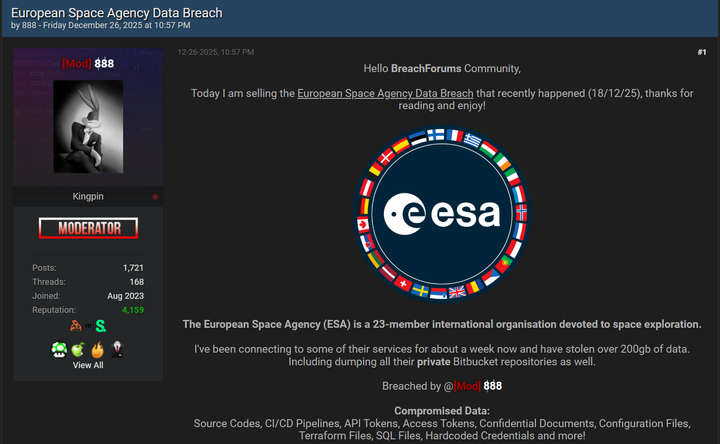
The agency’s confirmation arrived in the wake of public assertions by a threat actor on the "BreachForums" platform, who alleged successful penetration of several ESA servers. The actor presented purported screenshots as evidence, claiming sustained access to ESA’s JIRA and Bitbucket servers for a full week. These platforms are integral to modern software development and project management, facilitating collaborative work among engineers, developers, and scientists across geographically dispersed teams. JIRA is widely used for issue tracking and project management, while Bitbucket serves as a Git-based code management solution, storing source code, development histories, and collaborative project files.

In its official statement issued on Tuesday, the ESA acknowledged the "recent cybersecurity issue involving servers located outside the ESA corporate network." The agency further indicated that a comprehensive forensic security analysis had been initiated and was currently underway, alongside the implementation of measures to secure any potentially affected devices. Initial findings, as communicated by ESA, suggest that only a limited number of external servers may have been impacted. These specific servers, according to the agency, are dedicated to supporting unclassified collaborative engineering activities within the broader scientific community. While ESA refrained from detailing the precise nature of the compromised servers or the extent of data exfiltration in its public statement, the threat actor’s claims painted a more concerning picture.
The cyber actor asserted the exfiltration of over 200GB of data, purportedly stolen after gaining access to the European Space Agency’s systems and private Bitbucket repositories. The alleged haul is said to include a wide array of highly sensitive information: source code, continuous integration/continuous deployment (CI/CD) pipelines, API tokens, access tokens, confidential documents, configuration files, Terraform files, SQL files, and hardcoded credentials, among other critical assets.
The nature of the claimed stolen data, even if categorized as "unclassified," presents significant potential risks. Source code, for instance, represents the intellectual property underpinning complex systems and technologies. Its compromise could expose proprietary algorithms, system architectures, and potential vulnerabilities that could be exploited in future attacks. CI/CD pipelines, which automate software delivery, are critical infrastructure components; their compromise could enable supply chain attacks, allowing malicious code to be injected into legitimate software updates. API tokens, access tokens, and hardcoded credentials are essentially digital keys, granting direct entry to other systems, databases, or cloud services, facilitating lateral movement within an organization’s network or even across different platforms. Configuration files, Terraform files (used for infrastructure as code), and SQL files provide blueprints of an organization’s digital environment, revealing network topologies, database schemas, and sensitive operational settings, which can be invaluable to adversaries seeking to map out an attack surface.

The operational and strategic ramifications of such a breach are considerable. The potential loss of intellectual property, particularly source code for advanced engineering projects, could lead to a competitive disadvantage or be exploited by rival entities or nation-states for industrial espionage. Projects might face significant delays and increased costs as teams are forced to re-audit code, re-secure systems, and potentially re-engineer affected components. Furthermore, the exposure of credentials and system blueprints could significantly lower the barrier for future, more targeted attacks, potentially compromising systems deeper within the ESA’s core network or those of its partners. Beyond the immediate technical impact, a breach of this magnitude can erode trust among international collaborators, member states, and the public, potentially affecting future funding and partnerships. While the term "unclassified" might suggest a lower level of sensitivity, in the context of advanced engineering and space technology, even seemingly benign data can be pieced together to reveal critical insights or create new vulnerabilities.
This incident underscores the increasingly hostile and sophisticated cybersecurity landscape faced by organizations operating in critical sectors, especially those involved in national or international strategic infrastructure like space agencies. Such entities are prime targets for a diverse range of threat actors, including state-sponsored groups seeking geopolitical advantage, industrial espionage syndicates aiming for technological superiority, and even hacktivist groups driven by ideological motives. The motivations are manifold: to acquire cutting-edge research and development, disrupt critical services, or simply to demonstrate capability. The inherent complexity of modern IT environments, encompassing cloud services, numerous third-party integrations, and distributed workforces, significantly expands the attack surface, making comprehensive security a monumental challenge. The intersection of physical and cyber security in space operations further complicates matters, as a cyberattack on ground control systems could have catastrophic physical consequences for satellites or missions.
ESA’s response protocol, centered on a forensic security analysis, is a standard and critical step in incident management. This analysis typically involves a meticulous examination to identify the root cause of the compromise, ascertain the full scope of the breach, determine the methods used for data exfiltration, and identify and patch all exploited vulnerabilities. An effective incident response plan is crucial for containing damage, mitigating further risks, and restoring operational integrity. Transparent communication, as demonstrated by ESA’s notification of "all relevant stakeholders," is also vital for maintaining trust and coordinating a unified response across its member states and partners.
This is not the first instance of the European Space Agency encountering cybersecurity challenges in recent years. Approximately one year prior to this incident, the agency’s official web store was compromised. In that attack, malicious JavaScript code was surreptitiously injected, designed to harvest customer information and payment card data during the checkout process. This previous incident, reminiscent of Magecart-style skimming attacks, highlighted vulnerabilities within the agency’s e-commerce ecosystem and underscored the ongoing need for a holistic and adaptive security posture across all its digital assets, from mission-critical engineering platforms to public-facing commercial sites. The recurrence of breaches, even if targeting different facets of its infrastructure, suggests persistent security gaps or an ongoing struggle to keep pace with evolving threat methodologies.
To fortify defenses against such sophisticated threats, organizations like ESA must implement a multi-layered and proactive cybersecurity strategy. This includes robust access management controls, such as multi-factor authentication and the principle of least privilege, to restrict access to critical systems. Comprehensive supply chain security measures are essential, involving rigorous vetting of third-party tools and vendors, especially for critical development platforms like JIRA and Bitbucket. Continuous code security practices, including static and dynamic analysis and adherence to secure coding guidelines, are paramount to prevent vulnerabilities from being introduced at the development stage. Network segmentation, isolating critical systems from less sensitive ones, can limit the impact of a breach. Furthermore, advanced threat intelligence and continuous monitoring capabilities are crucial for early detection of anomalous activities. Finally, regular employee training on phishing awareness and secure development practices, coupled with periodic security audits and penetration testing, form the bedrock of a resilient cybersecurity framework.
In conclusion, the confirmed digital infiltration of the European Space Agency’s external engineering servers represents a stark reminder of the relentless cyber threats targeting high-value scientific and strategic entities. While the agency asserts the unclassified nature of the compromised data, the alleged exfiltration of source code, credentials, and infrastructure blueprints poses significant risks to ongoing projects, intellectual property, and future operational security. As the frontier of space exploration continues to expand, so too does the digital attack surface. Protecting Europe’s strategic space assets and scientific advancements necessitates not only immediate incident response but also a continuous, substantial investment in adaptive cybersecurity measures, robust protocols, and a culture of security awareness to navigate the ever-evolving landscape of cyber warfare and espionage. The future of space innovation hinges critically on the ability to secure its digital foundations against increasingly sophisticated adversaries.




 Ridwan Kamil
 Aura Kasih
 Lisa Mariana
 Ayu Aulia