Ayu Aulia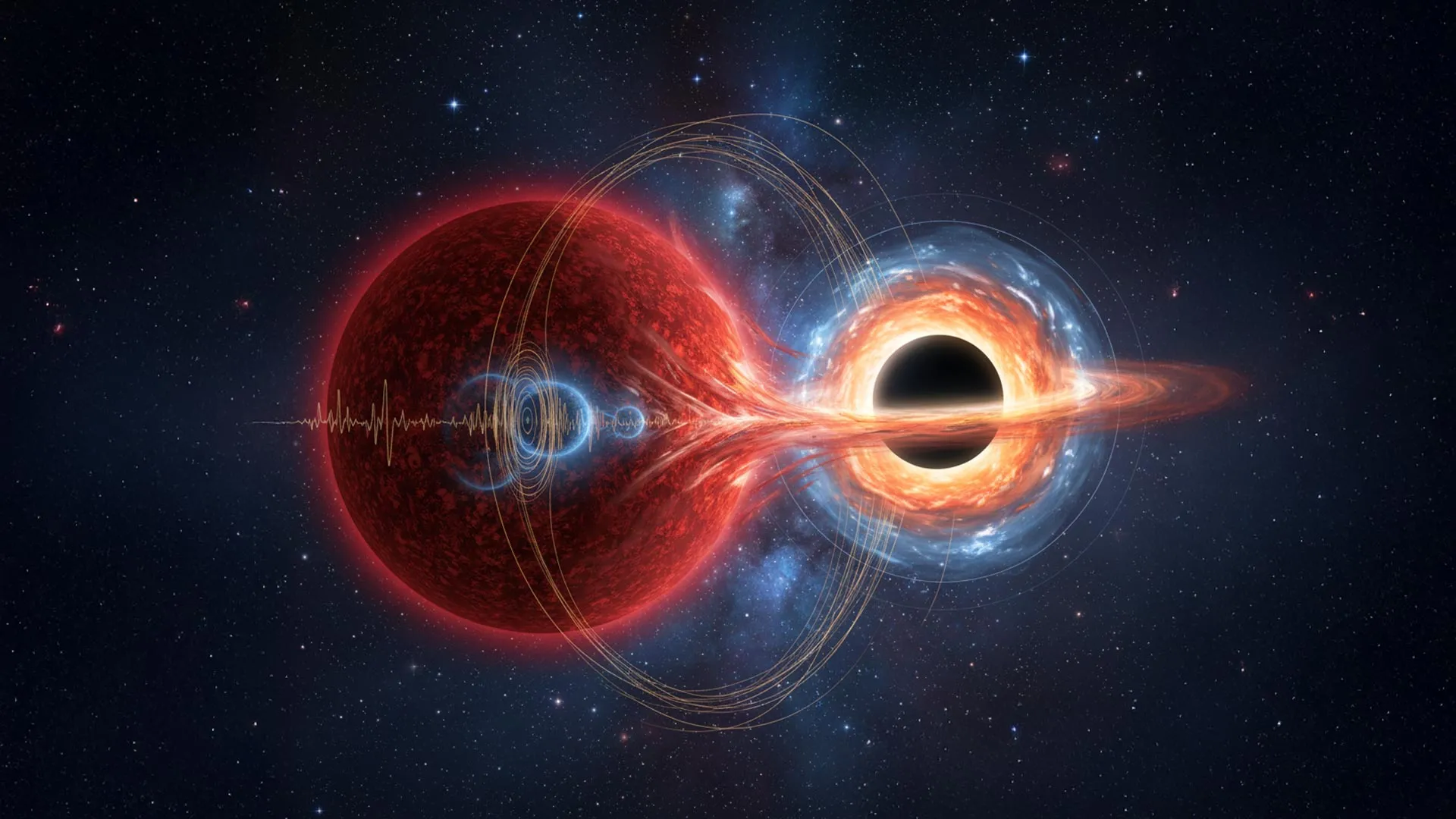
Recent investigations into a distant red giant star, designated as the companion in the Gaia BH2 system, have revealed a complex and unexpected history, challenging established theories of stellar evolution and binary system dynamics. By meticulously analyzing minute fluctuations in its light, astronomers have reconstructed a dramatic past involving a probable stellar merger or intense mass transfer event, which likely imparted an unusually rapid spin to the star. This remarkable celestial body currently orbits a quiescent black hole, prompting a re-evaluation of how such enigmatic systems form and evolve within the Milky Way galaxy.
The foundation of this groundbreaking research lies in the advanced capabilities of NASA’s Transiting Exoplanet Survey Satellite (TESS). TESS observations enabled the detection of faint, rhythmic vibrations traversing the red giant’s interior, colloquially termed "starquakes." These subtle tremors, akin to seismic waves on Earth, provide an invaluable window into the star’s internal structure and processes. Gaia BH2 itself, a black hole system previously identified in 2023 by the European Space Agency’s Gaia mission, has now become a focal point for understanding the intricacies of star-black hole interactions. Just as geophysicists utilize earthquake data to map Earth’s subterranean layers, astrophysicists leverage these stellar oscillations, a field known as asteroseismology, to precisely determine the physical properties and internal dynamics of distant stars, including the density and composition of their cores. The seminal findings derived from this asteroseismic analysis have been formally documented and published in the esteemed Astronomical Journal.
Daniel Hey, a distinguished research scientist specializing in stellar astrophysics, underscored the profound utility of this technique. "The application of asteroseismology offers an unparalleled method for probing the hidden complexities within stellar interiors," Hey remarked, highlighting the unexpected historical narrative that emerged from the vibrational data. "These oscillations have unveiled a history for this particular star that diverges significantly from conventional evolutionary models." The ability to discern such subtle internal characteristics from light curves represents a significant advancement in observational astronomy, pushing the boundaries of what can be inferred about distant cosmic phenomena.
The Paradox of Youth and Ancient Chemistry
One of the most compelling and perplexing discoveries pertained to the red giant’s elemental composition. Spectroscopic analysis classified the star as "alpha-rich," a designation indicating an abundance of elements heavier than helium, specifically those synthesized through alpha-process nucleosynthesis, such as oxygen, neon, magnesium, and silicon. Such elemental signatures are typically characteristic of Population II stars, which are ancient, metal-poor stars formed early in the universe’s history. Based solely on its chemical makeup, the red giant should logically be billions of years older than its actual age.
However, the asteroseismic analysis presented a starkly contrasting age estimate. The internal vibrations, which are highly sensitive to a star’s evolutionary stage and internal density profile, indicated an age of approximately 5 billion years. This figure positions the star as significantly younger than its alpha-rich chemistry would imply, creating a profound astrophysical paradox. This incongruity suggests a deviation from standard isolated stellar evolution, necessitating an alternative explanation for its formation and chemical enrichment.
Hey elaborated on the implications of this age-chemistry mismatch, noting, "The existence of young, alpha-rich stars represents a rare and intriguing challenge to our current understanding of stellar formation and nucleosynthesis." He further posited that "the combination of a relatively young age with an ancient chemical fingerprint strongly suggests that this star did not undergo its evolution in isolation. It is highly probable that it acquired additional stellar material from a companion, either through a direct merger event or by accreting matter during a phase of the black hole’s formation or interaction." This hypothesis introduces a dynamic element to the star’s history, moving beyond the traditional single-star evolutionary pathways.
Unusual Rotational Dynamics: A Signature of Interaction
Further evidence supporting a complex evolutionary narrative emerged from long-term observational campaigns conducted using ground-based telescopes. These meticulous observations revealed that the red giant completes a full rotation approximately every 398 days. For a red giant of its inferred age, which would typically have expanded considerably and thus slowed its rotation due to the conservation of angular momentum, this rotational velocity is remarkably high. Isolated red giants are generally expected to exhibit much longer rotation periods, often spanning thousands of days.
Joel Ong, a NASA Hubble Fellow also affiliated with the Institute for Astronomy, emphasized the significance of this anomalous rotation. "If this observed rotation rate is indeed intrinsic to the star, it cannot be adequately explained solely by the angular momentum inherited from its birth," Ong stated. "Such an elevated spin rate strongly implies that the star was accelerated through significant tidal interactions with a close companion. This observation provides further robust support for the notion that this binary system possesses a far more intricate and dynamic history than previously assumed." Tidal forces, arising from the gravitational gradient across a star due to a massive, nearby companion, can effectively transfer orbital angular momentum into the star’s rotational spin, thus speeding it up. The confluence of an unexpected chemical signature, a younger-than-expected age, and an unusually rapid rotation collectively paints a picture of a red giant that has been profoundly influenced by its immediate cosmic environment.
Dormant Black Holes: Unveiling a Hidden Population
The black hole component of Gaia BH2 belongs to a fascinating class of celestial objects known as dormant black hole systems. Unlike their more celebrated counterparts—active galactic nuclei or X-ray binaries—these black holes are not actively accreting significant amounts of material from their companion stars. Consequently, they lack the luminous accretion disks that produce intense X-ray emissions, rendering them virtually invisible to conventional X-ray telescopes. Their discovery, therefore, hinges on far more subtle observational techniques, primarily the precise measurement of their gravitational influence on nearby stars.
The European Space Agency’s Gaia mission has been instrumental in this endeavor. By meticulously mapping the positions and motions of billions of stars across the Milky Way, Gaia has been able to detect the characteristic "wobble" induced in a visible star by the gravitational tug of an unseen, massive companion. This astrometric method has opened a new frontier in black hole research, revealing a population of dormant black holes that are believed to vastly outnumber the actively accreting ones. The findings from Gaia BH2, alongside those from similar systems, are fundamentally altering the methodologies and strategies employed by scientists in their quest to identify and characterize the elusive black hole population within our home galaxy. Understanding these dormant systems is crucial for a complete census of black holes and for comprehending the full spectrum of binary evolution pathways.
Comparative Insights: The Enigma of Gaia BH3
The research team extended their investigation to include Gaia BH3, another black hole system that presents its own set of unique astrophysical puzzles. The companion star in Gaia BH3 exhibits an even more perplexing behavior. Theoretical models, based on its observed properties, predicted that this star should display pronounced stellar oscillations. However, contrary to these predictions, no significant vibrations were detected. This unexpected absence of starquakes in Gaia BH3’s companion suggests a fundamental inadequacy in current theoretical frameworks, particularly those governing the internal structure and dynamics of stars with extremely low metal content. The discrepancy highlights the complex interplay between metallicity, internal structure, and pulsation mechanisms, indicating that our understanding of stellar physics, especially for stars formed in the early, metal-poor universe, may require substantial revision.
The collective study of both Gaia BH2 and Gaia BH3 underscores the immense diversity and unexpected complexity inherent in binary star-black hole systems. These systems serve as natural laboratories, pushing the boundaries of our theoretical models for stellar evolution, binary interactions, and black hole demographics. The contrasting behaviors of the companion stars in these two dormant black hole systems provide critical empirical data points that challenge and refine the astrophysical community’s understanding of these extreme environments.
Future Directions and Unanswered Questions
The ongoing scientific journey to unravel the mysteries of Gaia BH2 is far from complete. Future observations from TESS, benefiting from extended mission duration and potentially enhanced data acquisition capabilities, are expected to yield an even more detailed and prolonged dataset of the red giant’s stellar vibrations. With a richer tapestry of asteroseismic data, astronomers anticipate gaining greater clarity on the precise nature of the star’s dramatic past. The primary goal is to definitively confirm whether the red giant indeed originated from a past stellar merger event or a sustained period of mass transfer.
Beyond confirming the merger hypothesis, these future studies aim to deepen our comprehension of the evolutionary pathways that lead to the formation and development of these unique quiet black hole pairs. Understanding the specific conditions and interactions that give rise to systems like Gaia BH2 and Gaia BH3 will provide invaluable insights into the broader context of stellar population synthesis and galactic archaeology. Such research contributes significantly to charting the cosmic ballet of stars and black holes, revealing the intricate processes that sculpt the universe as we know it. The continuous refinement of asteroseismic techniques, coupled with advancements in computational modeling and multi-wavelength observations, promises to further illuminate these perplexing cosmic anomalies, ultimately enhancing our understanding of the fundamental principles governing the lives and deaths of stars and the enigmatic presence of black holes.



 Ridwan Kamil
 Safa Marwah
 Aura Kasih
 Lisa Mariana