Lisa Mariana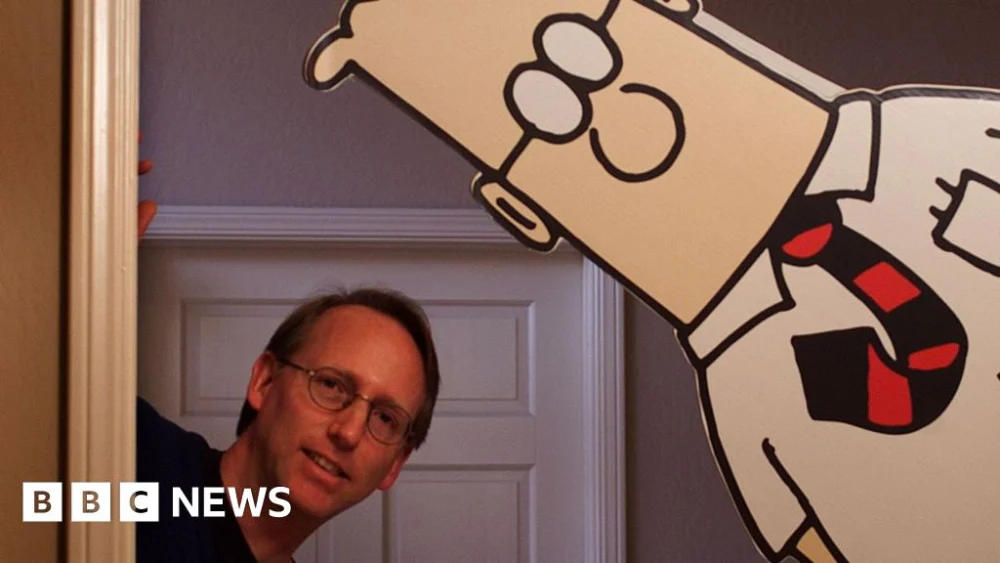
Scott Adams, the visionary behind the globally syndicated "Dilbert" comic strip, passed away at the age of 68, leaving behind a complex legacy that intertwines incisive workplace satire with contentious public commentary. His death, confirmed by his former spouse, Shelly Miles, during a live broadcast of his "Real Coffee with Scott Adams" podcast, marks the end of a career that saw him rise to international acclaim before becoming embroiled in a significant public controversy that led to the widespread cancellation of his iconic cartoon. Adams succumbed to complications from prostate cancer, a battle he had openly discussed with his audience in the months leading up to his passing.
Born in Oneonta, New York, in 1957, Scott Adams embarked on a path that would uniquely equip him to satirize the modern corporate landscape. After earning an MBA from the University of California, Berkeley, and spending years in various cubicle-bound roles at companies like Pacific Bell, Adams possessed firsthand experience with the often-absurd realities of corporate bureaucracy, managerial incompetence, and employee frustration. It was from this fertile ground of personal observation and professional exasperation that "Dilbert" emerged in 1989. Initially published in a handful of newspapers, the strip quickly resonated with a burgeoning white-collar workforce grappling with the inefficiencies and indignities of their daily grind.
"Dilbert" introduced a cast of characters that became archetypes of the contemporary office. Dilbert himself, a highly competent but perpetually downtrodden engineer, navigated a world populated by the perpetually optimistic but strategically challenged Dogbert, the dangerously incompetent Pointy-Haired Boss, and a host of other idiosyncratic colleagues like Wally and Alice. The strip’s brilliance lay in its ability to articulate the unspoken frustrations of millions, transforming the mundane and often maddening aspects of corporate life into universally relatable humor. Adams’s sharp wit and observational acumen allowed "Dilbert" to transcend mere cartooning, evolving into a cultural touchstone that provided a cathartic outlet for employees worldwide. Its popularity soared, eventually appearing in over 2,000 newspapers across 65 countries, translated into dozens of languages, and spawning a successful animated television series, books, and even a video game. The strip’s influence extended beyond entertainment, with "Dilbert" becoming a shorthand for dysfunctional corporate culture and Adams frequently invited to speak on management and productivity.
Beyond his prolific cartooning, Adams transitioned into a multifaceted public figure, authoring several non-fiction works that explored themes of success, mindset, and persuasion. Books like "How to Fail at Almost Everything and Still Win Big," "Win Bigly," "Loserthink," and "Reframe Your Brain" showcased his interest in self-help, cognitive biases, and the mechanics of influence, often drawing on his own experiences and observations. A trained hypnotist, Adams frequently incorporated psychological insights into his writing and commentary, positioning himself as a thought leader on various subjects extending far beyond the confines of the comic strip. This evolution in his public persona laid the groundwork for his later foray into more explicit political and social commentary, particularly through his online platforms and podcasts.
The latter phase of Adams’s career became increasingly defined by his outspoken views, which culminated in a widespread backlash in early 2023. During a live stream of his podcast, Adams made remarks that were widely interpreted as racist and immediately drew severe condemnation. His comments, made in response to a poll from a conservative organization, involved referring to Black Americans as a "hate group" and advising white individuals to "get the hell away from black people." These statements ignited a firestorm of criticism, leading to immediate and extensive repercussions across the media landscape. Numerous newspapers, including major outlets like The Washington Post and USA Today, swiftly announced their decision to discontinue the "Dilbert" comic strip, citing the offensive nature of Adams’s remarks.
Adams subsequently defended his statements, asserting that he had employed hyperbole to illustrate a point and that his words had been taken out of context by media reports. He maintained that he disavowed racism and that his intent had been misinterpreted. However, his explanations did little to quell the controversy or reverse the cancellations. The incident sparked a broader public debate concerning freedom of speech, the responsibilities of public figures, and the consequences of expressing controversial opinions in an increasingly polarized society. For many, Adams’s remarks crossed a line, overshadowing his artistic achievements and fundamentally altering how his work was perceived. The widespread removal of "Dilbert" from publications represented a significant moment in the ongoing discourse surrounding "cancel culture" and the evolving standards of public discourse.
The impact of this controversy on Adams’s professional standing was profound and irreversible. A cartoonist who had once enjoyed unparalleled syndication and widespread cultural acceptance found his primary creative outlet severely curtailed. The incident underscored the evolving relationship between creators and their audiences, particularly in an era where personal opinions expressed on digital platforms can swiftly impact professional careers. The decision by numerous newspaper syndicates to drop "Dilbert" was not merely a reaction to Adams’s words but also a reflection of a changing media landscape where editorial standards and public sensitivities increasingly demand accountability from content creators.
In the wake of the controversy, Adams continued to host his podcast, engaging with listeners and offering his perspectives on current events, often doubling down on his libertarian and contrarian viewpoints. His political alignment also became more explicit, drawing support from certain conservative circles. Notably, former President Donald Trump paid tribute to Adams on Truth Social following news of his death, characterizing him as a "Great Influencer" who "liked and respected me when it wasn’t fashionable to do so." This acknowledgment highlighted Adams’s later role as a figure within a specific political ecosystem, distinct from his earlier, more universally appealing persona as a satirist of corporate life.
Adams’s final months were marked by a courageous public battle with prostate cancer, which had metastasized to his bones. He openly shared updates on his health with his podcast audience, detailing his journey through end-of-life care. In a poignant broadcast on January 1st of this year, he acknowledged the grim prognosis, stating, "I’ll give you any updates if that changes, but it won’t." He spoke candidly about the loss of sensation in his legs and ongoing heart failure, preparing his listeners for what he described as a "month of transition." His ex-wife, Shelly Miles, conveyed his posthumous message during the announcement of his death: "I had an amazing life, I gave it everything I had. If I got any benefits from my work, I’m asking that you pay it forward as best as you can. That’s the legacy I want. Be useful, and please know I loved you all to the very end."
Scott Adams’s passing invites a comprehensive re-evaluation of his multifaceted career and complex legacy. On one hand, he will be remembered as a groundbreaking satirist who expertly captured the zeitgeist of the modern workplace, providing an invaluable humorous lens through which to view corporate absurdities. "Dilbert" remains a testament to his observational genius and comedic timing, a work that profoundly influenced workplace culture and humor for decades. Its impact on popular culture and its ability to articulate universal frustrations are undeniable, securing its place in the pantheon of influential comic strips.
On the other hand, his later years and the circumstances surrounding the cancellation of "Dilbert" will inevitably shape how he is remembered. The controversy ignited by his remarks served as a stark reminder of the delicate balance between free expression and social responsibility, particularly for public figures whose platforms reach millions. His legacy will likely be a subject of ongoing debate, reflecting the broader societal tensions between artistic freedom, personal commentary, and accountability. Future analyses of Adams’s work will undoubtedly grapple with the juxtaposition of his creative brilliance and the divisive nature of his later public statements, examining how one informs and complicates the other. His life and career thus offer a compelling case study in the evolution of a public intellectual in the digital age, where the lines between creator, commentator, and provocateur often blur, leading to both immense influence and profound controversy. The future of the "Dilbert" intellectual property, whether it remains dormant or is revived under different creative stewardship, will also form part of the ongoing discussion surrounding Adams’s enduring, albeit complicated, impact.


 Aura Kasih
 Safa Marwah
 Ayu Aulia