Lisa Mariana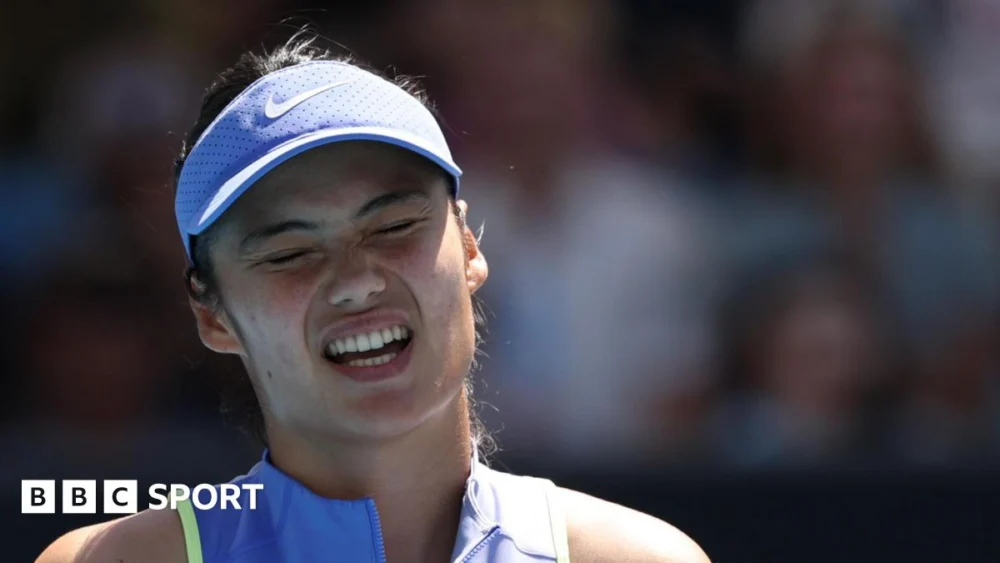
Emma Raducanu’s anticipated deep run at the Australian Open 2026 was prematurely concluded in the second round, as the British former Grand Slam champion succumbed to Anastasia Potapova in a performance that highlighted persistent challenges in her game development and physical readiness, thereby precluding a much-anticipated encounter with the reigning world number one, Aryna Sabalenka.
The contest unfolded on a day marked by intermittent cloud cover over Melbourne Park, with Raducanu, seeded 28th for the tournament, ultimately falling to the 55th-ranked Potapova in straight sets, 7-6 (7-3) 6-2. From the initial exchanges, a discernible lack of fluidity characterized Raducanu’s presence on court. Her movement, typically a hallmark of her dynamic style, appeared subdued, and a visible flatness permeated her overall demeanor. This translated directly into her on-court execution, where unforced errors punctuated key moments, preventing her from establishing sustained periods of dominance against a tenacious opponent.
Analysis of Raducanu’s performance revealed critical areas of concern. Her forehand, a stroke she has been actively refining in recent months, exhibited an unsettling uncertainty, frequently missing its intended mark or lacking the penetrating depth required to trouble a player of Potapova’s caliber. A prime example occurred during a pivotal juncture in the opening set, where a misjudged drive volley sailed wide, squandering a potential advantage. The second set saw a continuation of these struggles, notably a double fault that gifted Potapova a crucial break for a 4-1 lead, further compounding Raducanu’s evident discomfort and diminishing her prospects of forcing a decider.
This early exit assumes particular significance given Raducanu’s pre-tournament preparations. Her off-season schedule was notably disrupted by a foot injury, which severely limited her on-court training. She did not resume full hitting sessions until December 20, a mere few weeks before the start of the Grand Slam. This truncated preparation period, following a prolonged absence, inevitably placed her at a disadvantage, impacting her match fitness, timing, and overall rhythm. While she managed to navigate her first-round match against the 197th-ranked qualifier Mananchaya Sawangkaew, securing a victory that, in retrospect, merely masked her underlying issues, the step up in intensity against Potapova exposed the deficit in her readiness.
The initial set of the match was a microcosm of Raducanu’s current transitional phase. It was characterized by an erratic quality from both players, marked by a succession of five service breaks in the opening games. Raducanu displayed flashes of her former brilliance, carving out opportunities and even serving for the set at 5-4. However, the inability to close out the set, conceding her serve at that critical juncture, highlighted a recurring issue of converting advantages under pressure. Potapova, despite her own fluctuating form, seized the momentum in the ensuing tie-break, showcasing a greater resolve in the clutch moments to secure the crucial first set.
Following the first set, Potapova took a lengthy comfort break, a tactical pause that appeared to rejuvenate her while perhaps further disrupting Raducanu’s focus. The Russian-born player emerged with renewed vigor, initiating the second set with an aggressive display that saw her break Raducanu twice in quick succession, establishing a commanding 3-0 lead. Although there was a brief exchange of breaks, Potapova maintained her authority, ultimately cruising to victory with a composure that belied the earlier inconsistencies. Raducanu’s subdued post-match departure, a hasty exit from the court, underscored the disappointment and perhaps frustration accompanying her performance.
In her post-match reflections, Raducanu offered candid insights into her current state, articulating a clear strategic vision for her game that currently diverges from her on-court execution. "I want to be playing a different way," she stated, emphasizing a "misalignment with how I’m playing right now and how I want to be playing." This declaration suggests a conscious effort to evolve her game, perhaps moving towards a more aggressive or varied style, yet acknowledging the significant gap between aspiration and reality. She noted "pockets" of her desired play emerging in "flashes," recognizing these as positive indicators but conceding that such consistency is not yet a daily reality. This perspective, indicative of a long-term development strategy, suggests patience will be paramount. "It’s not going to fall into place straight away," she remarked, adding that "the more I work on how I want to be playing, it will be more of my identity every time I step onto the court. I need to work at that, but it’s not going to happen overnight." This mature outlook, while admirable, also underscores the scale of the task ahead for the 23-year-old.
The loss to Potapova served as a poignant reminder of Raducanu’s current standing within the elite echelons of professional tennis. Since her sensational triumph at the US Open in 2021, her career trajectory has been characterized by a challenging cycle of injuries, coaching changes, and immense public scrutiny. The pressure to replicate her Grand Slam success, coupled with the inherent difficulties of game development at the highest level, has proven formidable. Her return to Grand Slam seeding, the first in over three years, had fueled hopes of a resurgence, yet this early exit unequivocally demonstrated that her journey back to consistent elite performance remains a work in progress. The potential third-round clash with world number one Aryna Sabalenka, a match that would have captivated the tennis world, now remains a hypothetical scenario, underscoring the missed opportunity for Raducanu to test her evolving game against the sport’s current benchmark.
The broader implications for Raducanu’s 2026 season are significant. This Australian Open performance necessitates a thorough reassessment of her physical conditioning programs, match scheduling, and ongoing technical adjustments. The "misalignment" she describes points towards a deeper strategic undertaking, possibly involving fundamental changes to her shot mechanics, court positioning, or tactical approach. Such transformations require sustained effort and often do not yield immediate results, demanding resilience and an unwavering commitment to the process. For a player who has already experienced the pinnacle of the sport, navigating this period of recalibration under intense public scrutiny is arguably one of the most challenging phases of her career.
In a contrasting narrative for British tennis at the Australian Open, qualifier Arthur Fery’s breakthrough run in the men’s singles provided a compelling story of resilience and emergent talent. The 23-year-old, who successfully navigated three arduous rounds of qualifying to reach the main draw, captured headlines by orchestrating one of the tournament’s biggest upsets, eliminating the Italian 20th seed Flavio Cobolli. This impressive feat marked Fery’s first appearance in the main draw of an overseas major, signaling a significant milestone in his professional development.
However, Fery’s journey ultimately concluded in the second round, as he fell to Argentina’s Tomas Martin Etcheverry in a match that ended 7-6 (7-4) 6-1 6-3. The physical and mental toll of his qualifying campaign and initial main draw victory became evident as the match progressed. Fery openly conceded that the "accumulation of matches today" had caught up with him, particularly after losing a tight 79-minute opening set in a tie-break. This scenario, common for qualifiers who endure more court time than seeded players, impacted his ability to maintain intensity throughout the contest. Despite the defeat, Fery articulated a clear sense of achievement and optimism for his future. "I’m proud of what I’ve accomplished in the past two weeks," he stated, recognizing it as "probably my best result in my career so far and a stepping stone for 2026 and the future." Fery’s journey exemplifies the raw determination and incremental progress that characterize the vast majority of professional tennis careers, offering a hopeful counterpoint to the high-profile struggles of Raducanu.
From an analytical perspective, Raducanu’s Australian Open 2026 campaign underscores the multifaceted challenges faced by former Grand Slam champions in maintaining and evolving their game. Her current situation is not merely about physical recovery from injury but a deeper, strategic endeavor to redefine her identity as a player. The psychological burden of expectation, coupled with the technical demands of implementing significant game changes, creates a complex environment for development. Success in 2026 and beyond will hinge on her ability to meticulously execute her long-term vision, build physical robustness, and demonstrate sustained mental fortitude. For Raducanu, the path forward is less about immediate results and more about laying a solid foundation for consistent, high-level performance in the years to come, a process that inherently carries risks and requires patience from both player and observers alike. The Australian Open, while ending prematurely for her, has provided invaluable diagnostic information for her team as they chart the course for the remainder of the season.



 Aura Kasih
 Safa Marwah
 Ayu Aulia