Lisa Mariana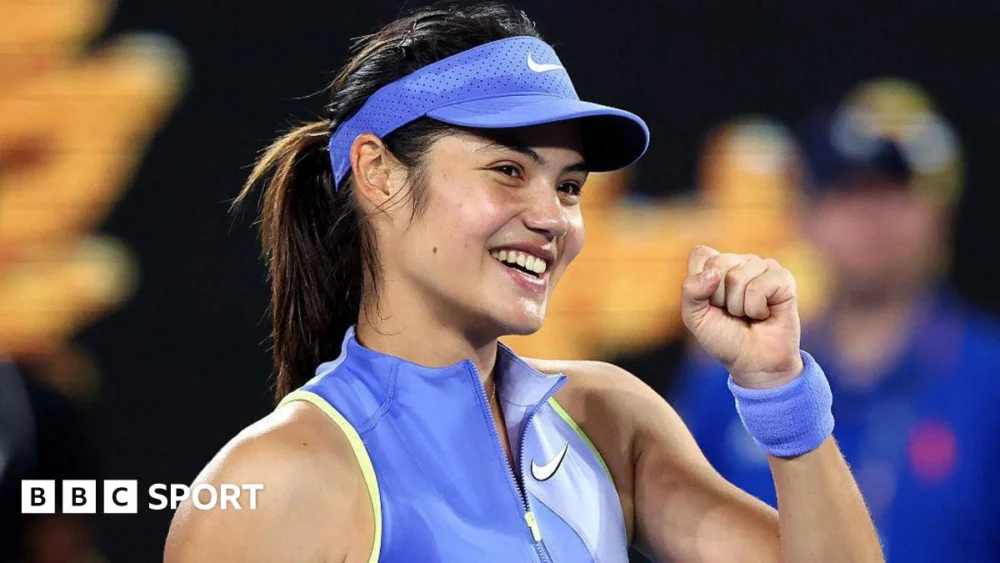
Emma Raducanu, the 2021 US Open champion, commenced her Australian Open 2026 campaign by adeptly overcoming both a challenging late-night schedule and an initially sluggish performance against Thailand’s Mananchaya Sawangkaew, ultimately prevailing with a commanding 6-4, 6-1 victory to advance into the tournament’s second round. This opening match at Melbourne Park offered an early test of her resilience and adaptability, particularly given the unique circumstances surrounding her evening encounter.
Raducanu’s professional journey since her improbable Grand Slam triumph has been characterized by a determined effort to establish consistency amidst the intense scrutiny and physical demands of elite tennis. Her 2025 season marked a significant step forward, seeing her return to the world’s top 30 and participate in a greater number of matches than in any prior year. This period of sustained competition was crucial for rebuilding her match fitness and tactical acumen. However, the build-up to the 2026 Australian Open presented fresh obstacles. A foot injury disrupted her planned off-season technical work with renowned coach Francisco Roig, whose illustrious career includes guiding Rafael Nadal to multiple major titles. This setback meant Raducanu arrived in Melbourne with limited competitive play and a notable early-season defeat to the world number 204, Taylah Preston, in Hobart, raising questions about her immediate readiness for Grand Slam intensity.
The first-round draw pitted Raducanu against Mananchaya Sawangkaew, a player making her Grand Slam main draw debut. Unseeded opponents, particularly those with a point to prove, often possess the capacity to disrupt established hierarchies, and Sawangkaew quickly demonstrated her intent. The Thai player, employing aggressive returns and intelligent net play, capitalized on Raducanu’s early tentativeness. The Briton’s movement appeared constrained, and her shots lacked their characteristic conviction, leading to an uncharacteristic flurry of unforced errors. Sawangkaew seized the initiative, breaking Raducanu’s serve in the third game and subsequently establishing a formidable position with a chance to secure a double break and a 4-1 lead in the opening set. This early passage of play provided a stark reminder of the unpredictable nature of Grand Slam tennis and the fine margins separating success from an early exit.
Yet, it was at this critical juncture, with the scoreline poised precariously, that Raducanu’s championship pedigree began to assert itself. Facing two break points at 15-40, she produced a series of brilliant winners, showcasing her latent power and precision, to hold serve and prevent further erosion of her position. This pivotal hold, at 2-4, served as the catalyst for a remarkable turnaround. From that point, Raducanu’s confidence visibly surged. Her movement became more fluid, her groundstrokes found their depth and pace, and she began to dictate the rallies with increasing authority. The transformation was striking: she reeled off seven consecutive games, turning a deficit into a commanding lead, ultimately securing the first set 6-4 and establishing an early break in the second. By the conclusion of the match, Raducanu was hitting with renewed conviction, unleashing heavy forehands and controlling the points, culminating in 17 winners against Sawangkaew’s nine, and winning an impressive 27 of the 40 points contested in the second set, sealing her victory with an emphatic ace.
Beyond the on-court tactical adjustments, Raducanu also contended with the unique psychological and physical demands of a late-night match start. Her arrival on court shortly after 9 PM local time meant a prolonged period of waiting, a scenario that can significantly impact a player’s pre-match routine and mental preparation. Raducanu, while acknowledging herself as a "night owl" in general, confessed that this preference did not extend to her playing schedule. This distinction highlights the specific physiological and psychological demands of competitive sport under floodlights. To mitigate the challenges, the 23-year-old meticulously tailored her day, commencing with a tranquil "potter around" Melbourne’s bustling riverside area, followed by a leisurely breakfast, treatment, team discussions, and a crucial afternoon nap. Her arrival at Melbourne Park at 5:30 PM allowed her ample time to engage in her pre-match routines and a 6 PM practice session, strategies designed to optimize her readiness for the cooler, slower night-time conditions.
The issue of late scheduling is not unique to Raducanu. Her compatriot, Cameron Norrie, described his own "very tricky day," arriving on site at 10 AM with an expectation of playing mid-afternoon, only to commence his five-set battle shortly before 6 PM due to extended preceding matches. Such experiences underscore the broader implications of Grand Slam scheduling, particularly the common practice of preceding women’s matches with men’s best-of-five-set contests on the same court. Raducanu had previously voiced concerns regarding the logical consistency of this approach, citing the potential for unpredictably late starts. Her proactive measure of booking a late-night training session on the Saturday preceding her match specifically to acclimate to the anticipated cooler, slower night conditions demonstrates a keen strategic awareness. Ironically, her match started earlier than expected due to a swift straight-sets victory by tenth seed Alexander Bublik, but the preparation for a late night proved beneficial in adapting to the unique nocturnal atmosphere of Melbourne Park.
Raducanu’s post-match reflections underscored her satisfaction with her competitive spirit. "Maybe I made a few errors thinking I had to do a bit too much early on," she conceded, acknowledging the initial over-eagerness. "I was just very happy with how I kept competing. It was a really important game at 2-4 to hold, having saved a couple break points at 15-40. After that I think it was a combination of me finding my feet, my movement, dominating a bit more and also a few errors from her." This candid assessment highlights her capacity for in-match analysis and adjustment, a crucial attribute for sustained success.
The victory, despite the initial stumbles, represents a significant early psychological triumph for Raducanu. It demonstrates her ability to navigate adversity, a trait that will be essential as she seeks to advance deeper into the tournament. The first-round win, particularly given her pre-tournament injury and limited match play, provides a much-needed injection of confidence. Her next challenge will be against Austrian Anastasia Potapova, a formidable opponent known for her aggressive baseline game. Should Raducanu navigate that encounter successfully, a potential third-round clash looms against the reigning world number one, Aryna Sabalenka. Such a match would serve as a critical benchmark, offering a clear indication of Raducanu’s current standing and her progress in returning to the elite echelons of the sport.
The long-term outlook for Raducanu hinges on several factors: consistent health, continued refinement of her tactical approach, and the ability to maintain the mental fortitude displayed in her opening match. Her collaboration with Francisco Roig, though initially hampered, signifies a commitment to fundamental technical development that could unlock new dimensions in her game. The challenge now is to build on this initial victory, not only in terms of progressing through the draw but also in establishing a consistent pattern of performance that re-affirms her Grand Slam champion status and moves her beyond the narrative of a singular triumph. The Australian Open 2026, therefore, is not merely another tournament; it is a crucial chapter in Raducanu’s ongoing quest for sustained excellence at the highest level of professional tennis.




 Aura Kasih
 Safa Marwah
 Ayu Aulia