Lisa Mariana
NASA stands on the cusp of a monumental undertaking, poised to inaugurate a new era of human deep-space exploration with the Artemis II mission. This pivotal endeavor, marking the first crewed journey to the vicinity of the Moon in over half a century, is slated for a potential launch as early as the first week of February, with its primary objective being the meticulous testing of the Orion spacecraft and the Space Launch System (SLS) in preparation for future lunar landings.
The Artemis Program: A New Horizon for Lunar Exploration
The Artemis program represents a strategic re-engagement with lunar exploration, moving beyond the flag-and-footprints approach of the Apollo era towards establishing a sustained human presence on and around the Moon. This ambitious initiative aims not only to return astronauts to the lunar surface, including the first woman and person of color, but also to leverage the Moon as a proving ground for technologies and procedures essential for eventual human missions to Mars. Artemis II, a critical stepping stone in this multi-phase program, is designed to rigorously evaluate the integrated performance of the SLS rocket and Orion capsule with a human crew onboard, ensuring the safety and efficacy of future, more complex missions. Its success is paramount to unlocking the next chapters of human spaceflight.
The Path to Launch: A Meticulous Dance of Engineering and Timing
The immediate precursor to launch involves a series of highly choreographed operations, beginning with the monumental task of transporting the SLS Moon rocket and its integrated Orion Space Capsule. This colossal stack will embark on a deliberate, four-mile journey from the iconic Vehicle Assembly Building (VAB) to Launch Complex 39B at Kennedy Space Center. The immense crawler-transporter-2, a marvel of engineering itself, will meticulously navigate this distance, a process anticipated to span up to 12 hours, underscoring the sheer scale and complexity of the hardware involved.
Upon arrival at the launch pad, an intricate sequence of preparations commences. Engineers will meticulously connect a vast array of ground support equipment, ranging from critical electrical lines and environmental control system ducts to cryogenic propellant feeds. These connections are vital for sustaining the spacecraft and rocket systems during pre-launch operations and for facilitating the fueling process.
A crucial pre-launch milestone is the "wet dress rehearsal," typically scheduled for late January. This comprehensive test involves fueling the SLS rocket with over 700,000 gallons of super-chilled liquid hydrogen and liquid oxygen, simulating a full countdown sequence right up to T-minus 10 seconds. The rehearsal is designed to validate all systems, procedures, and personnel responses under realistic launch conditions, without actually igniting the engines. Any anomalies or issues identified during this rigorous exercise could necessitate rolling back the SLS and Orion stack to the VAB for further inspection and rectification, potentially impacting the launch timeline.
Assuming all systems perform optimally, the earliest window for the Artemis II launch is projected for Friday, February 6th. However, lunar missions are uniquely constrained by celestial mechanics. Beyond the rocket’s readiness, the Moon’s precise orbital position relative to Earth is a critical determinant. This astrological alignment dictates specific "launch windows," typically occurring for approximately one week at the beginning of each month, followed by three weeks where no launch opportunities exist. This intricate interplay of terrestrial readiness and cosmic alignment underscores the precision required for deep-space endeavors.
The Artemis II Crew: Pioneers of a New Lunar Era
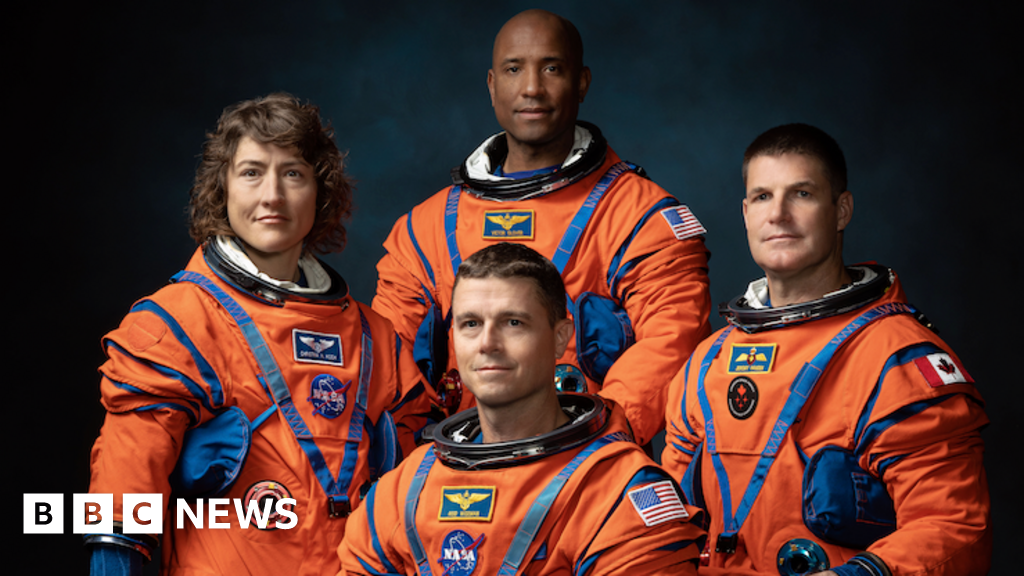
The four-person crew assigned to Artemis II represents a blend of seasoned NASA astronauts and a distinguished international partner, collectively embarking on a mission that will push the boundaries of human spaceflight further than any crew since Apollo.
Leading the mission as Commander is Reid Wiseman, a former naval aviator with previous experience on the International Space Station (ISS), where he served as a flight engineer. His leadership and extensive operational background will be crucial for navigating the complexities of deep-space flight.
Victor Glover will serve as the Pilot. A U.S. Navy aviator and astronaut, Glover has also completed a long-duration mission on the ISS, accumulating significant experience in orbital mechanics and spacecraft systems. His expertise in piloting and systems management will be integral to the mission’s success, particularly during the manual flight tests of the Orion capsule.
Christina Koch, a Mission Specialist, is renowned for holding the record for the longest single spaceflight by a woman, having spent 328 days on the ISS and participating in the first all-female spacewalk. Her extensive experience in microgravity environments and her resilience will be invaluable for the ten-day deep-space journey.
Completing the quartet is Jeremy Hansen, a Mission Specialist from the Canadian Space Agency (CSA). A former fighter pilot, Hansen will become the first Canadian to venture beyond low-Earth orbit. His inclusion underscores the growing international collaboration in space exploration and Canada’s vital role in the Artemis program, particularly through its contribution of robotics for the lunar Gateway station.
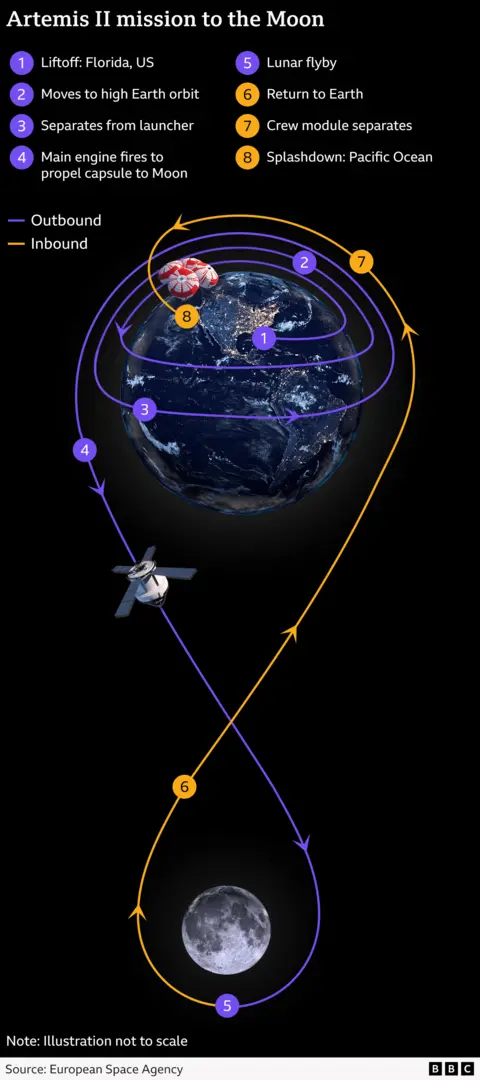
This diverse crew will undertake the critical task of validating the Orion spacecraft’s performance with human occupants. Once in Earth orbit, a key objective involves manually flying the capsule, allowing the astronauts to practice steering and maneuvering techniques essential for future lunar rendezvous and docking procedures. Following these initial tests, Orion will execute a Trans-Lunar Injection (TLI) burn, propelling the spacecraft towards the Moon. The mission profile involves a free-return trajectory that will take the crew thousands of kilometers beyond the Moon, further into space than any human has traveled before. This distant flyby is not merely a record-setting feat but a crucial opportunity to test Orion’s life-support, propulsion, power, and navigation systems under the harsh conditions of deep space.
Beyond their operational duties, the crew will also serve as vital "medical test subjects." They will continuously monitor and transmit biometric data and imagery from deep space, providing unprecedented insights into the physiological and psychological impacts of prolonged exposure to the deep-space environment. While radiation levels beyond Earth’s protective magnetosphere will be significantly higher than those experienced on the ISS, the mission profile is designed to remain within safe exposure limits. The confined environment of Orion’s small cabin (approximately nine cubic meters of living space for ten days) will also offer valuable data on crew dynamics and habitability for future long-duration missions. The mission will conclude with a high-velocity re-entry into Earth’s atmosphere, culminating in a precision splashdown off the west coast of the United States, in the Pacific Ocean, where recovery teams will be standing by.
Artemis III and Beyond: The Return to the Lunar Surface
It is crucial to emphasize that Artemis II is an uncrewed lunar flyby and will not land on the Moon. Its success is a prerequisite for Artemis III, the mission designated to return humans to the lunar surface for the first time since December 1972. NASA’s current timeline for Artemis III suggests a launch "no earlier than" 2027, though many experts in the aerospace community anticipate a more realistic timeframe of 2028 or even later, citing the inherent complexities and dependencies of such a monumental undertaking.
Several critical components and decisions remain outstanding for Artemis III. The selection of the Human Landing System (HLS) spacecraft to transport astronauts from lunar orbit to the surface is still pending finalization. Two primary contenders remain: SpaceX’s Starship lander and a proposed craft designed by Jeff Bezos’s Blue Origin. The development and rigorous testing of whichever system is chosen represent significant engineering challenges. Furthermore, new advanced spacesuits, specifically designed by Axiom Space for lunar surface operations in the challenging South Pole environment, are still under development and must be certified ready for flight.
When Artemis III eventually flies, its destination will be the Moon’s South Pole. This region is of particular scientific interest due to the potential presence of significant quantities of water ice in permanently shadowed craters, a resource that could be invaluable for future lunar habitats, providing potable water, breathable air, and even rocket fuel.
Following Artemis III, the Artemis program envisions a sustained human presence on and around the Moon. Artemis IV and V are slated to begin the construction of Gateway, a small modular space station orbiting the Moon. Gateway will serve as a vital staging point for lunar surface missions, a science laboratory, and a communication relay. Subsequent missions will see further additions to Gateway, the deployment of advanced robotic rovers, and increased international collaboration, fostering a robust ecosystem for long-term lunar habitation and exploration, ultimately paving the way for human missions to Mars.
A Historical Perspective: Apollo’s Legacy and Artemis’s Future
The last time humans walked on the Moon was during the Apollo 17 mission in December 1972. In total, 24 astronauts journeyed to the Moon, and 12 of them experienced the unique privilege of walking on its surface during the Apollo program. The initial impetus for America’s lunar ambitions in the 1960s was primarily geopolitical: to decisively win the Space Race against the Soviet Union and assert technological dominance during the Cold War. Once this objective was achieved, political will and public enthusiasm waned, leading to a significant reduction in funding for subsequent Moon missions.
The Artemis program, while benefiting from Apollo’s legacy, is driven by a broader set of motivations. Beyond national prestige, the contemporary drive includes scientific discovery, the development of a lunar economy, and fostering international partnerships. The program aims to establish a sustainable, long-term human presence, leveraging advanced technologies and commercial collaborations to achieve goals far exceeding those of the original Apollo missions.
A Global Race: Other Nations’ Lunar Ambitions
While NASA leads the Artemis initiative, several other nations are actively pursuing their own ambitious plans for lunar exploration, signaling a new era of multilateral engagement with Earth’s closest celestial neighbor. Many European astronauts are slated to participate in later Artemis missions through the European Space Agency (ESA), and Japan’s space agency (JAXA) has also secured seats, demonstrating a strong commitment to international cooperation.
Independent efforts are also gaining momentum. China, through its National Space Administration (CNSA), is aggressively developing its own capabilities, targeting a first crewed landing near the Moon’s South Pole by 2030. This program operates independently of the US-led Artemis framework and includes the development of its own heavy-lift rockets and lunar landers.
Russia’s Roscosmos continues to articulate aspirations of sending cosmonauts to the lunar surface and establishing a small base between 2030 and 2035. However, geopolitical sanctions, significant funding pressures, and persistent technical setbacks render this timetable highly optimistic and subject to considerable skepticism within the global space community.
India, following the remarkable success of its Chandrayaan-3 mission, which achieved a soft landing near the lunar South Pole in August 2023, has expressed clear ambitions for human lunar exploration. The Indian Space Research Organisation (ISRO) has set a goal of sending its own astronauts to the Moon by approximately 2040, as part of a broader strategy to expand its human spaceflight program beyond low-Earth orbit. This demonstrates a growing capacity and strategic vision within the emerging space powers.
The collective efforts of these nations signify a burgeoning, multi-polar landscape for lunar exploration, driven by diverse scientific, economic, and strategic interests. The Artemis II mission stands as a critical launchpad not only for NASA’s own lunar aspirations but for humanity’s collective journey back to the Moon and beyond. Its success will reverberate across the international space community, setting the stage for unprecedented cooperation and competition in the cosmos.




 Aura Kasih
 Safa Marwah
 Ayu Aulia