Ridwan Kamil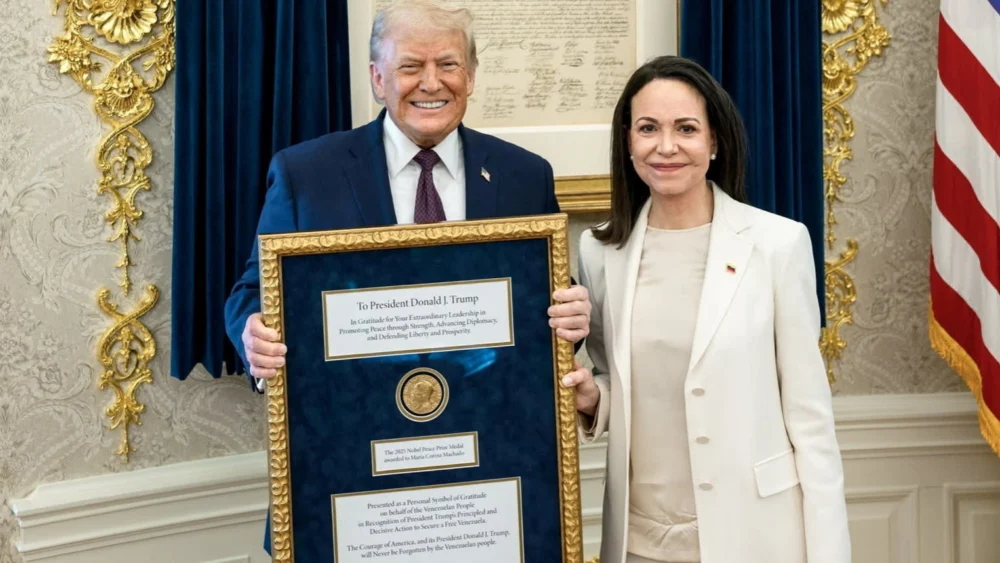
In a remarkable and widely unexpected act of symbolic diplomacy, a prominent Venezuelan opposition leader, recognized globally for her tireless advocacy for democracy and human rights, has presented her Nobel Peace Prize medal to former United States President Donald Trump. This unprecedented gesture, occurring amidst complex geopolitical currents and ongoing internal struggles within Venezuela, carries significant implications for both Venezuelan politics and the international perception of the peace prize itself.
The Venezuelan opposition figure, a Nobel laureate whose name has become synonymous with the fight against authoritarianism in her homeland, has chosen to entrust her esteemed award to a figure often associated with nationalist policies and a departure from traditional diplomatic norms. While the specific motivations behind this extraordinary act remain open to interpretation, it is clear that the decision transcends mere personal sentiment, resonating deeply within the intricate tapestry of Venezuelan political aspirations and the broader global discourse on democratic transitions.
This presentation of the Nobel Peace Prize medal to a former U.S. president is a highly unconventional development, particularly given the diverse and often conflicting political landscapes inhabited by both individuals. The Nobel Peace Prize, established by Alfred Nobel’s will, is awarded annually to individuals or organizations who have made outstanding contributions to peace. Its recipients are typically lauded for efforts in areas such as disarmament, conflict resolution, human rights, and humanitarian aid. The medal itself is a tangible representation of these monumental achievements, imbued with immense symbolic weight and historical significance.
The Venezuelan opposition leader, whose decades-long struggle against an increasingly entrenched regime has garnered international acclaim and solidarity, has long been a beacon of hope for millions seeking democratic reforms. Her commitment to non-violent resistance and her unwavering defense of fundamental freedoms have positioned her as a leading voice in the global human rights community. The awarding of the Nobel Peace Prize to her was a testament to the power of persistent activism in the face of formidable opposition and a recognition of the profound sacrifices made in the pursuit of liberty.
Donald Trump, the recipient of this distinguished honor, has a political career marked by a distinctive approach to foreign policy, often characterized by an "America First" doctrine, a willingness to challenge established international agreements, and a transactional style of diplomacy. His presidency saw significant shifts in U.S. engagement with various global actors, including Venezuela, where the U.S. under his administration imposed sanctions and offered support to the opposition. The juxtaposition of a Nobel Peace Prize recipient, celebrated for her grassroots activism and advocacy for democratic ideals, gifting her medal to a former president known for his disruptive approach to global politics, is a narrative that defies simple categorization.
Several potential interpretations emerge when considering the underlying reasons for this extraordinary act. One perspective suggests that the opposition leader may be seeking to leverage the former president’s influence and considerable public platform to amplify the ongoing struggle for democracy in Venezuela. By bestowing such a significant symbol of peace and recognition upon him, she might be aiming to re-engage his attention and potentially secure renewed political backing for her cause, particularly in anticipation of future electoral contests or diplomatic initiatives. This could be seen as a strategic move to harness the political capital associated with a former head of state, hoping to translate that into tangible support for her movement.
Another interpretation could involve a symbolic gesture of gratitude or recognition for past U.S. policies that, in the opposition leader’s view, aligned with their objectives of democratic transition in Venezuela. While the Trump administration’s approach to Venezuela was often criticized for its effectiveness and its broader impact, it did involve a stated commitment to supporting democratic forces. The medal’s presentation could, therefore, be a way of acknowledging these past efforts, irrespective of their ultimate outcomes, and signaling a desire to maintain a connection with influential American political figures.
Furthermore, the act might be interpreted as a commentary on the evolving nature of international diplomacy and the role of symbolic gestures in contemporary political discourse. In an era where traditional diplomatic channels are often supplemented or even supplanted by more direct, often personalized, forms of communication, the presentation of a Nobel Peace Prize medal could be seen as a potent non-verbal communication. It might be intended to convey a message about the enduring importance of certain principles, even if the messenger and the recipient occupy vastly different ideological spaces.
The implications of this event are multifaceted. For the Venezuelan opposition, it could galvanize their supporters and potentially create new avenues for international engagement. It might also spark internal debate within the movement regarding the strategic value of such unconventional alliances. The presentation could serve as a powerful visual statement, underscoring the urgency of their cause on the global stage.
For Donald Trump, receiving such a prestigious award, even in symbolic form, presents an interesting dynamic. It could be interpreted by his supporters as a validation of his foreign policy initiatives, while critics might view it with skepticism, questioning the motivations behind the gesture and the appropriateness of associating the Nobel Peace Prize with his political persona. His response to this presentation, and any subsequent engagement with the Venezuelan opposition, will be closely scrutinized.
The Nobel Peace Prize itself, an institution already subject to periodic debate regarding its selection process and the impact of its laureates, now finds itself at the center of another unconventional narrative. The medal, as a physical artifact, carries immense symbolic weight. Its transfer to a political figure like Donald Trump, outside the direct purview of the Nobel Committee’s selection, raises questions about the stewardship of such honors and the potential for their symbolic appropriation in political contexts.
Looking ahead, the long-term ramifications of this unprecedented exchange remain to be seen. The effectiveness of this symbolic gesture in advancing the cause of democracy in Venezuela will likely depend on a complex interplay of political factors, including the ongoing domestic situation in Venezuela, the broader geopolitical landscape, and the future actions of both the opposition leader and former President Trump. It serves as a potent reminder of the intricate and often unpredictable nature of political maneuvering and the enduring power of symbolism in shaping international perceptions and driving political agendas. The world will be watching to see how this remarkable act of diplomatic exchange unfolds and what tangible impact it has on the ongoing pursuit of peace and democracy. The event underscores the fluid boundaries of political influence and the creative ways in which individuals and movements seek to harness global attention for their causes, even through unconventional means. The symbolism of the Nobel Peace Prize, in this instance, has been repurposed in a manner that is both thought-provoking and potentially impactful on the international stage.

 Aura Kasih
 Safa Marwah
 Ayu Aulia