Lisa Mariana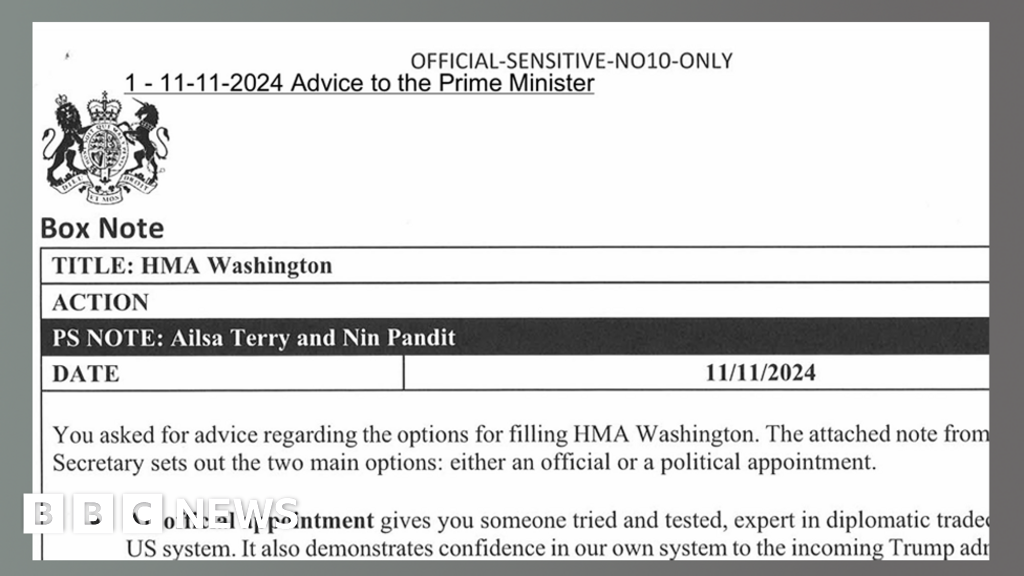
The recent public disclosure of 147 pages of government documents has cast a revealing light on the controversial appointment and subsequent termination of Lord Mandelson as the United Kingdom’s ambassador to the United States, unearthing critical details concerning the vetting process, the awareness of his association with convicted sex offender Jeffrey Epstein, and the financial settlement surrounding his departure.
This initial tranche of official correspondence, compelled into the public domain by parliamentary pressure, marks the inaugural release of records pertaining to the selection and eventual dismissal of Lord Mandelson. His removal from the high-profile diplomatic post last year followed widespread revelations concerning his sustained relationship with the late Epstein. Currently, Lord Mandelson is subject to a criminal investigation concerning allegations of misconduct in public office. He has consistently maintained his innocence, asserting that his actions were not criminal, were not motivated by personal gain, and that he is fully cooperating with law enforcement inquiries. These newly unveiled documents offer a foundational understanding of the complex circumstances surrounding these events.
Pre-Appointment Warnings: Reputational Risks Flagged to Prime Minister Starmer
One of the most significant revelations contained within the documents is the explicit warning delivered to Prime Minister Sir Keir Starmer regarding the potential "general reputational risk" associated with Lord Mandelson’s relationship with Jeffrey Epstein, prior to his confirmation as US ambassador. An advisory note, dispatched to the Prime Minister on December 11, 2024, a mere nine days before the ambassadorial appointment was formalized, enumerated several potential liabilities. Beyond the Epstein connection, the note also highlighted Lord Mandelson’s previous instances of resignation or dismissal from government roles, which had previously attracted public and media attention. Furthermore, the advisory cautioned that Lord Mandelson was perceived as a prominent proponent of closer ties between the UK and China, a stance that could potentially invite geopolitical scrutiny.
Crucially, the Prime Minister was informed of a 2009 report commissioned by JP Morgan bank, which concluded that Lord Mandelson had maintained an "unusually close relationship" with Epstein even after the financier’s initial conviction for soliciting prostitution involving a minor. Despite these explicit warnings, Sir Keir has publicly asserted that he remained unaware of the "extent and depth" of Lord Mandelson’s association with Epstein at the time of the appointment. This claim, however, now faces intensified scrutiny in light of the detailed information presented in the advisory note, raising serious questions about the Prime Minister’s judgment and the thoroughness of the vetting procedures for such a pivotal diplomatic role. The political implications for Sir Keir’s administration, particularly concerning accountability and transparency, are likely to be substantial.
Atypical Appointment and White House Reception
The selection of Lord Mandelson for the role of British ambassador to the United States represented a notable departure from conventional diplomatic practice. Typically, such high-level ambassadorial positions are filled by seasoned career diplomats. In contrast, Lord Mandelson brought a background steeped in politics and business, rather than traditional foreign service. At the time of his appointment, Prime Minister Starmer publicly lauded his "unrivalled experience," positioning him as a shrewd political operator uniquely capable of strengthening the UK’s relationship with the then-incumbent Donald Trump White House. The strategic rationale was to deploy a figure with significant political acumen to navigate the complexities of the Trump administration.
An email unearthed within the documents provides insight into the US administration’s perspective, stating that there was "no suggestion that Peter’s nomination was an issue in the Trump p/c." While the precise meaning of "p/c" remains open to interpretation, likely referring to the "political circle" or "presidential cabinet," this suggests that the Trump administration readily approved the appointment. This raises further questions, particularly given President Trump’s own extensively documented, albeit consistently denied, association with Jeffrey Epstein. The apparent lack of concern from the White House, despite the known connections, adds another layer of complexity to the narrative surrounding the appointment and the level of awareness regarding Epstein’s network among powerful political figures on both sides of the Atlantic. It invites speculation about the criteria and priorities that guided such high-stakes diplomatic endorsements.
Severance Demands and Government Negotiation
The termination of Lord Mandelson’s ambassadorial role last year also triggered a contentious negotiation over a severance package, a standard entitlement for civil servants whose employment is concluded. The documents reveal that Lord Mandelson initially sought a severance payment exceeding £500,000 following his dismissal. This claim was subsequently echoed in the House of Commons by Darren Jones, the Chief Secretary to the Prime Minister, who characterized the demand as "inappropriate and unacceptable" on the government’s part.
Lord Mandelson’s position, as understood by the BBC, disputes the characterization of his claim, asserting that he had no intention of pursuing his case through an employment tribunal. Ultimately, the Treasury negotiated a significantly reduced settlement of £75,000. An internal email from a government official, included in the disclosed files, commended the outcome, stating that the government had done "well to get this settlement down this low with minimal fuss."

In an email dated September 17, 2025, sent shortly after his sacking, Lord Mandelson expressed his primary concern as "leaving the US and arriving in the UK with the maximum dignity and minimum media intrusion," highlighting his continued status as a "crown/civil servant" and his expectation of commensurate treatment. He also alluded to possessing "common law employment rights," suggesting an awareness of his legal standing. This exchange underscores the high-stakes nature of such departures for public figures and the delicate balance between public accountability and individual rights. The discrepancy between the initial demand and the final settlement highlights the government’s efforts to manage both financial exposure and public perception in politically sensitive terminations.
"Weirdly Rushed": Concerns from a Senior Adviser
Further insights into the internal dynamics surrounding the appointment emerged from the observations of Jonathan Powell, the Prime Minister’s national security adviser. Powell is documented as having found Lord Mandelson’s appointment "weirdly rushed." These concerns, which also encompassed "the individual and reputation," were conveyed to Morgan McSweeney, Sir Keir’s former chief of staff. These comments were recorded during a "fact-finding call" between Powell and Mike Ostheimer, the Prime Minister’s lawyer, conducted the day after Lord Mandelson’s dismissal on September 11, 2025.
Jonathan Powell’s extensive professional history with Lord Mandelson, particularly their collaboration during Tony Blair’s premiership from 1997 to 2007, lends significant weight to his observations. As a powerful and experienced adviser, his reservations, if voiced during the initial appointment process, would have carried considerable influence within government circles. The implication of his "weirdly rushed" assessment points to potential deficiencies in the due diligence process or a perceived haste in securing the appointment, possibly overlooking critical warning signs or bypassing standard protocols. While there is no suggestion of wrongdoing by Lord Mandelson himself in this context, Powell’s comments underscore a potential internal unease regarding the process, raising questions about the thoroughness and political prudence of the decision-making at the highest levels of government.
Mandelson’s Role in a Blair-Epstein Meeting
The documents also shed light on Lord Mandelson’s involvement in facilitating a meeting between then-Prime Minister Tony Blair and Jeffrey Epstein in 2002. An email dated May 7, 2002, from Lord Mandelson to Jonathan Powell, explicitly states: "I mentioned to TB that Jeffrey is in London next week and he said he would like to meet him." This communication directly links Mandelson to the arrangement of the encounter.
A subsequent memo, penned by senior civil servant Matthew Rycroft on May 14, 2002, served as a briefing note for Sir Tony ahead of the scheduled meeting with Epstein later that day. The memo described Epstein as a "super-rich" financial adviser and noted his "close" association with the Duke of York. Furthermore, it relayed that "Peter says that Epstein now travels with Clinton and Clinton wants you to meet him. He thinks you would find worthwhile a conservation with him about a) science and b) international economic and monetary trends."
A spokesperson for Sir Tony Blair acknowledged the meeting, stating that, to the best of his recollection, it lasted "less than 30 minutes in Downing Street in 2002," focusing on "US and UK politics." The spokesperson emphasized that Sir Tony "never met or engaged with him subsequently," and that the meeting occurred "long before his crimes were known of and his subsequent conviction." While the meeting predates Epstein’s widely publicized convictions, Mandelson’s role in facilitating it adds another dimension to the ongoing scrutiny of his connections and influence. It highlights the extent of Epstein’s network among powerful global figures and the pathways he used to gain access.
The Unseen Information: An Ongoing Investigation and Future Disclosures
It is crucial to recognize that this initial release of documents represents merely a fraction of the total information pertinent to the Mandelson affair. Officials are currently engaged in a comprehensive review of thousands of documents, indicating that today’s material may indeed be "the tip of the iceberg."
Darren Jones, addressing the Commons, confirmed that the Metropolitan Police had specifically requested the withholding of certain documents to prevent prejudicing their ongoing criminal investigation into Lord Mandelson. This investigation notably includes allegations that Lord Mandelson may have leaked sensitive government information during his tenure as business secretary in a previous Labour government. Lord Mandelson has consistently denied any criminal conduct and financial motivation.
A particularly notable omission from this first batch of disclosures pertains to a specific vetting exchange involving three key questions that Morgan McSweeney, Sir Keir’s former chief of staff, posed to Lord Mandelson regarding his ties to Epstein. These questions reportedly concerned his continued contact with Epstein following the financier’s initial conviction for soliciting prostitution with a minor, reports of his stay at Epstein’s residence while Epstein was incarcerated, and his association with a charity founded by Epstein’s associate Ghislaine Maxwell. Sir Keir Starmer has previously alleged that Lord Mandelson was untruthful about the extent of his friendship with Epstein during the vetting process. Conversely, Lord Mandelson maintains that his responses to these vetting questions were accurate. Chief Secretary Jones assured MPs that all documents within the scope for release would eventually be published, implying that these crucial withheld details will emerge at a later stage. The ongoing police investigation and the strategic withholding of information underscore the profound and evolving nature of this political and legal saga, promising further revelations and continued public debate as more details come to light.




 Aura Kasih
 Ridwan Kamil