Lisa Mariana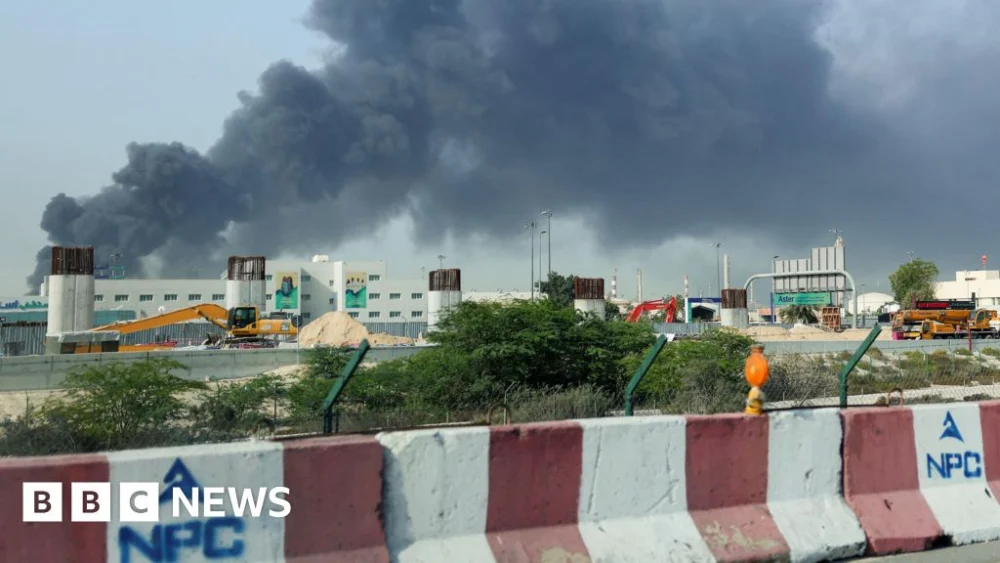
A devastating surge of Iranian ballistic missile and drone attacks has ripped through the Arabian Gulf, leaving a trail of death, injury, and extensive damage across critical civilian and military installations. This unprecedented wave of retaliation, which has grounded thousands of flights and severely impacted maritime operations, was triggered by a joint US-Israeli military offensive that targeted and killed Iran’s supreme leader, thrusting the already volatile region into a new and dangerous era of direct confrontation.
The repercussions were immediately felt across the United Arab Emirates. In Abu Dhabi, the nation’s capital, a targeted drone strike aimed at Zayed International Airport (AUH) resulted in tragic consequences. While air defense systems successfully intercepted the incoming unmanned aerial vehicle, the ensuing cascade of debris proved fatal, claiming the life of one individual and causing injuries to seven others. Emergency services swiftly responded to the scene, managing the aftermath and securing the affected areas, but the incident underscored the vulnerability of even highly protected civilian infrastructure to sophisticated aerial assaults. The partial closure of runways and terminal areas for assessment led to significant operational delays and cancellations, impacting thousands of passengers and cargo movements.
Further north, the bustling metropolis of Dubai also bore the brunt of the offensive. Dubai International Airport (DXB), the world’s busiest airport by international passenger traffic, sustained damage in a related "incident" that led to four staff members requiring medical attention. Details surrounding the exact nature of the damage remained under investigation, but initial reports indicated structural impacts and disruptions to key operational zones, necessitating extensive diversion of flights and a temporary halt to arrivals and departures. The psychological impact on staff and passengers was palpable, transforming one of the globe’s most vital travel hubs into a scene of uncertainty and concern. Beyond the airports, Dubai’s critical maritime infrastructure was also targeted. The Jebel Ali Port, a colossal deep-sea container terminal ranking among the world’s top ten busiest, experienced a significant fire within one of its berths. This blaze was attributed to falling debris following an "aerial interception," indicating the broad geographical spread and indiscriminate nature of the retaliatory strikes. The disruption at Jebel Ali, a linchpin of global supply chains, signaled potential long-term economic ramifications for international trade and shipping.
The Iranian offensive extended far beyond the UAE, encompassing a wide array of US allies and military assets across the Gulf. Bahrain, a crucial strategic partner for the United States and host to the US Navy’s Fifth Fleet headquarters in Manama, faced direct strikes. The Bahrain International Airport reportedly suffered damage after being targeted by a drone, forcing temporary closures and operational adjustments. More alarmingly, Iran’s Islamic Revolutionary Guard Corps (IRGC) explicitly claimed responsibility for striking the headquarters of the US Navy’s Fifth Fleet itself. Eyewitness accounts and visual evidence corroborated this assertion, with immense plumes of black smoke billowing from an area adjacent to the base, suggesting a direct and successful hit on a highly sensitive US military installation. This particular incident represented a profound escalation, crossing a critical threshold by directly targeting American forces in the region.
Oman, typically a more neutral player in regional disputes, was not spared. The state news agency reported that the commercially vital Duqm Port was targeted by two drones, resulting in injuries to one worker and causing operational disruptions. Duqm’s strategic location on the Arabian Sea makes it a key logistical and naval facility, and its targeting demonstrated the comprehensive scope of Iran’s retaliatory strategy, aiming to impact a broad spectrum of economic and military interests across the Gulf.
The scale and coordination of these attacks underscored Iran’s advanced capabilities in ballistic missile and drone technology. Iranian forces employed a diverse arsenal, launching multiple waves designed to overwhelm regional air defense systems. While Qatar, Bahrain, Jordan, and Kuwait – all nations hosting significant US military contingents – reported intercepting numerous incoming missiles and drones, the widespread accounts of falling debris causing damage across various locations indicate that a significant portion of the projectiles either evaded complete neutralization or caused secondary damage upon interception. This highlights a critical challenge for existing air defense architectures: while capable of intercepting individual threats, saturation attacks, or those employing novel trajectories, can still pose substantial risks, particularly to civilian areas where falling debris can be as dangerous as a direct hit.
The immediate trigger for this dramatic escalation was the killing of Iran’s supreme leader in a joint US-Israeli air offensive. This strike, which targeted a figure of unparalleled religious and political authority within Iran, was perceived by Tehran as an existential threat and a profound act of aggression demanding an unequivocal and forceful response. For decades, the complex interplay between the United States, Israel, and Iran has been characterized by proxy conflicts, economic sanctions, cyber warfare, and occasional covert operations. However, the direct targeting of Iran’s highest authority marked a fundamental shift, moving beyond the established "shadow war" into an overt military confrontation. Iran’s leadership swiftly vowed "harsh revenge," and the subsequent attacks demonstrate a calculated strategy to inflict maximum economic and strategic pain on US allies and assets, thereby raising the costs of further direct engagement.
The geopolitical ramifications are immense. The attacks have not only severely destabilized the Arabian Gulf but have also sent shockwaves across the global political landscape. The immediate impact on global aviation, with thousands of flights grounded and re-routed, represents one of the most severe disruptions to international travel since the initial phases of the COVID-19 pandemic. The economic fallout extends to global shipping and energy markets, with oil prices immediately reacting to the increased risk in the Strait of Hormuz, a critical chokepoint for global energy supplies. Insurance premiums for maritime transport in the Gulf are expected to soar, further exacerbating supply chain pressures.
From a strategic perspective, the events place immense pressure on the United States and its allies. The direct targeting of US military installations and the demonstration of Iran’s ability to penetrate the air defenses of key allies will undoubtedly prompt a reassessment of regional security postures and defense capabilities. The dilemma for Washington is acute: how to deter further Iranian aggression without triggering an even wider regional conflagration. The response to the attacks will shape the trajectory of regional security for years to come, with options ranging from further military retaliation, which risks a full-scale war, to diplomatic overtures, which might be perceived as weakness.
For the Gulf states, particularly the UAE and Bahrain, the attacks underscore their precarious position as front-line states in any conflict involving Iran. Despite their advanced military capabilities and strong alliances with the US, their critical infrastructure and bustling economies remain vulnerable. The events are likely to spur renewed efforts to enhance indigenous defense systems and potentially re-evaluate their regional diplomatic strategies. The human cost, while thankfully limited in fatalities, represents a profound loss and a stark reminder of the devastating consequences of escalating geopolitical tensions.
Looking ahead, the region faces an unprecedented period of uncertainty. The immediate future hinges on the nature of the US and Israeli response to Iran’s retaliation. Any further military action from either side risks spiraling into a full-blown regional conflict with global implications. International calls for de-escalation are mounting, but the deeply entrenched grievances and heightened tensions make diplomatic breakthroughs challenging. The current crisis marks a perilous new chapter, demanding astute leadership and unprecedented restraint from all parties to prevent a catastrophe that could engulf the entire Middle East and beyond. The fragility of peace in the Gulf has been starkly exposed, with vital arteries of global commerce and travel now directly imperiled by the escalating geopolitical confrontation.



 Aura Kasih