Aura Kasih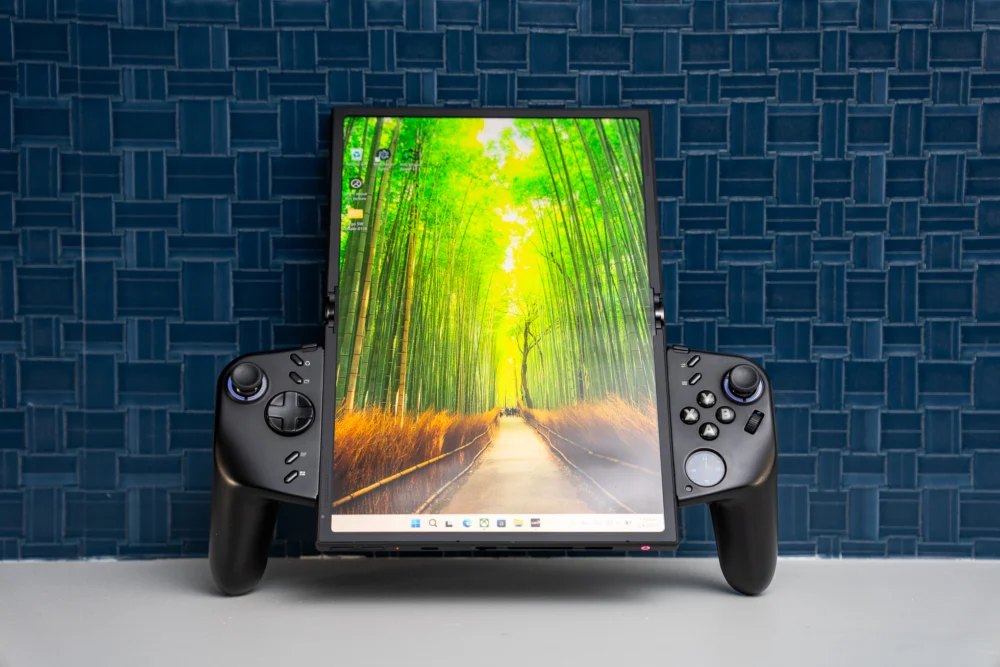
Lenovo has dramatically pushed the boundaries of portable computing with its conceptual Legion Go Fold, a Windows-based gaming handheld that ingeniously integrates a flexible POLED display and detachable controllers, offering a transformative user experience that blurs the lines between gaming device, tablet, and miniature laptop. This innovative design showcases a bold vision for how mobile computing could evolve, addressing both the demands of modern gamers and the desire for versatile productivity tools.
The Legion Go Fold concept represents a significant departure from conventional handheld gaming devices, most notably through its pioneering application of a foldable display. At its core, the device boasts an 11.6-inch flexible POLED screen, a technological marvel that allows for a dynamic transformation of its form factor. In its most compact configuration, the display folds down to a still-generous 7.7 inches, with the detachable, Joy-Con-esque controllers seamlessly integrated into the sides, creating a familiar and ergonomic handheld gaming experience akin to existing premium portable PCs. However, the true innovation unfolds when the device is opened, revealing the full 11.6-inch display, which can be utilized in a variety of compelling configurations.
One of the most striking aspects of the Legion Go Fold’s design is the versatility afforded by its repositionable controllers. When unfolded, these controllers can be attached to any of the four edges of the display, enabling users to adapt the device for diverse use cases. This adaptability is particularly evident in the vertical splitscreen mode. Here, the expansive display is divided, allowing gamers to dedicate one half to their current gameplay while utilizing the other half for complementary applications. This could include real-time strategy game management, access to in-game guides, or seamless integration with communication platforms for coordinated multiplayer sessions. The implications for in-game strategy and player engagement are substantial, offering a level of multitasking previously unimaginable on a handheld.
Transitioning to a more immersive gaming environment, the horizontal fullscreen mode leverages the entire 11.6-inch display, presenting games in a cinematic 16:10 aspect ratio. This full screen real estate is crucial for enjoying visually rich titles and provides a more engaging experience than smaller displays can offer. Beyond gaming, the Legion Go Fold concept extends its utility into productivity with a sophisticated laptop mode. By detaching the controllers and mounting the handheld into a specially designed folio case, the device transforms into a functional mini-laptop. This case incorporates a stable stand for the display, a full-sized keyboard, and a responsive trackpad, effectively creating a portable workstation capable of handling a wide range of professional tasks. Furthermore, the detached controllers can be unified into a single gamepad unit using a separate grip mount, ensuring a comfortable and familiar control scheme for traditional gaming when not in laptop mode.
The forward-thinking design of the Legion Go Fold extends to its secondary display, a circular touchscreen integrated into the right controller. This innovative addition serves multiple purposes, functioning as a touchpad for cursor control and also as a supplementary display. It can showcase extracted UI elements from games, providing at-a-glance information without disrupting the main gameplay. Beyond gaming, it can display system monitoring data, the current time, or even animated GIFs, adding a personalized touch to the device’s interface. This dual-display approach, while potentially facing adoption challenges regarding game developer support for custom UI elements, signifies a commitment to exploring novel interaction paradigms.
Underpinning this advanced hardware is a formidable specification sheet. The Legion Go Fold is powered by an Intel Core Ultra 7 258V Lunar Lake processor, a cutting-edge chip designed for efficiency and high performance in mobile computing. This is complemented by a substantial 32GB of RAM, ensuring smooth multitasking and the ability to run demanding applications and games without compromise. Storage is equally robust, with a 1TB solid-state drive providing ample space for a extensive game library and large project files. The device is powered by a 48Whr battery, offering a balance between performance and longevity, though real-world battery life will undoubtedly be a critical factor for consumer adoption. The flexible POLED display itself is a technological highlight, boasting a sharp resolution of 2435 x 1712 pixels and an exceptionally high refresh rate of 165Hz, promising fluid visuals and responsive gameplay.
However, the concept is not without its limitations and areas for potential improvement. A notable design choice is that the Legion Go Fold does not fold inwards to protect its screen, unlike traditional clamshell devices such as the Nintendo DS or Game Boy Advance. Instead, the foldable nature allows the screen to bend outwards, prioritizing an expanded display experience over a compact, protected form factor. This means users will need to be mindful of screen protection when the device is not in active use. During initial demonstrations, early prototypes exhibited a visible crease in the center of the display, a common characteristic of current foldable screen technology. While this crease can become less noticeable with prolonged use, its presence is a testament to the ongoing evolution of flexible display manufacturing.
Furthermore, the initial build quality and the mechanism for detaching and reattaching the controllers were described as somewhat "janky," suggesting that significant refinement would be necessary to ensure durability and a premium feel should the device move from concept to mass production. The experience of transforming the device into laptop mode, while ultimately rewarding, also required a degree of fumbling, indicating that user interface and physical interaction design will be critical for a seamless user experience.
The potential cost of such an advanced device is also a significant consideration. Given that high-end gaming handhelds are already approaching and exceeding the $1,000 mark, and factoring in the inherent complexities and costs associated with foldable display technology and the ongoing global supply chain challenges, particularly concerning RAM, the retail price of a production-ready Legion Go Fold could be prohibitively high. This economic factor will undoubtedly play a crucial role in determining its market viability.
Despite these challenges, the Legion Go Fold concept represents a compelling vision for the future of portable computing. It showcases Lenovo’s commitment to innovation and exploration of novel form factors. The ability to seamlessly transition between a powerful gaming handheld, a versatile tablet, and a functional mini-laptop addresses a growing demand for devices that can adapt to a multitude of user needs. While the current iteration is a concept, it provides valuable insights into the direction of portable PC gaming and the potential for foldable technology to redefine personal computing. The market will be watching closely to see if Lenovo can overcome the technological hurdles and economic realities to bring such an ambitious device to consumers, potentially ushering in a new era of adaptable and powerful personal computing devices. The pursuit of a truly pocketable, foldable PC handheld that can shrink from a large display to a compact form factor remains an intriguing frontier, and the Legion Go Fold, while not fulfilling that specific desire, boldly explores the possibilities of expanding display real estate and multi-modal functionality.




 Lisa Mariana