Aura Kasih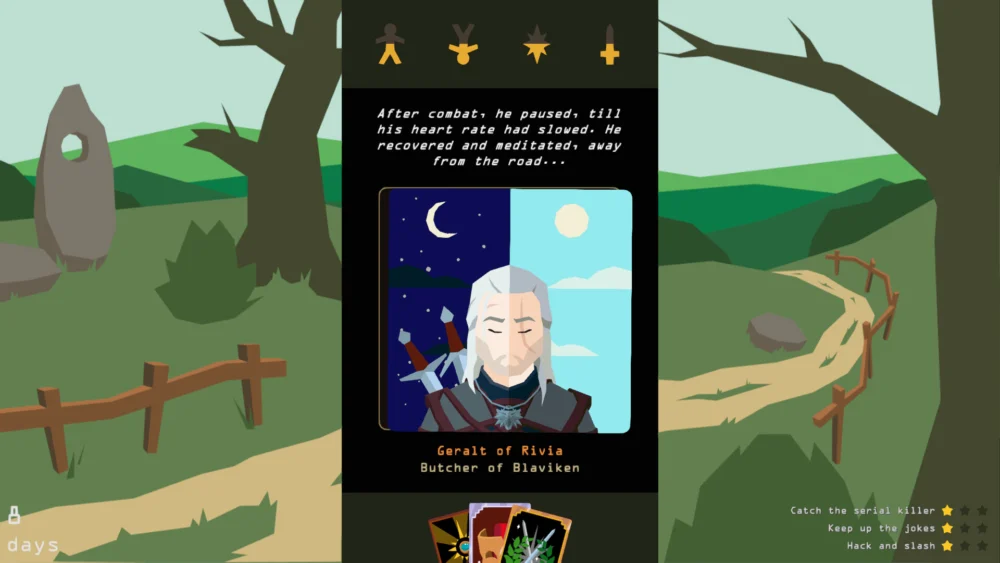
In a fascinating convergence of seemingly disparate gaming philosophies, the acclaimed "Tinder-like" decision-making mechanics of the Reigns series have proven to be an unexpectedly perfect vehicle for navigating the intricate and often perilous world of The Witcher. This innovative adaptation, developed by Nerial, the studio behind the original Reigns titles and a previous foray into Westeros with Reigns: Game of Thrones, demonstrates how a simplified interactive framework can effectively distill the essence of a sprawling, lore-heavy fantasy universe.
Francois Alliot, creative director at Nerial, articulated this core principle, emphasizing the inherent strength of the Reigns formula in bridging the gap between complex narratives and accessible gameplay. "There’s a profound elegance in how our system can transmute deeply intricate universes, their rich lore, and complex storylines into deceptively simple actions," Alliot explained. "This adaptability allows it to resonate across a remarkably broad spectrum of contexts, making ambitious worlds approachable for a wider audience." The studio’s prior successes, including their original kingdom management games and the Game of Thrones iteration, laid the groundwork for this exploration, proving the versatility of their core gameplay loop.
The genius of the Reigns experience lies in its elegant distillation of all interactions into a binary choice. Players are presented with a series of cards, each representing an event, a plea, or a dilemma. Progression is achieved by a simple swipe – left or right – signifying a rejection or acceptance, with each decision irrevocably shaping the unfolding narrative and the player’s fate. In Reigns: The Witcher, this translates to Geralt of Rivia facing a myriad of challenges, from a desperate elf seeking protection to a diplomatic envoy requiring a swift response. The player’s role is to navigate these encounters by making these fundamental yes-or-no decisions, accepting the subsequent consequences, which inevitably lead to a character’s demise and the termination of that particular playthrough.
This two-tiered approach was central to the design philosophy of Reigns: The Witcher. For established fans of Andrzej Sapkowski’s literary saga and CD Projekt Red’s critically acclaimed video games, the title offers a playful, meta-textual playground. "It’s not intended as a new canonical Witcher narrative," Alliot clarified. "Rather, it functions as a meta-game, a sophisticated fanfiction simulator that allows players to playfully engage with the established universe." Conversely, for newcomers who might be daunted by the sheer volume of source material – the novels, the extensive game lore, and the popular television adaptations – Reigns: The Witcher serves as an exceptionally accessible entry point. Narrative designer Oscar Harrington-Shaw elaborated on this aspect: "It functions beautifully as an initial gateway. Players can absorb the distinct tone and understand the underlying rules, or often the deliberate lack thereof, that govern this world. Crucially, it achieves this without demanding the significant commitment required by a full-fledged role-playing game."
Adapting the Reigns formula to the specific contours of The Witcher universe necessitated several key modifications. A fundamental tenet of the original Reigns games was the cyclical nature of death, where the player’s demise as a monarch would simply result in assuming control of their successor. This model proved incompatible with the established immortality of Geralt of Rivia, a core characteristic that defines the iconic monster slayer. To circumvent this narrative impedance and maintain the game’s structural integrity, a clever narrative conceit was introduced: players do not directly embody Geralt. Instead, they assume the role of his flamboyant bard companion, Dandelion (Jaskier), whose task is to chronicle Geralt’s legendary exploits through song. These tales, however, are not necessarily factual accounts but rather embellished narratives, allowing Nerial creative freedom. "This shift provided us with the liberty to deviate from strict lore," Alliot noted, "enabling us to inject a significant amount of humor and imaginative flair into the proceedings." This freedom is most vividly illustrated in the game’s numerous and often absurd death scenarios, ranging from the aforementioned demise during an orgy to a fatal bout of excessive alcohol consumption.

The decision to center the gameplay around Dandelion proved to be a pivotal creative stroke, stemming from extensive discussions with CD Projekt Red, the custodians of The Witcher IP. "This approach was beneficial in two critical ways," explained Harrington-Shaw. "Firstly, it elegantly explains the inherent gameplay loop and provides a satisfying narrative endpoint for each run. This allows us to embrace a wide array of humorous and unexpected deaths, framing them as dramatic conclusions to Dandelion’s ballads. Secondly, and perhaps more importantly, it introduces a unique layer of tension. Players are invested in Geralt’s survival, yet they are simultaneously driven to craft compelling and entertaining narratives for Dandelion’s songs, creating an engaging dual objective."
This conceptual framework significantly encourages player experimentation. Rather than feeling compelled to strictly roleplay as Geralt, players are incentivized to explore unconventional choices, driven by curiosity about the narrative outcomes. This willingness to deviate from the "optimal" path often unlocks unforeseen storylines and narrative branches, demonstrating that even seemingly "wrong" decisions can lead to rewarding discoveries in subsequent playthroughs. The inherent replayability of the Reigns formula is thus amplified, with even an early demise potentially seeding intriguing possibilities for future sessions.
Furthermore, the integration of a combat system presented another design challenge, one that could have easily disrupted the streamlined Reigns experience. The imperative to incorporate monster slaying, a cornerstone of The Witcher’s identity, was balanced against the need to maintain the game’s core mechanics. The Nerial team devised a rhythm-game-inspired combat encounter. During these sequences, players guide Geralt left and right on a board to either attack incoming monsters or evade their assaults. The genius of this implementation lies in its adherence to the established Reigns control scheme: regardless of whether a player is navigating a delicate political negotiation or facing down a formidable fiend, the fundamental interaction remains a simple swipe left or right. This ensures that the combat, while present and engaging, feels like a natural extension of the game’s core decision-making process, rather than an alien addition.
Despite these necessary adaptations, The Witcher universe possesses intrinsic qualities that render it an almost ideal match for the Reigns gameplay structure. Its characteristic dark humor, coupled with a morally ambiguous and often bleak world populated by warring factions, aligns perfectly with the game’s capacity to present complex situations with stark choices. However, the most significant contributing factor is arguably Geralt himself. "Geralt is perpetually confronted with difficult, binary choices," Harrington-Shaw observed. "The Witcher’s world is steeped in shades of gray morality, a characteristic that proved exceptionally amenable to translation into our decision-driven format."
The strategic deployment of the Reigns mechanics within The Witcher IP underscores a broader trend in the gaming industry: the potential for simplified, accessible gameplay loops to serve as potent conduits for engaging with complex and expansive fictional universes. Reigns: The Witcher not only offers a novel way for long-time fans to interact with their beloved characters and world but also presents a compelling and unintimidating entry point for a new generation of players to discover the grim beauty and moral quandaries of Geralt’s Continent. The success of this title suggests a promising future for similar cross-genre collaborations, demonstrating that innovation often lies not in overcomplication, but in elegant distillation.
Reigns: The Witcher is currently available on PC and mobile platforms, inviting players to embark on this unique journey through the Continent.



 Ayu Aulia
 Lisa Mariana