Ayu Aulia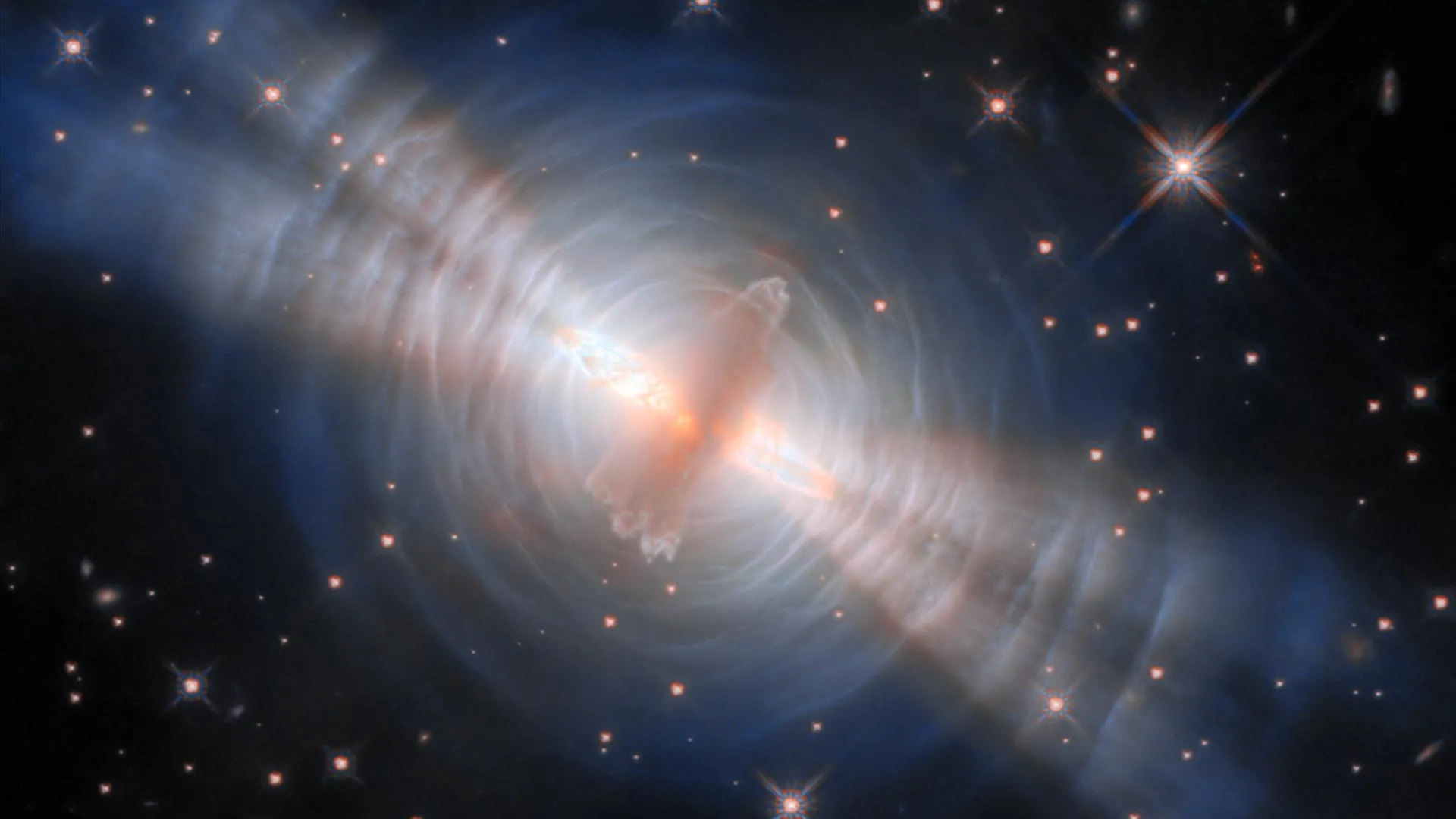
A newly released image from the venerable Hubble Space Telescope offers an unprecedented view into the dramatic end-of-life processes of a Sun-like star, revealing a breathtaking interplay of light and shadow within the enigmatic celestial structure known as the Egg Nebula. This captivating cosmic canvas, intricately sculpted by powerful ejections of gas and dust from a star nearing its demise, provides astronomers with a crucial observational window into a fleeting yet profoundly significant phase of stellar evolution. Located approximately 1,000 light-years distant within the constellation Cygnus, the nebula enshrouds its central progenitor star in a dense shroud of opaque material, presenting a striking visual dichotomy akin to a luminous core encased within a dark, obscuring shell. Hubble’s superior optical resolution has been instrumental in dissecting the intricate filaments and complex morphology of this object, enabling a deeper understanding of the dynamic mechanisms that drive its rapid transformation.
The Egg Nebula holds a singular position in astronomical study as the archetypal, earliest-identified, and nearest example of a pre-planetary nebula. This designation signifies a transient epoch in the stellar lifecycle, preceding the more widely recognized planetary nebula stage. During this precursor phase, a star sheds its outer gaseous layers, forming an expansive envelope of ejected material. The term "planetary nebula" itself is a historical misnomer, originating from early telescopic observations that sometimes rendered these objects with a planet-like circular appearance; they bear no actual relation to planets. Understanding this pre-planetary phase is critical because it represents the pivotal moment when the ejected material begins to be illuminated and shaped by the evolving central star.
A Crucial Phase in Stellar Evolution
Because it exists in such an nascent evolutionary state, the Egg Nebula presents an invaluable opportunity for astrophysicists to meticulously examine the complex physical processes that unfold as intermediate-mass stars, similar to our Sun, exhaust their nuclear fuel and approach their final stages. In this specific pre-planetary nebula phase, the nebula’s luminosity is primarily derived from the reflection of light emanating from its deeply embedded central star. This illumination selectively escapes through distinct polar apertures, creating the impression of luminous "eyes" or "searchlights" piercing through the surrounding opaque dust. The reflected glow originates from a relatively compact, flattened disk of dust that the star expelled only a few centuries ago, a remarkably brief period on astronomical timescales. This recent ejection highlights the rapid and dynamic nature of stellar death throes.
Dominating the Hubble imagery are two intensely bright, collimated beams of light that stream outward from the obscured central star. These energetic outflows illuminate vast, fast-moving polar lobes of material that are actively punching through and expanding beyond older, slower-moving concentric rings of expelled matter. These ring structures, arranged in successive arcs, represent earlier episodes of mass loss from the star. The highly ordered structure and the observed kinematics of these features strongly suggest the profound gravitational influence of one or more unseen companion stars. These hypothetical companions are presumed to remain hidden within the dense, equatorial disk of dust, their presence inferred through their shaping effects on the surrounding nebula.
The Lifecycle of Sun-like Stars
Stars with masses comparable to our Sun undergo a well-defined evolutionary sequence. After billions of years spent fusing hydrogen into helium in their cores during the main sequence phase, they eventually deplete their primary hydrogen fuel. This depletion triggers a series of internal structural changes, leading the star to expand dramatically into a red giant. Further evolution sees them ascend the Asymptotic Giant Branch (AGB), a phase characterized by thermal pulses and significant mass loss. During the AGB phase, the star sheds its outer layers in a series of powerful, often sporadic, ejections of gas and dust. As the hot, dense stellar core becomes progressively exposed, it begins to emit intense ultraviolet radiation. This high-energy radiation subsequently ionizes and energizes the surrounding expelled gas, causing it to fluoresce and produce the spectacular, glowing shells characteristic of fully developed planetary nebulae, such as the well-known Helix, Stingray, and Butterfly nebulae.
The Egg Nebula, however, has not yet reached this fully ionized and extensively illuminated stage. It currently resides in the fleeting and short-lived transitional period known as the pre-planetary nebula phase, a critical evolutionary window that typically endures for only a few thousand years. This relatively brief duration makes direct observation of such objects a rare and scientifically valuable event. Studying the Egg Nebula at this precise moment allows astrophysicists to conduct a detailed examination of the initial mass ejection processes and the subsequent shaping mechanisms while the evidence remains fresh and relatively undisturbed by further stellar evolution. This allows for a kind of "stellar forensics," where the clues to a star’s dramatic final acts are still clearly visible.
Mechanisms of Shaping and Cosmic Recycling
The highly symmetrical patterns discernable in the Hubble images are particularly significant. Such precise bilateral symmetry effectively rules out chaotic, explosive events like supernovae, which would produce far more irregular and turbulent structures. Instead, the elegant arcs, the prominent polar lobes, and the central, obscuring dust cloud are believed to have originated from a coordinated and sequential series of powerful, sputtering outbursts originating deep within the carbon-rich core of the aging star. Stars in this advanced evolutionary stage are prolific manufacturers and expellers of vast quantities of heavy elements and dust grains. These materials, forged in the intense nuclear furnaces of dying stars, are subsequently dispersed into the interstellar medium. Over cosmic timescales, this enriched material can then coalesce to form new generations of stars, planets, and even the building blocks of life. Indeed, our own solar system, including Earth and its fellow rocky planets, formed from just such recycled stellar material approximately 4.5 billion years ago, underscoring the profound cyclical nature of matter in the universe.
The formation of the dramatic bipolar outflows observed in the Egg Nebula is a subject of intense astrophysical research. While the exact mechanisms are still being refined, leading theories often invoke the presence of a binary star system. In such a scenario, the gravitational interaction between the dying primary star and a close companion could facilitate the formation of an accretion disk around one or both stars. Material falling onto such a disk can be accelerated and collimated into powerful jets by magnetic fields, producing the observed bipolar morphology. Alternatively, the interaction of a fast, tenuous wind from the central star with a previously ejected, denser, slower-moving equatorial torus of material can also lead to the formation of collimated outflows. The "yolk" and "egg white" analogy perfectly encapsulates this structure: the dense, dark "yolk" represents the thick, dusty, optically opaque equatorial disk, while the illuminated "egg white" corresponds to the polar lobes where light from the hidden star can escape and reflect off dust particles.
Hubble’s Enduring Legacy of Observation
The Hubble Space Telescope has repeatedly returned to observe the Egg Nebula over the course of its remarkable operational lifetime, progressively building a comprehensive observational record. An initial visible light image captured by the Wide Field and Planetary Camera 2 (WFPC2) provided the first detailed views. This was followed in 1997 by a near-infrared perspective from the Near Infrared Camera and Multi-Object Spectrometer (NICMOS), which allowed astronomers to peer slightly deeper into the nebula’s glowing interior by exploiting infrared light’s ability to penetrate dust more effectively. In 2003, the Advanced Camera for Surveys (ACS) offered an expansive panorama, revealing the full extent of the dusty ripples and arcs extending far from the central object. More recently, observations from the Wide Field Camera 3 (WFC3) in 2012 provided high-resolution insights into the extremely dense central cloud and the powerful gas outflows. The newest image, a composite masterwork, combines data from the 2012 program with additional, more recent observations, culminating in the clearest, most comprehensive, and intricately detailed portrait yet achieved of this fascinating cosmic structure.
These multi-epoch observations are critical for understanding the dynamic evolution of the Egg Nebula. By comparing images taken years apart, astronomers can track the expansion rates of the different components, measure the velocities of the outflowing material, and even discern subtle changes in the illumination patterns. Such temporal studies provide empirical evidence for theoretical models of pre-planetary nebula evolution and help refine our understanding of the timescales involved in these rapid stellar transformations. The continued ability of Hubble to revisit and re-examine such key objects, leveraging its suite of advanced instruments, underscores its unparalleled scientific value.
For over three decades, the Hubble Space Telescope has consistently delivered groundbreaking discoveries that have fundamentally reshaped humanity’s comprehension of the cosmos. Its unwavering performance and scientific output stand as a testament to international collaboration and engineering excellence. The Hubble mission represents a robust partnership between NASA, the United States’ National Aeronautics and Space Administration, and ESA, the European Space Agency. Operational oversight for the telescope and its mission is expertly managed by NASA’s Goddard Space Flight Center in Greenbelt, Maryland, with crucial additional operational support provided by Lockheed Martin Space in Denver. Scientific operations for NASA are meticulously managed by the Space Telescope Science Institute in Baltimore, which is operated by the Association of Universities for Research in Astronomy. The Egg Nebula, with its dramatic bipolar jets and hidden stellar heart, is just one more stellar example of Hubble’s enduring legacy in illuminating the universe’s most profound mysteries. The insights gained from objects like the Egg Nebula are not merely academic; they inform our understanding of the origins of the elements that make up our world and ourselves, connecting us directly to the grand cycle of stellar birth, life, and death. Future observatories, such as the James Webb Space Telescope, will undoubtedly build upon Hubble’s foundational work, offering even deeper infrared penetration to fully resolve the hidden central star and its companions, thereby completing the cosmic puzzle of the Egg Nebula.




 Aura Kasih
 Lisa Mariana