Lisa Mariana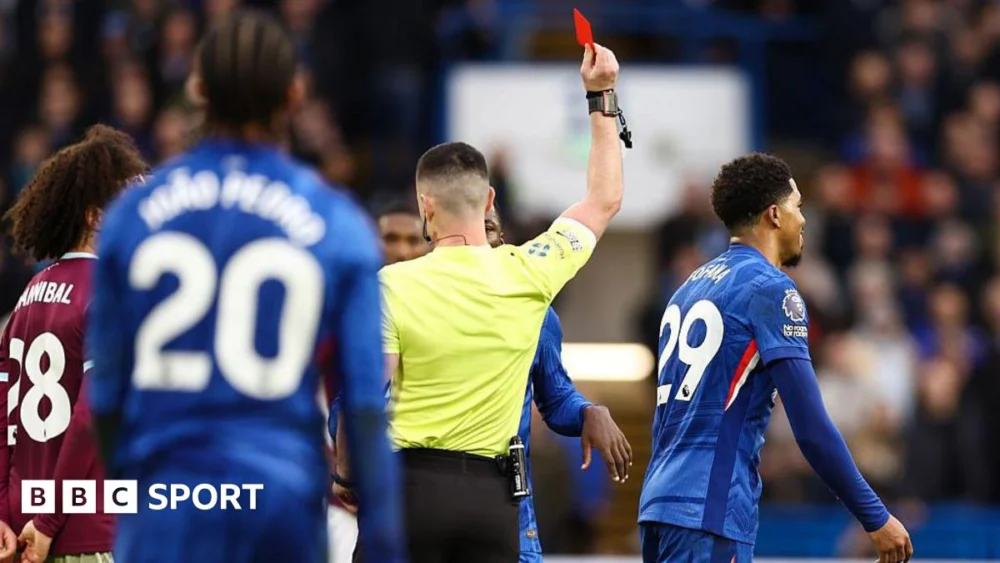
The recent 1-1 draw between Chelsea and Burnley, culminating in a dramatic late equalizer for the visitors, starkly illuminated a series of entrenched systemic vulnerabilities plaguing the West London club, underscoring a critical inability to convert advantageous positions into decisive victories and sparking renewed scrutiny over both tactical execution and player mentality. This result, achieved despite Chelsea holding a numerical advantage and an initial lead, propelled the club to an unenviable position as the Premier League’s foremost accumulator of dropped points on home soil this season, further compounding a pervasive disciplinary issue that continues to undermine their competitive aspirations.
Liam Rosenior, the head coach who assumed the helm following the departure of Enzo Maresca, has inherited a complex tapestry of challenges that appear deeply woven into the fabric of the current Chelsea squad. The late concession against Burnley, occurring in the 93rd minute, marked the 17th point relinquished by Chelsea at Stamford Bridge this campaign after holding a winning position – a statistic that stands alone at the summit of the Premier League’s most concerning trends. This pattern of surrendering leads is not an isolated incident but rather a recurring motif, emblematic of a deeper malaise characterized by defensive fragility, a lack of clinical ruthlessness, and an apparent deficiency in game management during critical junctures. The immediate aftermath of such results invariably leads to an intense internal examination, a process Rosenior described as an "inquest after every game," though the visceral reaction to the Burnley outcome, particularly his lament of having "set fire to four points" following a similar 2-2 home draw against Leeds United in the preceding league fixture, signifies a heightened level of managerial frustration and a growing urgency to address these profound structural weaknesses.
Beyond the recurring issue of squandered leads, Chelsea’s disciplinary record has emerged as another significant impediment to their progress. The dismissal of Wesley Fofana in the 72nd minute against Burnley, for what was deemed a professional foul, contributed to the club reaching a league-high six red cards this term. This figure not only surpasses every other team in the division but also equals Chelsea’s highest number of red cards in a single Premier League season, a mark previously set in the 2007-08 campaign, yet achieved with a substantial 11 league matches still remaining in the current calendar. Fofana’s sending-off demonstrably altered the dynamic of the Burnley match, shifting momentum away from Chelsea and directly contributing to the subsequent collapse that allowed Burnley to salvage a point.
The impact of these dismissals extends far beyond individual matches. Playing with a numerical disadvantage for significant periods places immense strain on remaining players, both physically and tactically, often leading to increased fatigue, altered defensive structures, and a diminished attacking threat. While Chelsea has occasionally demonstrated resilience with ten men – notably securing a victory against Nottingham Forest after an 87th-minute dismissal and rallying to draw against Arsenal following Moises Caicedo’s red card – the broader pattern suggests a significant correlation between red cards and negative outcomes, including defeats against Manchester United, Brighton, and Fulham where early dismissals proved pivotal. This consistent lack of discipline is not merely a statistical anomaly but a tangible factor directly impacting results and hindering the club’s ability to compete consistently at the highest level.
Further analysis of Chelsea’s disciplinary profile reveals a systemic problem. The club currently occupies the lowest position in the Premier League’s Fair Play table, accumulating 86 points from a staggering 60 yellow cards this season. This trend is not new; Chelsea finished second-bottom last season and dead last the season prior, indicating a persistent issue that transcends coaching changes and player rotations. The cumulative effect of numerous cautions, leading to suspensions for key personnel, further disrupts team cohesion and selection stability.
A commonly cited explanation for this pervasive disciplinary problem, as well as the broader challenges in game management, is the age profile of the squad. Chelsea’s hierarchy has deliberately pursued a strategy of assembling the youngest squad in the Premier League, with no player over the age of 28 having featured this season. While this approach is predicated on long-term development and potential future value, it inherently brings with it a certain degree of inexperience, impulsiveness, and perhaps a lack of the seasoned temperament required to navigate the high-stakes environment of top-flight football, particularly in moments of pressure or frustration. Young players, by their nature, may be more prone to rash decisions, both in terms of challenges and reactions, which can lead to bookings and, ultimately, dismissals.
However, Head Coach Liam Rosenior offers a more nuanced perspective, challenging the notion that youth alone is the primary culprit. He posited, "I think youth is one thing, accountability is another." This distinction is crucial, shifting the focus from an inherent characteristic of the squad to a behavioral and psychological one. Rosenior emphasized his own accountability as the head coach for results and performances, while simultaneously stressing the need for players who can be relied upon to execute their duties effectively when circumstances become challenging. He articulated a clear objective: "We need players you can rely on in the moment to do their job. That’s something we need to address very quickly." This suggests that while youth may be a factor, the core issue lies in identifying and nurturing players who possess the mental fortitude and tactical discipline to perform under duress, regardless of age.
Rosenior also sought to contextualize the red card issue, pointing out that the majority of the season’s dismissals occurred prior to his appointment on New Year’s Day, even noting that his predecessor, Enzo Maresca, received a red card for an overzealous celebration. Rosenior stated, "Our discipline since I’ve come in – which is what I can speak about – has been very good." This serves to demarcate his tenure and suggests an awareness of the issue, alongside efforts to instil a more disciplined approach within the team. Nevertheless, Fofana’s red card under his watch serves as a stark reminder that these ingrained patterns are difficult to eradicate swiftly.
Another critical area of concern for Chelsea, and one that directly contributed to the late equalizer against Burnley, is their defensive vulnerability from set-pieces. The statistics are damning: Chelsea has conceded a league-high 13.54 expected goals (xG) from set-pieces this season, which has translated into 11 actual goals conceded. This places them among the worst in the division for defending dead-ball situations. Burnley’s equalizer was a textbook example of exploiting this weakness, with Zian Flemming afforded a free header in the centre of Chelsea’s box – a situation Rosenior bluntly described as a "marking assignment missed." He added, "I’m not here to throw players under the bus – I will always protect my players, and I’ll deal with it during the week. But there was a player assigned that duty who marked the wrong man." This admission highlights a fundamental breakdown in defensive organization and individual responsibility. The danger posed by set-piece specialists, exemplified by Burnley’s combination of a dead-ball expert and an aerial threat like Flemming, is a well-known aspect of modern football, making Chelsea’s consistent susceptibility in this area particularly perplexing and indicative of a deeper systemic flaw. Rosenior acknowledges the gravity of this, stating, "Set plays are massive in the Premier League, they’re so important. Our record this season, defending set plays, is not at the level required for us to achieve what we want to achieve, and that’s something I need to address."
The aggregation of these issues – the inability to hold leads, the pervasive disciplinary problems, and the defensive fragility from set-pieces – points towards a broader mentality issue within the squad. While Rosenior affirms the presence of leaders within the team, he subtly articulates the qualities of winning teams: "The best teams, the teams that win titles – which is where we want to get to – win games 1-0 when they probably haven’t played at their best." This aspiration contrasts sharply with Chelsea’s current reality, where even with a numerical advantage, they failed to secure victory. The capacity to "see a game out," to grind out results, and to demonstrate resilience in difficult moments appears to be a missing ingredient, arguably linked to the very youthfulness of the squad that Rosenior seeks to reframe as an issue of accountability rather than inherent limitation. The pressure of Stamford Bridge, where expectations are perpetually high, can be a heavy burden for a young, developing squad, potentially contributing to a lack of composure in crucial moments.
Liam Rosenior’s appointment initially brought a semblance of calm to Stamford Bridge, a brief interlude from the turbulence that preceded his arrival. However, the visceral nature of his post-Burnley comments, coupled with the disheartening performance, may signal the end of this honeymoon period. While his initial 11 games in charge have shown glimpses of promise, the underlying issues inherited from his predecessor persist and continue to manifest in critical ways. The atmosphere at Stamford Bridge remains febrile, with anti-ownership chants becoming more pronounced and fringe protests gaining traction, reflecting a growing disillusionment among the fanbase.
The road ahead for Chelsea is fraught with significant challenges. A daunting run of Premier League fixtures against formidable opponents such as Arsenal, Aston Villa, and Newcastle United looms large. These matches will not only test the tactical acumen of Rosenior but also the mental fortitude and collective discipline of his young squad. The outcomes of these encounters will be pivotal in determining whether Chelsea can salvage their season, make a credible push for European qualification, and ultimately begin to address the deeply rooted issues that continue to undermine their aspirations for consistent success. The task facing Rosenior is not merely about tactical adjustments but about instilling a winning mentality, a robust defensive structure, and a level of discipline that has been conspicuously absent from Chelsea’s performances for too long. The question remains whether this young squad, under a relatively new coach, can mature quickly enough to navigate these turbulent waters and truly turn the corner.



 Aura Kasih

 Ridwan Kamil