
 Lisa Mariana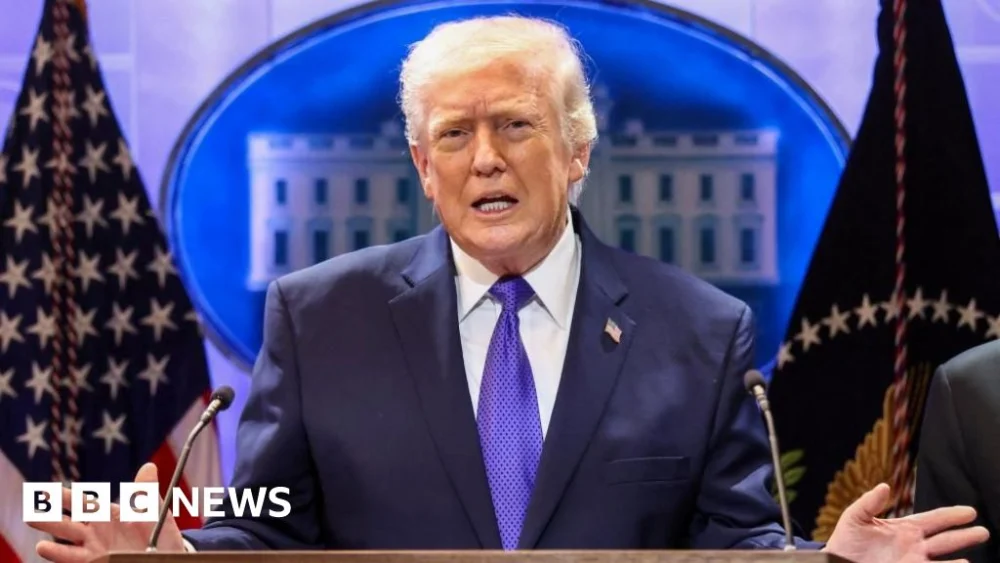
In a swift and defiant response to a landmark Supreme Court decision invalidating a broad spectrum of his administration’s global import taxes, President Donald Trump has unilaterally introduced a fresh 10% tariff on goods entering the United States. This unprecedented move, which leverages a previously dormant legal provision, casts a renewed shadow of uncertainty over international trade and signals the President’s unwavering commitment to his protectionist agenda despite a significant judicial setback.
The dramatic developments unfolded on Friday when the nation’s highest judicial body delivered a decisive 6-3 ruling, asserting that the President had exceeded his constitutional authority by imposing a wide array of global tariffs announced in the preceding year. This judicial rebuke represented a profound victory for numerous American businesses and state governments that had challenged the duties, raising the specter of potentially billions of dollars in tariff refunds and injecting considerable turbulence into global commerce. Speaking from the White House, President Trump vehemently denounced the ruling as "terrible," castigating the justices who sided against his trade policies as "fools" and "unpatriotic." He immediately announced his intention to pursue alternative legal avenues to continue pressing forward with his tariff strategy, which he maintains is crucial for fostering domestic investment and manufacturing.
The Supreme Court’s majority opinion effectively dismantled a significant portion of the administration’s trade policy, which had relied on a contentious interpretation of the 1977 International Emergency Economic Powers Act (IEEPA). This statute grants the President considerable power to regulate international commerce during times of national emergency. However, the Court, in a keenly watched decision, determined that IEEPA did not explicitly confer the authority to impose tariffs, a power historically and constitutionally vested in the legislative branch. Chief Justice John Roberts, writing for the majority, underscored this distinction, noting that "When Congress has delegated its tariff powers, it has done so in explicit terms and subject to strict limits." He further elaborated that any intention by Congress to grant such "distinct and extraordinary power to impose tariffs" would have been conveyed expressly, as demonstrated in other tariff statutes throughout American history. This judicial interpretation reinforced the principle of separation of powers, reaffirming Congress’s prerogative over taxation and trade policy.
The majority decision saw an unusual alignment of justices, with the Court’s three liberal members joining two of President Trump’s own appointees, Justices Amy Coney Barrett and Neil Gorsuch, in striking down the tariffs. This cross-ideological consensus highlighted the profound legal questions surrounding the scope of executive authority in trade matters. Conversely, three conservative justices—Clarence Thomas, Brett Kavanaugh, and Samuel Alito—registered their dissent, arguing for a broader interpretation of presidential powers under IEEPA. President Trump publicly expressed his "absolute shame" regarding the Republican appointees who voted against his policy, labeling them "lap dogs" and criticizing their perceived disloyalty to the Constitution, a rare public denouncement of his own judicial selections.
The invalidated tariffs had initially targeted key trading partners like Mexico, Canada, and China, before undergoing a dramatic expansion last April to encompass dozens of nations under the administration’s self-proclaimed "Liberation Day." These measures had provoked a significant outcry from both domestic and international businesses, which faced abrupt increases in import costs, and fueled widespread concerns about inflationary pressures on consumer goods. Legal arguments presented before the Supreme Court by the challenging states and small businesses emphasized that IEEPA contained no explicit mention of "tariffs," suggesting Congress never intended to cede its fundamental power to tax or grant the President an "open-ended power to junk" existing trade agreements and tariff regulations.
In the immediate aftermath of the Supreme Court’s ruling, financial markets responded positively, with the S&P 500 index closing higher, reflecting a cautious optimism among businesses regarding the potential relief from these duties. Manufacturers and importers, many of whom had been struggling under the weight of increased costs, expressed a sense of reprieve. Beth Benike, owner of Minnesota-based Busy Baby products, a company that manufactures in China, articulated this sentiment, describing it as "a thousand-pound weight has been lifted off my chest." Similarly, Nik Holm, chief executive of Terry Precision Cycling, a small business involved in the lawsuit, welcomed the decision as a "relief," anticipating the eventual refund of "improperly-collected duties."
However, the President’s immediate counter-measure has introduced a fresh layer of complexity, potentially making the anticipated refunds and relief from tariff costs elusive. Just hours after the Supreme Court’s ruling, President Trump invoked Section 122 of the Trade Act of 1974 to impose a new 10% global tariff. This particular provision, which has rarely, if ever, been utilized for such a broad application, grants the President authority to impose tariffs up to 15% for a period of 150 days, after which congressional approval is required for their continuation. This strategic pivot signals the administration’s determination to maintain leverage in trade negotiations and protect domestic industries, albeit through a different legal mechanism.
Analysts widely anticipate that the White House will explore and potentially deploy other existing trade tools, such as Section 232 of the Trade Expansion Act of 1962 and Section 301 of the Trade Act of 1974. Section 232 permits the imposition of import taxes based on national security risks, while Section 301 addresses unfair trade practices. The Trump administration has previously utilized these provisions for tariffs on steel, aluminum, and automobiles, which were unaffected by the recent Supreme Court ruling. The shift to Section 122 for a global tariff, however, presents a distinct challenge. A White House official confirmed that countries that had previously negotiated specific trade deals with the U.S., including the United Kingdom, India, and the European Union, will now face the new 10% global tariff under Section 122, superseding their previously agreed-upon rates. The administration expects these trading partners to continue honoring the concessions made under their original trade agreements, a position that is likely to be met with skepticism and potential diplomatic friction.
The rapid succession of legal and policy shifts has intensified the already volatile global trade environment. Geoffrey Gertz, a senior fellow at the Center for a New American Security, aptly summarized the situation, stating, "Things have only gotten more complicated and more messy today." Major trade partners, while acknowledging the Supreme Court’s decision, offered largely muted initial reactions. European Commission spokesman Olof Gill indicated that the ruling was being "analyzed carefully," underscoring the need for a comprehensive assessment of the implications. The global community now faces the task of understanding the ramifications of this new tariff regime and preparing for potential responses, including retaliatory measures or renewed diplomatic efforts to de-escalate trade tensions.
The question of tariff refunds remains a significant area of uncertainty. While hundreds of companies, ranging from retail giants like Costco to aluminum producers such as Alcoa and food importers like Bumble Bee, have filed lawsuits contesting the previous tariffs in anticipation of refunds, the Supreme Court’s majority decision did not directly address the refund process. This omission likely remands the complex issue of how such refunds might be administered to the Court of International Trade. Justice Brett Kavanaugh, in his dissenting opinion, presciently warned that the situation regarding refunds would be a "mess."
Economists and legal experts caution businesses against immediate exuberance. Diane Swonk, chief economist at KPMG US, warned that while the desire for relief is understandable, the cost of protracted litigation could make recouping funds particularly challenging for smaller firms. She advised, "Unfortunately, I’d say curb your enthusiasm." Steve Becker, head of the law firm Pillsbury, suggested that the most favorable outcome for businesses would be the establishment of a streamlined government procedure for refunds that does not necessitate individual lawsuits. While expressing confidence that companies would "get their money back eventually," he emphasized that "How long it will take really is up to the government." The legal and administrative hurdles involved in processing potentially billions of dollars in refunds are considerable, promising years of litigation and bureaucratic entanglement.
This latest chapter in the Trump administration’s trade policy underscores a persistent willingness to challenge established norms and legal interpretations in pursuit of its "America First" agenda. The clash between executive power and judicial oversight, coupled with the immediate implementation of a new tariff regime, ensures that trade policy will remain a central and contentious issue, with far-reaching implications for the American economy, global commerce, and the delicate balance of governmental authority. The coming months will reveal whether this new legal pathway for tariffs proves more resilient to challenge or simply opens another front in the ongoing trade disputes.


 Aura Kasih

 Ridwan Kamil