Lisa Mariana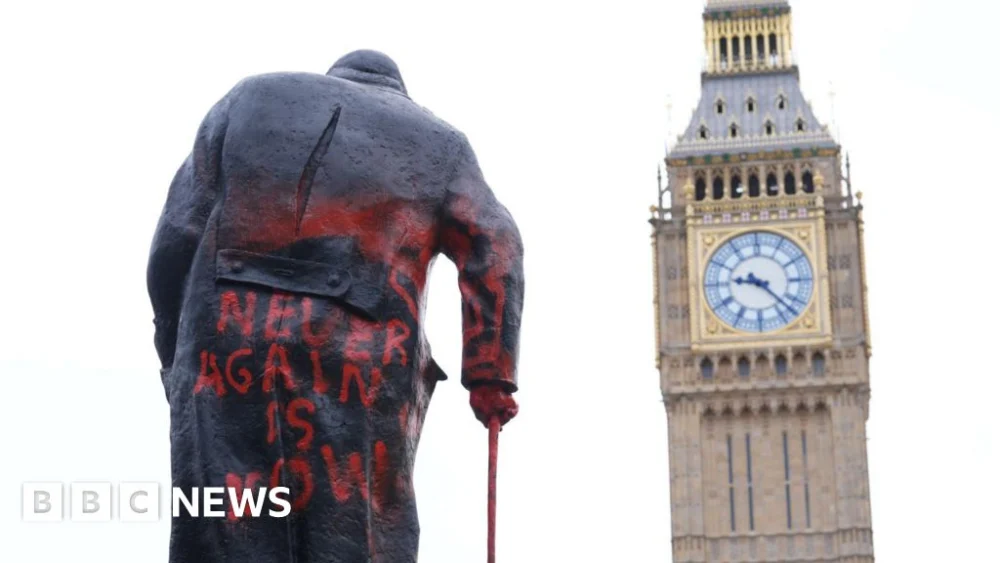
In a striking act of protest, the prominent bronze effigy of Sir Winston Churchill in London’s Parliament Square has been desecrated with a series of politically charged inscriptions, drawing immediate attention to ongoing geopolitical conflicts and igniting renewed debate surrounding historical legacy and public expression. The incident, discovered early Friday morning, saw the revered statue adorned with red spray paint bearing phrases such as "Zionist war criminal," "Stop the Genocide," "Free Palestine," "Never again is Now," and the highly controversial "Globalise the Intifada," prompting swift action from authorities and reigniting discussions about the nature of public dissent and the preservation of national monuments.
The defacement of the Churchill statue, situated at the heart of the United Kingdom’s political landscape, represents a potent symbol of contemporary global grievances intersecting with historical interpretations. Parliament Square, a globally recognised site of both democratic protest and solemn commemoration, serves as a backdrop for numerous statues honouring figures deemed instrumental to British and international history. The targeting of Churchill, a towering figure in 20th-century British politics celebrated for his wartime leadership but also subject to scrutiny for aspects of his imperialist and racial views, underscores the deeply polarised perspectives on historical memory in modern society.
Upon discovery, the site was immediately secured, with police cordoning off the area to facilitate an urgent cleanup operation. Specialist teams from Westminster City Council were dispatched to remove the indelible markings from the bronze and its stone plinth, an intricate process given the material and the public visibility of the monument. Such acts of vandalism incur significant costs for local authorities and divert resources from other public services, prompting calls for stricter enforcement and more robust protective measures for national heritage sites. The Metropolitan Police confirmed an investigation has been initiated into the incident, examining CCTV footage and other evidence to identify those responsible for the criminal damage.
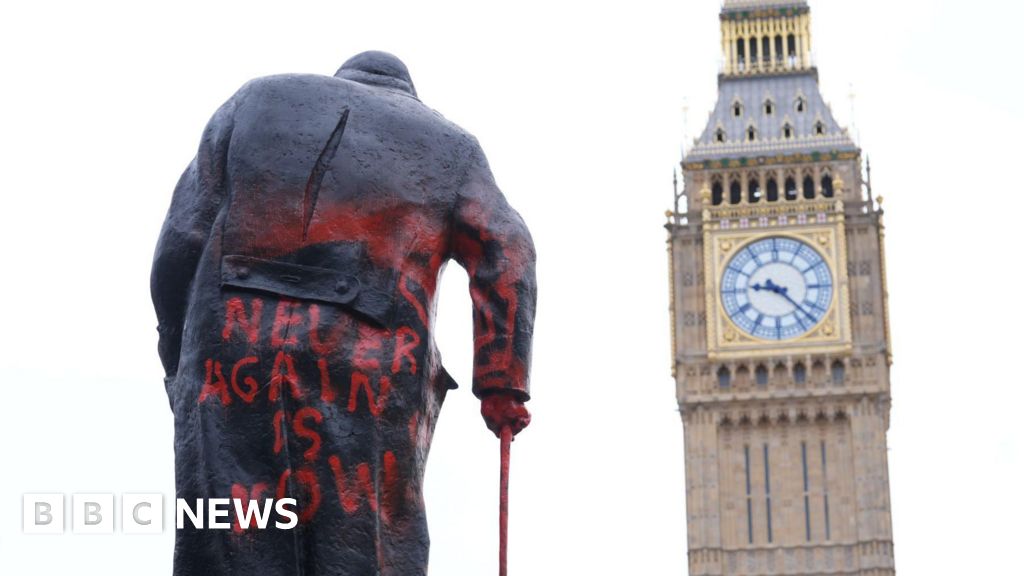
The inclusion of the phrase "Globalise the Intifada" among the graffiti has particular legal and security implications. In December, both the Metropolitan Police and Greater Manchester Police issued explicit directives indicating that individuals chanting this specific slogan during public demonstrations would be subject to arrest. This policy clarification followed a period of intense public concern regarding extremist rhetoric, notably in the wake of terror attacks in Bondi Beach, Australia, and at the Heaton Park synagogue in Manchester. Authorities interpret the phrase as potentially inciting violence or promoting terrorism, classifying it under existing anti-terrorism legislation and public order acts. The appearance of this exact phrase on a national monument therefore elevates the seriousness of the vandalism beyond mere property damage, placing it within a framework of potential public order offences and incitement.
Sir Winston Churchill’s statue, a 12-foot (3.6-meter) bronze creation by Ivor Roberts-Jones, was unveiled in 1973 by his widow, Lady Churchill. It depicts the former Prime Minister in a characteristic stance, gazing towards the Houses of Parliament, symbolising his enduring presence in British political consciousness. The monument is one of a distinguished collection of twelve statues in and around Parliament Square, including those of Abraham Lincoln and Nelson Mandela, each representing pivotal moments and figures in global democratic development and social justice. The choice to place Churchill in such a prominent location reflects a historical consensus regarding his monumental impact on the nation, particularly during World War II. However, this consensus has increasingly been challenged by contemporary movements that highlight the more controversial aspects of his legacy.
This is not the first instance of the Churchill statue becoming a canvas for protest. In June 2020, during the height of the global Black Lives Matter (BLM) movement, triggered by the death of George Floyd in the United States, the statue was defaced with graffiti accusing Churchill of being a "racist." This act sparked a nationwide debate on Britain’s colonial past, racial injustice, and the appropriateness of monuments celebrating figures with problematic historical records. The incident led to temporary boarding-up of the statue to protect it from further damage and became a focal point for discussions about re-evaluating historical narratives. Later that same year, in October, an activist associated with Extinction Rebellion was convicted and ordered to pay over £1,500 for painting "racist" on the statue’s plinth during a climate change protest, further underscoring the convergence of various social and political movements on this singular monument.
The recurring targeting of the Churchill statue signifies a deeper societal struggle over national identity, historical accountability, and the symbolism of public space. For many, Churchill remains an unwavering symbol of British resilience and defiance against fascism, a figure whose leadership ensured the nation’s survival during its darkest hour. For others, particularly those from communities impacted by colonial policies or experiencing contemporary forms of racism and injustice, his legacy is far more complex and troubling, marked by policies and attitudes that caused immense suffering. The graffiti "Zionist war criminal" and "Stop the Genocide" directly links this historical figure to current geopolitical conflicts, suggesting an attempt by the perpetrators to draw parallels between historical injustices and present-day events, thereby challenging established historical narratives and calling for a re-evaluation of past leaders through a contemporary ethical lens.
The phenomenon of statue vandalism is a global one, reflecting evolving cultural norms and a heightened awareness of historical injustices. Across continents, monuments to colonial figures, slave owners, or controversial political leaders have been defaced, toppled, or debated, as societies grapple with how to reconcile a complex past with modern values. This trend highlights the power of public monuments not merely as static historical markers but as dynamic sites of ongoing cultural and political contestation. The acts of vandalism, while criminal, often serve as disruptive, attention-grabbing forms of protest, forcing public discourse on issues that might otherwise remain marginalised.
From a security and urban management perspective, the repeated defacement of the Churchill statue and other monuments in Parliament Square presents a significant challenge. Enhanced surveillance, including high-definition CCTV cameras and increased police patrols, are standard responses. However, these measures often prove insufficient against determined individuals or groups. Longer-term solutions might involve public consultations on the future of contested monuments, the addition of contextualising plaques, or even the relocation of certain statues to museum settings where their histories can be more fully explored and debated without risking public disorder or damage. The financial burden of repeated clean-ups and potential repairs also necessitates a more sustainable approach to protecting these significant public assets.
The incident in Parliament Square serves as a stark reminder of the volatile intersection between historical memory, contemporary politics, and public expression. It underscores the ongoing tensions surrounding Britain’s imperial past, its role in current global affairs, and the persistent struggle for diverse communities to shape national narratives. As investigations continue and the debate over the statue’s significance intensifies, this act of vandalism will undoubtedly fuel further discussion on the boundaries of protest, the interpretation of history, and the responsibilities of a democratic society in managing its contested public spaces and symbols. The challenge for authorities and society at large remains how to facilitate legitimate expressions of dissent while protecting public property and upholding the rule of law, particularly when such acts are inextricably linked to deeply held political and ethical convictions.



 Aura Kasih
 Ayu Aulia