
 Lisa Mariana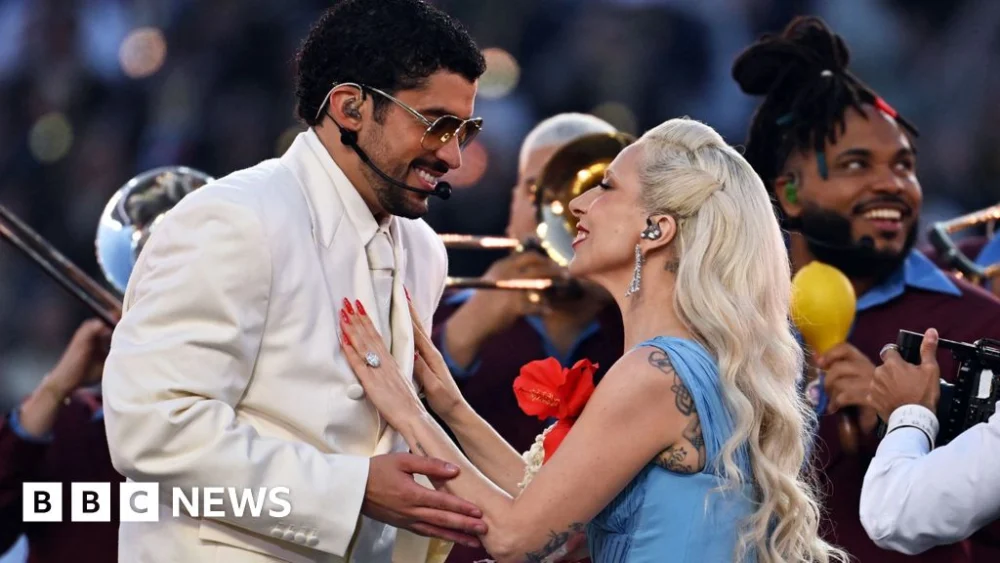
The recent Super Bowl halftime spectacular, headlined by global music phenomenon Bad Bunny, marked a pivotal moment for cultural representation and artistic expression on one of the world’s most-watched stages, concurrently igniting fervent political debate following sharp criticism from former President Donald Trump. The performance, a vibrant homage to Puerto Rican heritage and a broader call for pan-American unity, transcended mere entertainment, serving as a powerful cultural statement that resonated with millions while also becoming a flashpoint in the ongoing discourse surrounding national identity and cultural integration within the United States.
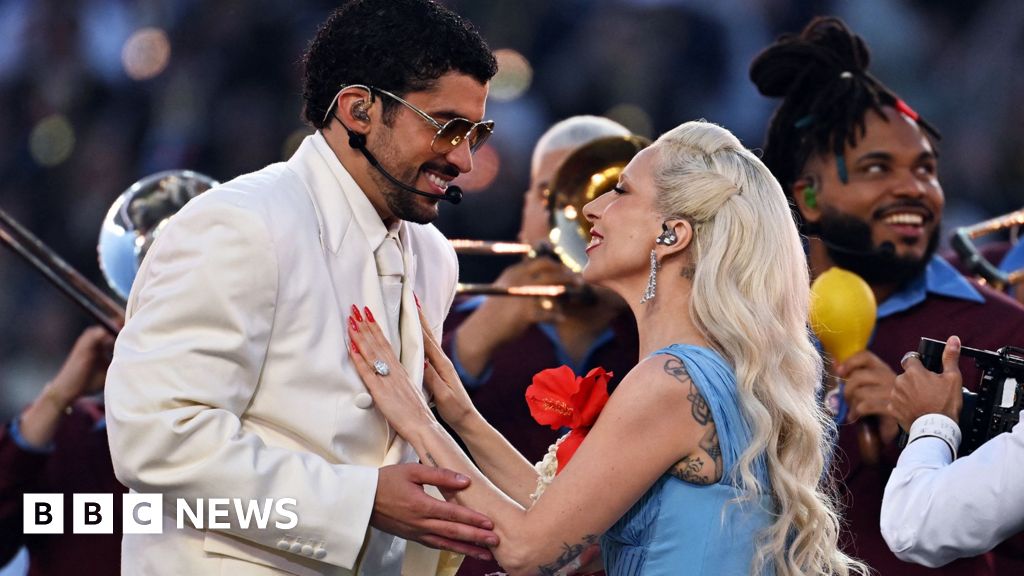
Benito Antonio Martínez Ocasio, known professionally as Bad Bunny, delivered a meticulously crafted 14-minute set at Levi’s Stadium in Santa Clara, California, that was a profound celebration of his native Puerto Rico. This performance was a landmark achievement, positioning a Latin artist and Spanish-language music at the forefront of an event historically dominated by English-language acts. As the world’s most-streamed artist in 2025, according to Spotify, Bad Bunny brought an unparalleled global reach and cultural significance to the Super Bowl stage, making his artistic choices all the more impactful.
The visual and thematic core of the show was an immersive journey into a vibrant Latin landscape, meticulously designed to transport audiences to the heart of Puerto Rico. From his initial emergence amidst a symbolic sugarcane field—a poignant nod to the island’s agricultural history and colonial past—to a stage transformed with elements mirroring traditional Puerto Rican life, every detail underscored a deep connection to his roots. Central to this elaborate set was his famous "casita," a brightly colored, traditional Puerto Rican home facade that has become a recurring motif in his performances. This architectural emblem served as a lively backdrop for a parade of celebrity cameos, including actors Pedro Pascal and Jessica Alba, and fellow music stars Cardi B and Karol G, who were seen enthusiastically dancing, symbolizing a collective embrace of Latin culture.
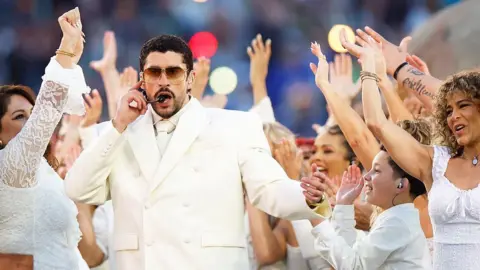
Bad Bunny’s decision to perform almost entirely in Spanish represented a significant cultural milestone for the Super Bowl, an event that consistently draws over 100 million viewers in the United States alone. In a nation where linguistic diversity is often debated, presenting such a high-profile performance predominantly in Spanish challenged conventional norms and asserted the prominence of the Spanish language and its speakers within the American cultural fabric. While the performance was a powerful affirmation of identity for Spanish-speaking audiences, it also prompted discussions about accessibility and the evolving demographics of the American viewership. His singular English line, "God bless America," delivered with conviction before listing various nations of Central, South, and North America as dancers unfurled their respective flags, was a strategic gesture. It was an explicit appeal for unity, asserting a broader, more inclusive definition of "America" that encompasses the entire hemisphere, a message further amplified by a billboard proclaiming "The only thing more powerful than hate is love" and a football bearing the slogan "Together, We Are America." These elements collectively articulated a vision of hemispheric solidarity and mutual respect.
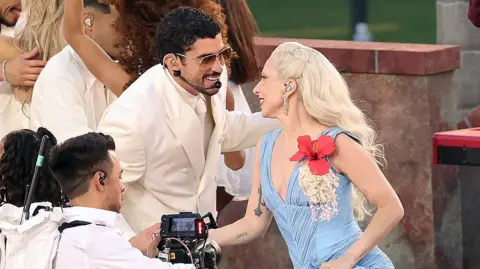
The performance also featured high-profile musical collaborations that added layers of artistry and cross-cultural appeal. Lady Gaga joined Bad Bunny for a Latin-infused rendition of her hit "Die With A Smile," showcasing a seamless blend of genres and a mutual appreciation between two global icons. Puerto Rican pop legend Ricky Martin also graced the stage, performing "Lo Que Le Pasó A Hawaii," a song that carries a powerful message about preserving Puerto Rican culture against external influences. These collaborations underscored the universal appeal of music and the potential for artistic exchange to bridge cultural divides, enhancing the show’s overall impact and reinforcing its message of unity.
However, the groundbreaking performance quickly became a subject of political contention. Former President Donald Trump, known for his vocal opinions on cultural matters and his "America First" political stance, swiftly condemned the show on his social media platform, Truth Social. He characterized Bad Bunny’s set as "absolutely terrible, one of the worst, EVER!" and declared it "an affront to the Greatness of America," adding that "nobody understands a word this guy is saying." Trump’s remarks immediately polarized public opinion, drawing strong reactions from both supporters and critics.
The former president’s criticism can be contextualized within a broader political strategy that often leverages cultural debates to rally his base. His comments tapped into sentiments of linguistic nationalism and a perceived threat to traditional American cultural hegemony, framing the Spanish-language performance as an alien intrusion rather than a celebration of diversity. The explicit mention of "nobody understands a word" underscored a rejection of multilingualism and multiculturalism, aligning with his past rhetoric on immigration and national identity. This reaction was not isolated; it was part of a discernible pattern of conservative pushback against cultural expressions that challenge a narrow definition of American identity. In a parallel development, an alternative "All-American Halftime Show" was organized by Turning Point USA, a conservative youth organization, and headlined by Trump-supporting musician Kid Rock, explicitly designed as a counter-narrative to the main Super Bowl event. This parallel event highlighted the deepening cultural schism within American society, where even entertainment becomes a battleground for ideological conflicts.
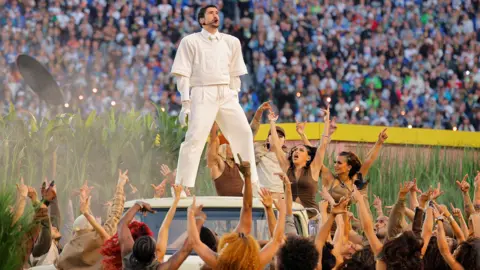
Beyond the immediate spectacle, Bad Bunny’s performance carried significant, albeit subtle, political undertones related to Puerto Rico’s complex relationship with the United States. His choice to wear a beige sweater emblazoned with the number "64" was a particularly poignant detail. This number symbolically refers to the revised official death toll of Hurricane Maria in 2017, a devastating storm that ravaged Puerto Rico. The Trump administration faced widespread criticism at the time for what many perceived as an inadequate and delayed federal response to the crisis, contrasting sharply with aid provided to mainland states affected by similar natural disasters. By incorporating this subtle numerical reference, Bad Bunny silently but powerfully highlighted the island’s enduring trauma and the political failures surrounding its recovery, demonstrating his continued commitment to advocacy for his homeland. Climbing an electricity pylon during his performance, reminiscent of the widespread power outages following the hurricane, further amplified this unspoken tribute to the victims and the resilience of the Puerto Rican people.
While the Super Bowl performance contained these potent symbolic critiques, it notably refrained from the explicit political statements Bad Bunny had made previously. At last week’s Grammy Awards, for instance, he had used his acceptance speeches to declare "ICE out," directly challenging the US Immigration and Customs Enforcement agency. This more direct stance on immigration issues was consistent with his previous decision to avoid touring the US mainland, citing concerns that his fans might be targeted by ICE officers. His statement to i-D magazine that "many reasons" prevented him from performing in the US mainland previously, and "none of them were out of hate," highlighted a deep-seated concern for his community. The shift to more symbolic, less overt political messaging for the Super Bowl stage can be interpreted as a strategic choice to maximize reach and impact, allowing the cultural message to resonate broadly before potentially alienating a segment of the audience with direct political confrontation. The choice to feature Puerto Rico as a self-governing territory of the USA, with its flag carried side-by-side with the US flag, was a sophisticated statement about shared identity and political nuance.
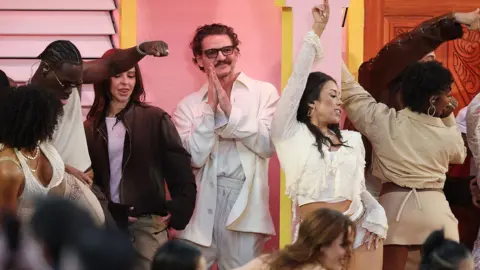
The Super Bowl halftime show served as a powerful testament to Bad Bunny’s artistic evolution and his unwavering commitment to his cultural identity. From early hits like "Tití Me Preguntó," "MONACO," and "BAILE INOLVIDABLE" to tracks from his Grammy Award-winning album Debí Tirar Más Fotos, the medley showcased his versatility and global appeal. The performance also integrated themes of family and community, symbolized by a young couple getting married amidst the dancers and a touching moment where Bad Bunny symbolically handed his Grammy to a child, with his 2026 acceptance speech playing in the background. These elements underscored his message that cultural pride and collective strength are foundational to his artistry.
Despite some initial sound issues, Bad Bunny commanded the stage with an undeniable swagger and vocal prowess, demonstrating the confidence of a seasoned headliner. This was not his first Super Bowl appearance, having made a guest appearance with Shakira in 2020, but this time, he was the main event, and he owned it. His performance journey, which has already taken him across Central and South America and is set to continue to Australia, Japan, and Europe, informed the globalized yet deeply personal aesthetic of the Super Bowl show. The recurring motif of the "casita," which has become a social media sensation for its celebrity guests, further cemented the performance’s blend of global stardom with intimate cultural representation.
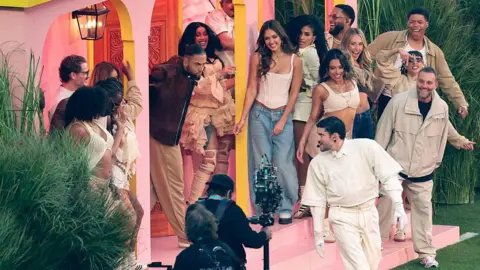
Ultimately, Bad Bunny’s Super Bowl halftime performance represents a watershed moment for Latin culture on one of the world’s most visible sporting stages. It not only showcased the immense talent and global influence of a Puerto Rican artist but also initiated a vital conversation about cultural representation, linguistic diversity, and the complex interplay between entertainment and politics in contemporary America. The juxtaposition of a culturally rich, unifying performance with swift political condemnation highlights the deeply polarized landscape of the United States. However, by steadfastly presenting an authentic vision of his heritage and advocating for a more inclusive "America," Bad Bunny has undoubtedly left an indelible mark, broadening the scope of who and what is celebrated on the biggest national platforms and setting a precedent for future generations of artists. The event cemented his status not just as a music superstar, but as a significant cultural and political voice, whose actions will continue to resonate far beyond the stadium lights.


 Ridwan Kamil
 Aura Kasih

 Ayu Aulia