Lisa Mariana
The recent decision by Church House, Westminster, the operational headquarters associated with the Church of England, to host a significant press conference for the Reform UK party, has precipitated a robust wave of condemnation from numerous Christian advocacy organisations, who assert a profound ideological incompatibility between the party’s immigration platform and fundamental tenets of Christian doctrine. This controversy highlights the intricate challenges faced by religious institutions in navigating their commercial operations alongside their moral and spiritual mandates, particularly when their premises become platforms for political discourse perceived as contrary to their core values.
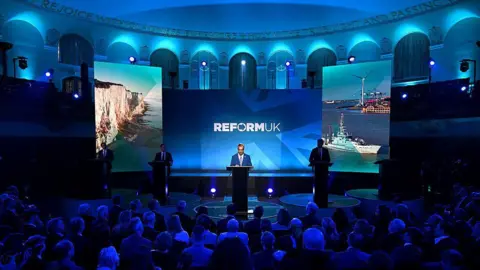
Last week, the Assembly Hall at Church House, a venue historically significant for hosting the Church of England’s national assembly, the General Synod, became the setting for Reform UK leader Nigel Farage to unveil his party’s refreshed leadership team. Among the key announcements was the appointment of Zia Yusuf as the party’s lead on home affairs, tasked with spearheading policies aimed at drastically reducing both legal and illegal immigration. Subsequently, the party detailed proposals for a "UK Deportation Command," a new governmental body envisioned for the large-scale expulsion of undocumented migrants. These pronouncements, delivered within the very chamber symbolic of Anglican governance, immediately ignited a firestorm of protest from groups dedicated to upholding what they perceive as the Church’s compassionate stance on migration.

The backlash was swift and unequivocal. Several prominent Christian organisations, including "Christians for a Welcoming Britain," "Better Story," and "Christians Against the Far Right," articulated their profound dismay and "outrage" at the perceived endorsement implied by the venue choice. These groups contend that permitting Reform UK to utilise such a symbolically charged location creates an impression of ecclesiastical sanction for policies they deem "hostile" and "divisive," thereby undermining the Church’s longstanding commitment to hospitality, social justice, and the welfare of the vulnerable.
Reverend Keith Brindle, an Anglican priest based in Frome and coordinator for "Christians Against the Far Right," penned a particularly scathing letter of complaint to Church House. In his correspondence, Rev. Brindle asserted that the venue had been "used as a moral backdrop for policies that contradict the very heart of the Christian faith." He further argued that Church House had inadvertently "provided a veneer of spiritual legitimacy to Reform’s anti-migrant and anti-Muslim politics, and their cynical scapegoating." His impassioned plea underscored a core theological argument: "As followers of Jesus, we must refuse to let the architecture of our faith be used to endorse the dehumanisation of our neighbours. The Church must be a sanctuary for the displaced, not a platform for their expulsion." This statement encapsulates the theological underpinning of the dissent, drawing upon biblical principles of welcoming the stranger and caring for the marginalised, which are central to many Christian social teachings.
The Church of England, as an institution, has a well-documented history of advocating for the rights of refugees and asylum seekers. Its official statements and resolutions from the General Synod frequently articulate a commitment to humane treatment, robust support systems, and a rejection of rhetoric that demonises migrant communities. For instance, resolutions have often called for safer routes for asylum seekers, an end to indefinite detention, and policies that reflect Christian compassion. The incongruity between these stated positions and the platform articulated by Reform UK at Church House forms the crux of the current dispute. Critics argue that even if Church House operates as a separate commercial entity, its close association with the Church of England makes it inseparable from the Church’s broader moral witness.

Church House, in its defence, maintains that it operates strictly on a commercial basis and is not an integral part of the Church of England’s ecclesiastical structure. A spokesperson clarified that the venue accepts "bookings from organisations that meet our ethical lettings policy, subject to availability." This policy explicitly states that bookings may be declined if "the hirer promotes views which are anathema to the teachings of the Church of England, as may be affirmed by its Synodical or Episcopal statement from time to time, such as groups which promote racial prejudice." The challenge for Church House lies in defining the precise boundary between legitimate political discourse, even if controversial, and the promotion of "racial prejudice" or "anathema" views. Reform UK’s policies, while strident on immigration, are framed by the party as legitimate national security and economic concerns, rather than overtly racially prejudiced. This distinction, however, is precisely where the Christian groups draw their line, arguing that the practical effect of such policies is discriminatory and dehumanising.
This is not the first instance where Church House has faced scrutiny over its choice of clients. In late 2020, the venue hosted two professional boxing matches sponsored by an online gambling firm, 32Red. That decision drew considerable criticism from campaigners concerned about gambling addiction, who argued that an institution associated with the Church should not be seen to facilitate or endorse an industry widely perceived as harmful. Similarly, the annual Land Warfare Conference, organised by the Royal United Services Institute (RUSI), a defence and security think tank, has also faced opposition from peace activists when held at Church House. These previous controversies underscore a recurring tension: how does a commercial venue with a foundational link to a major religious body balance its financial viability with its ethical obligations and the expectations of its broader faith community?
The argument put forth by Reform UK’s spokesperson dismissed the criticism as "little more than a cheap political stunt by a group that is completely out of touch with the British public." The party emphasised that immigration consistently ranks as a top concern for voters in national polls, framing the attempts to "shut down debate" on this topic as "both un-Christian and authoritarian." This counter-narrative suggests that the protesting groups are attempting to stifle legitimate political discourse and are out of step with mainstream public sentiment. It also highlights the inherent political calculation in choosing such a venue, potentially aiming to lend an air of establishment legitimacy to a party often characterised as populist.
The wider implications of this incident are significant. For Church House, it raises questions about the interpretation and consistent application of its ethical lettings policy. The perceived blurring of lines between its commercial operations and the moral authority of the Church of England could damage its reputation and strain its relationship with various Anglican and ecumenical bodies. For the Church of England itself, the controversy forces a re-evaluation of how its name and associated properties are used, and whether greater oversight is required to ensure alignment with its theological and ethical stances. The incident also shines a light on the increasing politicisation of faith in contemporary Britain, where religious institutions find themselves increasingly drawn into partisan debates, often against their will.
From an analytical perspective, the episode reveals the complex interplay between property ownership, commercial enterprise, political positioning, and religious identity. While Church House may technically be a separate commercial entity, its address, name, and historical function create an inescapable symbolic link to the Church of England. In a society where symbols carry considerable weight, the optics of a party advocating for stringent immigration policies holding a conference within the perceived heart of the Anglican establishment are potent. This situation underscores the ongoing challenge for religious organisations to define and maintain their public witness in a pluralistic and often secularised public sphere, particularly when their physical spaces become contested terrains for ideological battles. The event at Church House, therefore, is not merely a logistical matter but a profound commentary on the intersection of faith, politics, and public perception in the modern era. The debate over whether such gatherings align with or contradict fundamental Christian principles is likely to continue, prompting deeper introspection within the Church of England regarding its identity and its role in national discourse.



 Aura Kasih
 Ayu Aulia