Ayu Aulia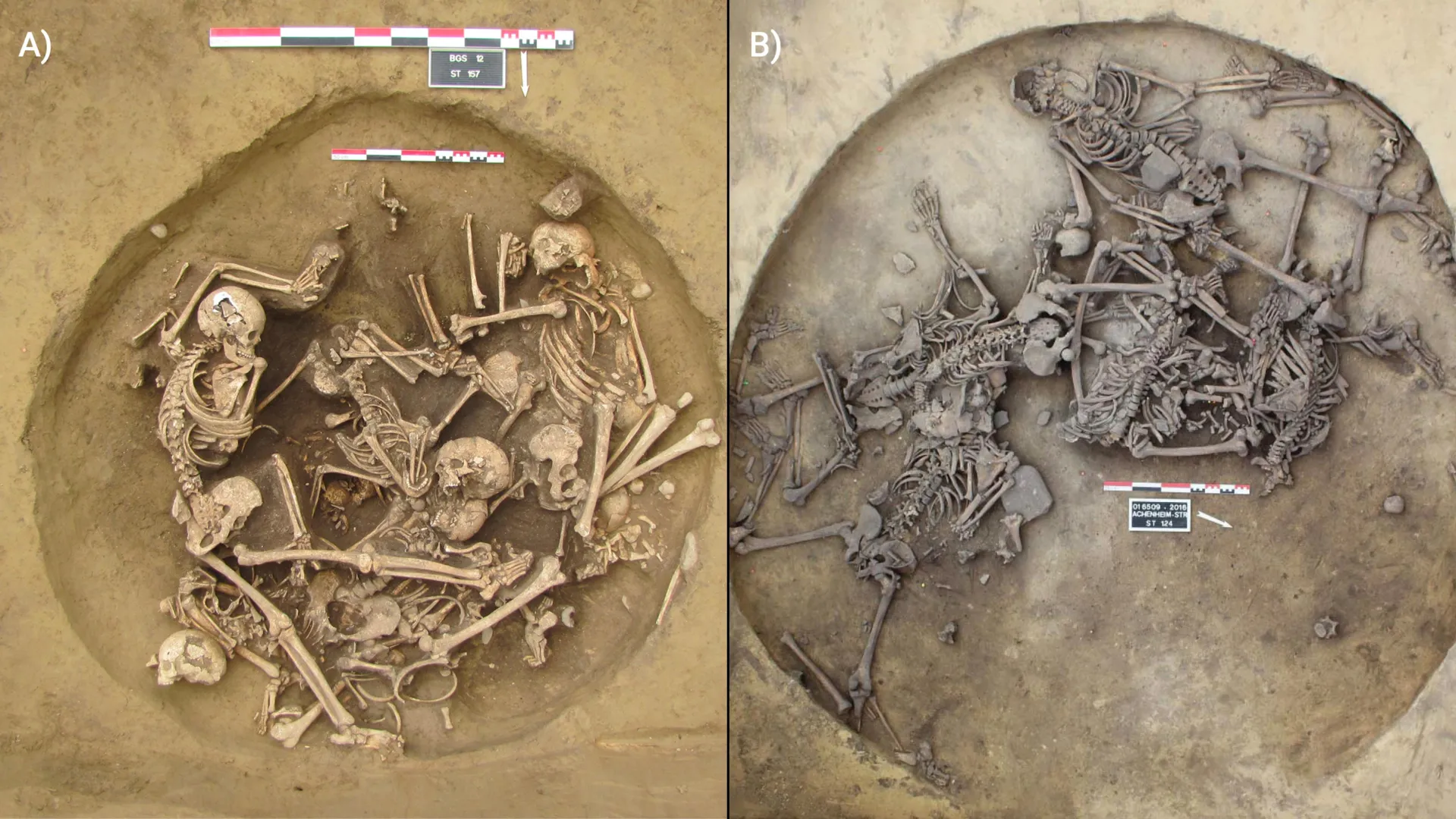
Revolutionary archaeological and biochemical investigations are fundamentally altering the scholarly understanding of early human conflict, revealing sophisticated ritualistic practices embedded within post-battle scenarios in prehistoric Europe. This meticulous research, focusing on individuals discovered in what may represent one of the continent’s earliest documented victory celebrations, challenges entrenched assumptions regarding the nature and purpose of violence in the Neolithic era.
The collaborative study, published in the esteemed journal Science Advances, bears the title ‘Multi-isotope biographies and identities of victims of martial victory celebrations in Neolithic Europe’. It was co-authored by Dr. Teresa Fernández-Crespo and Professor Rick Schulting, leading a multidisciplinary team that employed advanced multi-isotope analysis to reconstruct the life histories of individuals interred in mass graves located in Alsace, northeastern France. These human remains have been precisely dated to approximately 4300-4150 BCE, placing them firmly within the Middle Neolithic period.
Reconceptualizing Prehistoric Violence: Beyond Random Brutality
For decades, prevailing theories often depicted prehistoric violence as largely chaotic, driven primarily by immediate survival imperatives or spontaneous territorial disputes. The current findings present a compelling counter-narrative, suggesting that violence in these early agricultural societies was frequently deliberate, structured, and deeply entwined with complex social and symbolic objectives. It implies a level of premeditation and cultural integration far exceeding mere uncontrolled aggression.
Excavations at the Achenheim and Bergheim sites yielded profoundly unsettling yet informative archaeological patterns. Researchers unearthed complete human skeletons exhibiting unequivocal signs of extreme, repeated violence, often alongside distinct pits filled exclusively with severed left upper limbs. This particular confluence of excessive physical force and the selective removal of specific body parts does not align with established archaeological profiles of simple Neolithic massacres or hurried executions. Instead of unorganized, reactive brutality, the research team posits that these deaths constituted an integral part of formalized, organized rituals conducted in the aftermath of inter-group conflict. These post-victory rites were designed with dual objectives: to publicly humiliate and denigrate defeated adversaries, and simultaneously, to reinforce and solidify the collective identity and cohesion of the victorious group. This interpretation shifts the understanding of early conflict from mere physical annihilation to a potent form of social and political communication.
Unlocking Life Histories Through Ancient Chemistry
To gain deeper insights into the identities and origins of these individuals, scientists employed a comparative approach, analyzing isotopic markers present in the victims’ bones and dental enamel against those from individuals interred in typical, non-mass burial contexts within the same geographical region. These intricate chemical signatures, preserved within skeletal remains, function as invaluable biographic records, reflecting an individual’s long-term dietary habits, geographical movements, and periods of significant physiological stress throughout their lifetime. For instance, stable isotopes of carbon and nitrogen in bone collagen can indicate dietary reliance on terrestrial versus marine resources, or the consumption of plants versus animal protein. Oxygen isotopes in tooth enamel, formed during childhood, can reveal the geographical region where an individual spent their formative years, as its signature is influenced by local drinking water sources. Strontium isotopes, similarly, offer clues about geological origins and mobility.
The meticulous isotopic analysis yielded clear and significant distinctions. The individuals identified as victims displayed markedly different dietary patterns and presented discernible markers of greater mobility and heightened physiological strain compared to the local population buried in standard graves. This compelling evidence strongly suggests that the victims were not indigenous members of the local community but rather originated from external regions, likely brought to the sites as captives or prisoners of war.
A Dual-Layered Ritual of Dominance and Identity
Further stratification of the isotope data revealed another striking contrast within the mass grave assemblages. The severed left upper limbs, hypothesized to have been collected from warriors slain in the immediate combat phase, exhibited isotopic values consistent with the local population. Conversely, the individuals whose complete skeletons bore the severe marks of torture and ritualized execution appeared to originate from more distant geographical areas, their isotopic signatures diverging significantly from the local baseline.
This compelling isotopic dichotomy provides robust support for the hypothesis of a structured, two-tiered post-battle ritual. Local adversaries who perished during the actual fighting were subjected to dismemberment, with their limbs potentially returned to the victor’s settlement as symbolic trophies or potent mnemonic devices. In stark contrast, other individuals, likely captured from more remote territories, endured prolonged periods of captivity followed by violent, ritualized executions. Researchers interpret this complex sequence of events as a sophisticated form of Neolithic political theatre, meticulously orchestrated to transmit a powerful and unequivocal message to both internal audiences (reinforcing group solidarity and power) and external entities (deterring future aggression and asserting regional dominance).
Professor Schulting articulated the profound significance of these findings: "These discoveries illuminate a deeply embedded social practice – one that leveraged violence not merely as a tool of warfare, but as a deliberate spectacle, a means of inscribing memory, and a powerful assertion of societal dominance. It speaks to a level of symbolic complexity in early societies that we are only just beginning to fully appreciate."
Broader Implications: Rethinking the Architecture of Early Societies
By meticulously uncovering the multifaceted social and cultural functions of violence during the Neolithic period, this groundbreaking study injects a crucial new perspective into the tapestry of human history. It fundamentally challenges simplistic notions of prehistoric conflict, suggesting that war and ritual were not disparate phenomena but rather intrinsically interwoven, with acts of violence serving enduring symbolic and political purposes that profoundly shaped the nascent social structures of early agricultural societies. This research contributes significantly to the understanding of how early communities defined themselves against others, how power was consolidated, and how social order was maintained through both cooperation and coercion.
The transition from mobile hunter-gatherer lifestyles to settled agricultural communities during the Neolithic period brought about unprecedented changes in human social organization. Increased population densities, the establishment of permanent settlements, and the accumulation of surplus resources likely led to intensified competition over land, water, and labor. In this evolving landscape, the emergence of organized conflict was almost inevitable. However, this study demonstrates that such conflict was not merely a destructive force; it was also a constructive element in the formation of social identity and political hierarchy. The deliberate, ritualized nature of the violence observed at Achenheim and Bergheim suggests that early communities were already employing sophisticated strategies to manage inter-group relations and consolidate power, long before the advent of complex state-level societies.
The concept of "political theatre" in the Neolithic period is particularly illuminating. These victory rituals, with their clear differentiation between local and distant victims, and the distinct forms of violence applied to each, served as public demonstrations of power. For the victorious group, they would have fostered a sense of unity, shared identity, and collective strength, reinforcing social norms and deterring internal dissent. For external groups, the message would have been one of overwhelming power and the dire consequences of defiance, potentially influencing future diplomatic or military encounters. This sophisticated use of violence as a communicative act underscores the intellectual and organizational capacities of these early societies.
Furthermore, this research opens new avenues for understanding the evolution of human aggression and the psychological dimensions of warfare. The systematic nature of the violence, particularly the torture and dismemberment, points to an understanding of the human body not just as a physical entity but as a potent symbol. The desecration of enemy bodies, whether through dismemberment or prolonged torture, served to de-humanize the adversary and amplify the victor’s triumph, leaving an indelible mark on the collective memory of both perpetrator and witness.
The research received vital support from a Marie Skłodowska-Curie Actions individual grant, awarded to Dr. Fernández-Crespo under the European Union’s Horizon 2020 research and innovation program. This extensive project fostered collaboration among researchers from a diverse array of institutions, including the CNRS, Aix Marseille University, and Minist Culture, LAMPEA in Aix-en-Provence, France; the School of Archaeology at the University of Oxford, UK; the Department of Chemistry at Vrije Universiteit Brussel, Belgium; the Department of Archaeology and New Technologies at Arkikus, Spain; ANTEA-Archéologie, France; the University of Strasbourg, France; UMR 7044 Archimède, University of Strasbourg, France; and Inrap Grand Est, France. This interdisciplinary approach, drawing on expertise from archaeology, anthropology, chemistry, and other fields, was instrumental in generating such comprehensive and transformative insights into the complexities of prehistoric human behavior. Future research endeavors, potentially employing similar multi-isotope techniques across other Neolithic sites in Europe and beyond, are poised to further illuminate the intricate interplay between violence, ritual, and societal development in the distant past.



 Aura Kasih
 Lisa Mariana


 Ridwan Kamil