Ayu Aulia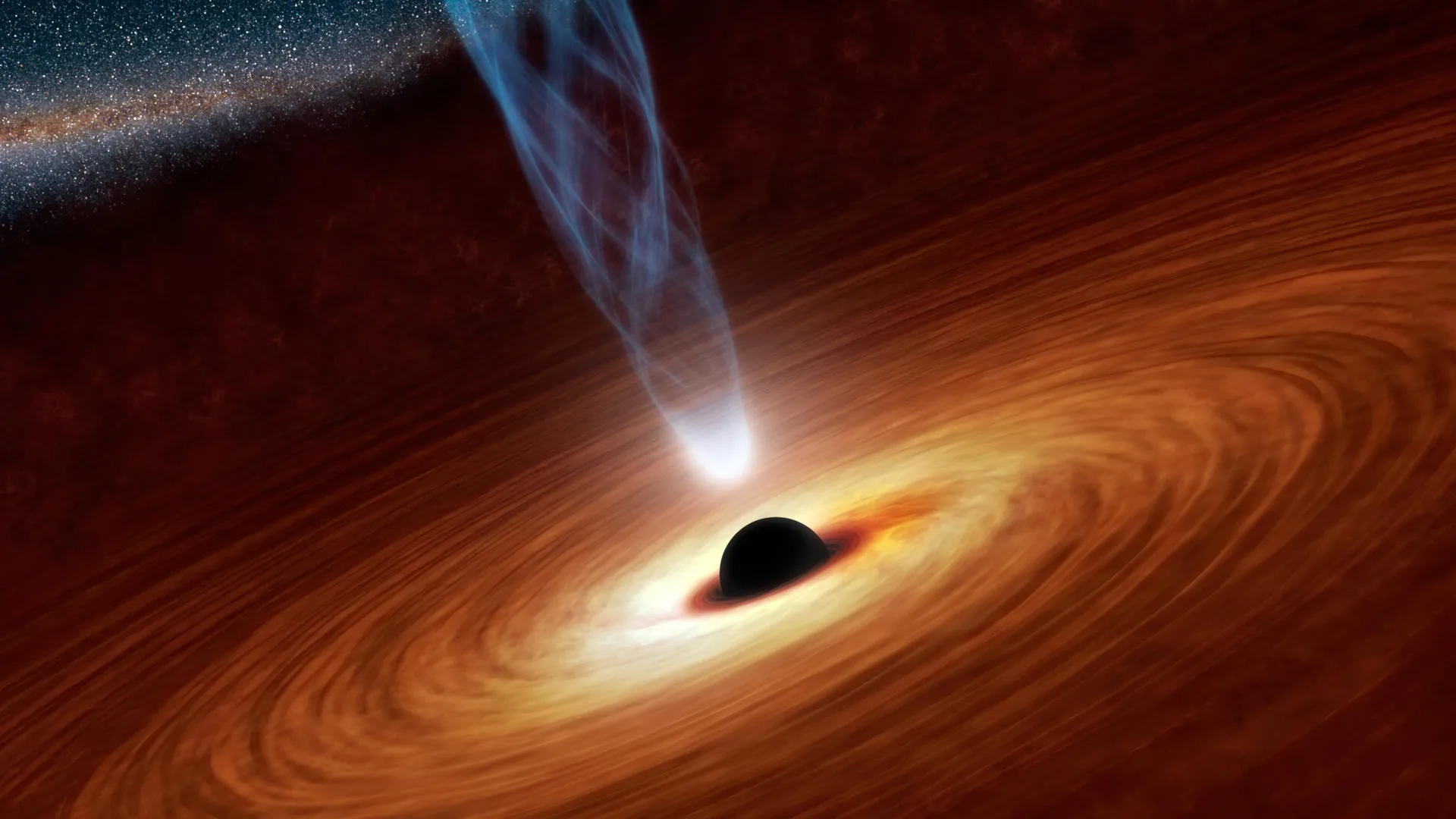
An international collaboration of astronomers has identified an extraordinary quasar in the nascent cosmos, harboring a supermassive black hole exhibiting growth rates previously considered incompatible with its observed multi-wavelength emissions. This unique object, discovered through meticulous observations with the Subaru Telescope, presents a paradoxical combination of extreme accretion, powerful X-ray output, and a robust radio jet, challenging established theoretical frameworks that predict these phenomena should not occur simultaneously, thereby offering a crucial new window into the enigmatic rapid formation of colossal black holes in the Universe’s infancy.
At the heart of nearly every galaxy lies a supermassive black hole (SMBH), a gravitational titan whose mass can range from millions to billions of times that of our Sun. These cosmic behemoths grow primarily by drawing in vast quantities of surrounding gas and dust. As this material spirals inward, it forms a luminous accretion disk, a swirling maelstrom where intense friction and gravitational forces heat the plasma to extreme temperatures. Above this disk, a compact region of superheated plasma, known as the corona, frequently emerges, serving as a powerful source of high-energy X-rays. In a subset of these systems, the accretion process also fuels the launch of narrow, relativistic jets of particles that radiate intensely at radio wavelengths, extending far beyond the host galaxy. When a supermassive black hole is actively feeding and emitting prodigious amounts of energy, it is classified as a quasar—one of the most luminous objects in the Universe. A fundamental enigma in astrophysics concerns how some of these gargantuan black holes managed to attain such immense masses so early in cosmic history, merely a billion years or so after the Big Bang, when the Universe itself was still in its formative stages.
Pushing the Boundaries of Cosmic Growth: The Eddington Limit Revisited
One prevailing hypothesis to explain this rapid early growth invokes a mechanism known as super-Eddington accretion. Under typical astrophysical conditions, the outward pressure exerted by radiation emitted from the infalling material acts as a natural brake, limiting the rate at which a black hole can accrete matter. This theoretical maximum accretion rate is termed the Eddington limit. When a black hole accretes at or below this limit, the radiation pressure and gravitational pull are in a delicate balance. However, certain extreme environments, characterized by an overwhelming supply of gas, may permit black holes to momentarily exceed this limit. In such scenarios, the influx of matter is so rapid that the radiation cannot escape efficiently, leading to a temporary breakdown of the Eddington barrier and enabling significantly accelerated mass accumulation. Theoretical models for super-Eddington accretion often involve geometrically thick, radiation-pressure-supported "slim disks" where photon trapping can occur, further enhancing the inflow rate.
To probe whether such extreme growth occurred in the primordial Universe, the research team utilized the sophisticated capabilities of the Subaru Telescope’s Multi-Object Infrared Camera and Spectrograph (MOIRCS). The instrument’s near-infrared spectrograph allowed them to observe light from distant objects, whose emission has been stretched to longer, redder wavelengths by the expansion of the Universe. By meticulously tracking the kinematics of gas in the vicinity of the quasar and analyzing the spectral properties of the Mg II (magnesium ion) emission line at 2800 Å, which is a reliable tracer of gas velocity and density, the astronomers were able to derive a robust estimate of the central black hole’s mass. The observations revealed a supermassive black hole that existed approximately 12 billion years ago (corresponding to a redshift of z=3.4), actively accreting matter at an astonishing rate, estimated to be roughly 13 times the theoretical Eddington limit, a figure corroborated by independent X-ray measurements of the system.
A Quasar Defying Conventional Astrophysical Wisdom
What renders this particular object profoundly significant is its anomalous behavior across the electromagnetic spectrum. Many established theoretical models of black hole accretion predict a distinct set of characteristics during super-Eddington growth. Specifically, these models often suggest that the inner structure of the accretion flow, becoming geometrically thicker and more turbulent, should lead to a weakening of X-ray emission, potentially by burying or disrupting the X-ray-emitting corona. Furthermore, powerful relativistic jets, which are responsible for the radio-loud classification, are typically thought to be suppressed or fundamentally altered under super-Eddington conditions, as the magnetic field geometries crucial for jet launching might be destabilized.
In stark contrast to these predictions, the newly identified quasar exhibits intense X-ray luminosity simultaneously with being strongly radio-loud. This unprecedented combination implies that the black hole is undergoing extreme, super-Eddington accretion while concurrently maintaining a highly active X-ray corona and launching a powerful, energetic radio jet. This observation challenges the fundamental assumptions embedded within current astrophysical models of accretion physics and jet formation, suggesting the presence of physical processes or accretion states that are not yet fully understood or accounted for in our theoretical frameworks. The robust X-ray emission points to a vigorous corona capable of energizing particles to extreme temperatures, while the powerful radio jet signifies efficient extraction and collimation of energy from the black hole system, both seemingly at odds with the expected conditions of runaway accretion.
The Hypothesis of a Transient Transitional Phase
To reconcile these seemingly contradictory observations, the research team has put forth an intriguing hypothesis: the quasar may be caught in a brief, transitional phase of its evolution. This scenario posits that a sudden, massive influx of gas—perhaps triggered by a galaxy merger, a tidal disruption event, or the rapid infall of gas from the surrounding cosmic web—has propelled the black hole into a super-Eddington accretion state. According to this interpretation, for a limited cosmic window, both the X-ray-emitting corona and the powerful radio jet remain highly energized, possibly due to a delayed response to the altered accretion flow, or perhaps due to the rapid replenishment of magnetic fields or energy reservoirs. Following this intense, short-lived burst, the system would then gradually transition and settle into a more "typical" mode of growth, possibly returning to or approaching the Eddington limit, with corresponding changes in its X-ray and radio emission properties.
If this interpretation holds true, this object represents an exceedingly rare opportunity—a cosmic "snapshot" captured during a critical, dynamic period of black hole evolution in the early Universe. Such transitional phases are predicted to be fleeting on astronomical timescales, making their direct observation exceptionally challenging. Studying this quasar thus offers an unparalleled chance to directly observe the intricate interplay between accretion rate, corona formation, and jet launching as it dynamically evolves. This could provide crucial empirical constraints for theoretical models seeking to explain how supermassive black holes could have assembled their colossal masses so swiftly in the Universe’s formative epoch, a period characterized by abundant gas and frequent galactic interactions.
Profound Implications for Galaxy Evolution and Feedback Mechanisms
The presence of a strong radio signal in this quasar carries significant implications for our understanding of galaxy evolution. Such powerful jets are not merely passive byproducts of black hole activity; they are potent agents of "feedback," capable of injecting enormous amounts of energy into their surrounding environments. These jets can heat or even expel vast quantities of gas within the host galaxy, a process that can dramatically influence the rate of star formation. By heating the cold gas reservoirs necessary for star birth, these jets can effectively quench star formation, stifling the growth of the galaxy. Conversely, in some models, the shockwaves produced by jets can compress gas, potentially triggering bursts of star formation. The intricate relationship between super-Eddington growth, which is driven by massive gas supply, and the energetic output of jet-driven feedback is a complex and still poorly understood aspect of the co-evolutionary paradigm between supermassive black holes and their host galaxies.
This anomalous quasar provides an invaluable empirical reference point for refining and testing new theoretical models of black hole-galaxy co-evolution. If powerful jets can indeed coexist with rapid, super-Eddington accretion, it suggests that the timing and efficiency of feedback mechanisms might be different from what current models predict. This could necessitate a significant re-evaluation of how galaxies acquired their observed properties and how the growth of their central black holes influenced their cosmic destinies. The energy budget and the pathways of energy transfer from the black hole to the galaxy environment during these extreme accretion phases are now subject to renewed scrutiny.
The discovery fundamentally alters our understanding of the early Universe’s most extreme objects. The research team is now focused on follow-up observations across multiple wavelengths and sophisticated simulations to unravel the precise mechanisms powering the unusually robust X-ray and radio emissions. Furthermore, they intend to scrutinize existing astronomical survey data to ascertain whether similar, enigmatic objects have been overlooked, potentially hiding in plain sight. This work promises to ignite new theoretical investigations into the fundamental physics of accretion disks, magnetic field dynamics, and jet formation under the most extreme conditions imaginable, propelling astrophysics closer to a comprehensive understanding of the cosmic engines that shaped the Universe we observe today. The existence of this single object acts as a powerful catalyst for a paradigm shift, urging the scientific community to reconsider the presumed limitations of black hole growth and the intricate dance between these cosmic leviathans and their evolving galactic homes.



 Lisa Mariana

 Aura Kasih