Ayu Aulia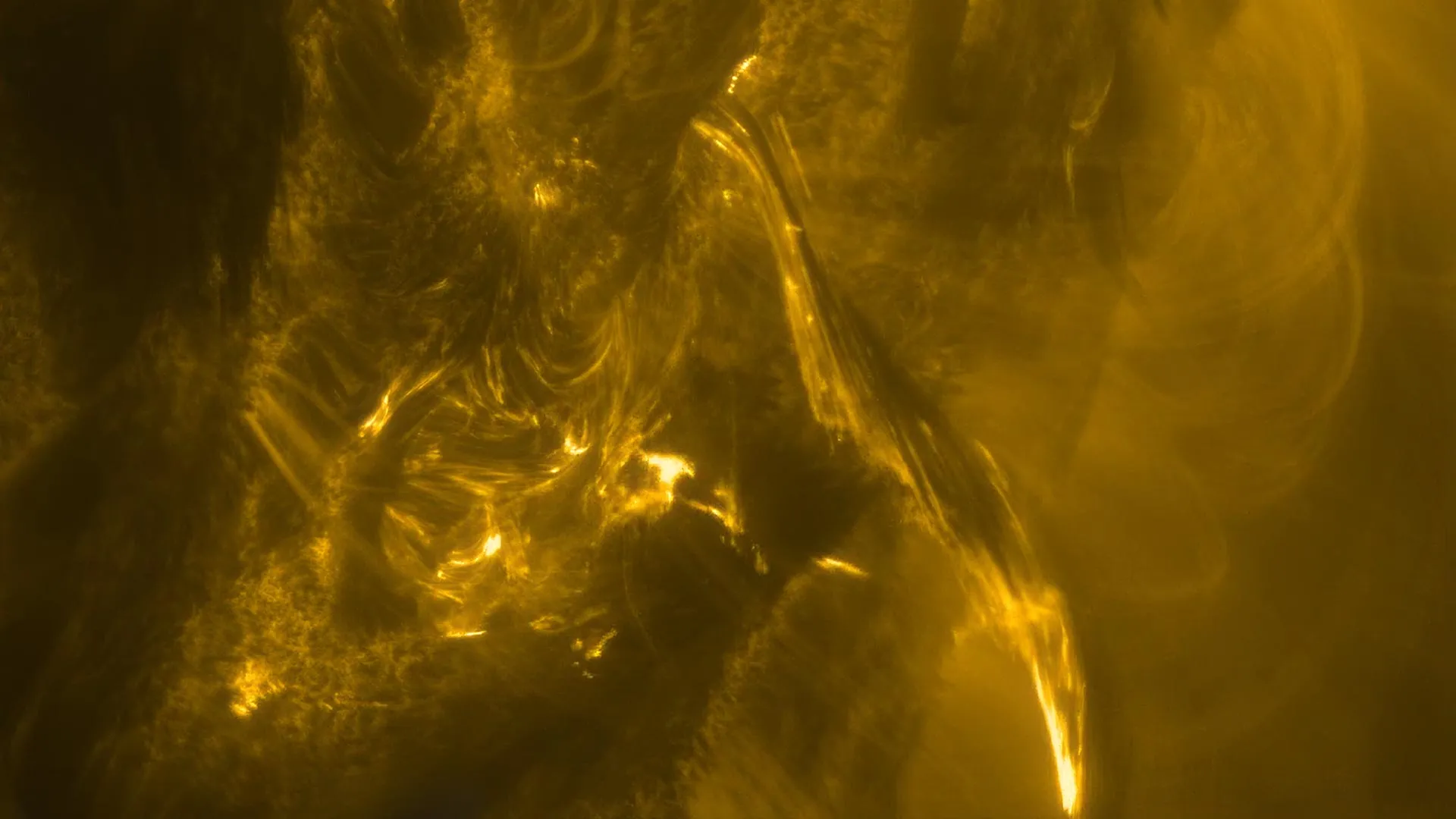
New observations from the European Space Agency’s (ESA) Solar Orbiter spacecraft have provided unprecedented insight into the initiation of solar flares, revealing that these colossal explosions commence not as singular events, but through a sequence of subtle magnetic disturbances that rapidly escalate into a powerful cascade of energy, culminating in dramatic plasma ejections and a prolonged atmospheric "rain" of superheated material. This groundbreaking discovery offers a refined understanding of the complex processes governing the Sun’s most violent phenomena, with significant implications for predicting space weather.
For decades, the precise mechanisms by which the Sun unleashes immense quantities of energy in solar flares—among the most potent explosions in our solar system—have remained a profound enigma. These events originate from the sudden release of energy stored within highly twisted and strained magnetic fields in the Sun’s atmosphere, a process known as magnetic reconnection. During this fundamental astrophysical process, magnetic field lines, often pointing in opposing directions, break apart and subsequently reform into new configurations, releasing vast amounts of energy that heat plasma to millions of degrees and accelerate particles to extreme velocities. The strongest of these flares can propagate effects across the solar system, potentially triggering geomagnetic storms on Earth that disrupt critical infrastructure, including radio communications, satellite operations, and even power grids. Consequently, a comprehensive understanding of flare genesis and evolution is paramount for enhancing space weather forecasting capabilities.
A pivotal breakthrough in this long-standing scientific quest has been achieved through a rare confluence of data captured by four sophisticated instruments aboard the Solar Orbiter. This integrated observational campaign provided the most detailed multi-layered perspective ever recorded of a major solar flare’s earliest moments. The event, observed during the spacecraft’s close approach to the Sun on September 30, 2024, is meticulously detailed in a study published on January 21 in the esteemed journal Astronomy & Astrophysics.
The collaborative efforts of the Solar Orbiter’s instruments allowed scientists to meticulously track the buildup to the flare over approximately 40 minutes—an observational feat rarely accomplished due to inherent limitations in spacecraft observing windows and onboard data storage capacities. Dr. Pradeep Chitta, a lead author of the study from the Max Planck Institute for Solar System Research in Göttingen, Germany, underscored the fortuitous nature of these observations: "We were exceptionally fortunate to witness the precursor events of this substantial flare with such remarkable fidelity. High-cadence observations of this detail are not routinely feasible, given the constraints of observational windows and the significant memory requirements these data impose on the spacecraft’s computer. We were indeed in the optimal position at the critical moment to capture the intricate details of this flare."
The journey into the heart of the flare began with the Extreme Ultraviolet Imager (EUI), which commenced its observations of the active region at 23:06 Universal Time (UT), roughly 40 minutes prior to the flare’s peak intensity. EUI delivered extraordinarily high-resolution images of the Sun’s outer atmosphere, the corona, discerning features merely hundreds of kilometers in scale and recording changes every two seconds. Simultaneously, the Spectral Imaging of the Coronal Environment (SPICE), the Spectrometer/Telescope for Imaging X-rays (STIX), and the Polarimetric and Helioseismic Imager (PHI) provided complementary data, scrutinizing different atmospheric layers, from the scorching corona down to the visible surface, the photosphere. This synergistic approach offered an unprecedented, holistic view of the dynamic processes unfolding across the Sun’s complex structure.
As EUI began its surveillance, it revealed a prominent, dark, arch-shaped filament composed of intertwined magnetic fields and plasma. This structure was intimately connected to a distinctive cross-shaped pattern of magnetic field lines that progressively intensified in brightness. Subsequent close-up analyses unveiled a continuous genesis of new magnetic strands, appearing in nearly every image frame, often within intervals of two seconds or less. Each newly formed strand remained magnetically confined, gradually coiling and twisting, reminiscent of tightly wound ropes.
The accumulation and intensification of these twisting magnetic strands led to a progressive destabilization of the region. Analogous to an avalanche gathering momentum, the intricate magnetic structures commenced a rapid sequence of breaking and reconnecting. This initiated a spreading chain of disruptions, each progressively more energetic than its predecessor, manifesting as sudden, localized bursts of luminosity.
At 23:29 UT, a particularly intense brightening event signaled a critical phase in the flare’s development. Shortly thereafter, the dark filament, previously anchored, detached from one side and violently propelled outwards, unrolling dramatically as it ascended. Concurrently, vivid flashes of reconnection became discernible along its length with extraordinary clarity, culminating in the main flare eruption around 23:47 UT. Dr. Chitta elaborated on the significance of these pre-flare moments: "The minutes leading up to the flare are profoundly important, and Solar Orbiter granted us a direct view into the flare’s base where this avalanche process originated. We were astonished by how the large flare was driven by a series of smaller, yet rapidly spreading, reconnection events across both space and time."
For a considerable period, solar physicists have theorized that an "avalanche" model could account for the collective behavior observed in countless small flares on the Sun and other stars. However, it remained an open question whether this same principle applied to the initiation of a single, large-scale flare. These new findings decisively demonstrate that a major flare does not necessarily manifest as a solitary, monolithic explosion. Instead, it can emerge from a multitude of smaller, interactive reconnection events that synergistically build upon one another, culminating in a powerful, cascading eruption.
Beyond the initiation phase, the research team, leveraging the combined measurements from the SPICE and STIX instruments, meticulously investigated how this rapid sequence of reconnection events deposited energy into the uppermost layers of the Sun’s atmosphere with unparalleled spatial and temporal resolution. High-energy X-rays, crucial indicators of where accelerated particles release their energy, played a central role in this analysis. Understanding the behavior of these energized particles is vital for predicting space weather, as they can escape into interplanetary space, posing substantial risks to orbiting satellites, human spaceflight missions, and terrestrial technologies.
During the September 30 flare, both ultraviolet and X-ray emissions exhibited a gradual increase as SPICE and STIX commenced their observations. As the flare intensified, the X-ray output surged dramatically, accelerating particles to astonishing velocities—ranging from 40 to 50 percent of the speed of light, equivalent to approximately 431 to 540 million kilometers per hour. The data also provided direct evidence of energy transfer from the magnetic fields into the surrounding plasma during the reconnection process.
"We observed ribbon-like features moving incredibly swiftly down through the Sun’s atmosphere, even before the primary phase of the flare," Dr. Chitta noted. "These streams of ‘raining plasma blobs’ are clear signatures of energy deposition, which progressively strengthen as the flare evolves. Even after the main flare subsides, this plasma rain continues for a period. It marks the first time we have witnessed this phenomenon with such a high level of spatial and temporal detail within the solar corona."
Following the most intense phase of the flare, EUI images captured the original cross-shaped magnetic structure gradually returning to a more relaxed state. Concurrently, STIX and SPICE recorded a corresponding cooling of the plasma and a decline in particle emissions towards pre-flare levels. PHI, observing the flare’s impact on the Sun’s visible surface, completed this comprehensive, three-dimensional reconstruction of the entire event, offering an unparalleled insight into the interplay between different solar atmospheric layers during a flare.
"We did not anticipate that the avalanche process could lead to the acceleration of such high-energy particles," Dr. Chitta remarked. "There remains a significant amount to explore within this process, though achieving a deeper understanding would necessitate even higher-resolution X-ray imagery from future missions to truly deconstruct these intricate events."
This remarkable discovery represents one of the most significant achievements of the Solar Orbiter mission to date. Dr. Miho Janvier, ESA’s Solar Orbiter co-Project Scientist, affirmed its importance: "Solar Orbiter’s observations lay bare the central engine of a flare and underscore the critical role played by an avalanche-like mechanism of magnetic energy release. An intriguing prospect is whether this fundamental mechanism is universal, occurring in all flares, both on our Sun and on other flaring stars across the cosmos."
Dr. David Pontin of the University of Newcastle, Australia, a co-author of the paper, added: "These compelling observations, captured with incredible detail and in near real-time, allowed us to discern how a sequence of smaller events cascaded into monumental bursts of energy. By correlating the EUI observations with magnetic-field data, we were able to disentangle the precise chain of events that culminated in the flare. What we observed challenges certain existing theories for flare energy release and, in conjunction with further observations, will enable us to refine these theories, thereby significantly enhancing our understanding of these powerful solar phenomena."
The Solar Orbiter mission is a collaborative endeavor between ESA and NASA, with operations managed by ESA. Its suite of advanced instruments includes the Extreme Ultraviolet Imager (EUI), led by the Royal Observatory of Belgium (ROB); the Polarimetric and Helioseismic Imager (PHI), spearheaded by the Max Planck Institute for Solar System Research (MPS), Germany; the Spectral Imaging of the Coronal Environment (SPICE), a European-led instrument managed by the Institut d’Astrophysique Spatiale (IAS) in Paris, France; and the STIX X-ray Spectrometer and Telescope, led by FHNW, Windisch, Switzerland. These instruments collectively provide a powerful platform for revolutionizing our comprehension of the Sun and its profound influence on the heliosphere.




 Lisa Mariana

 Aura Kasih