
 Ayu Aulia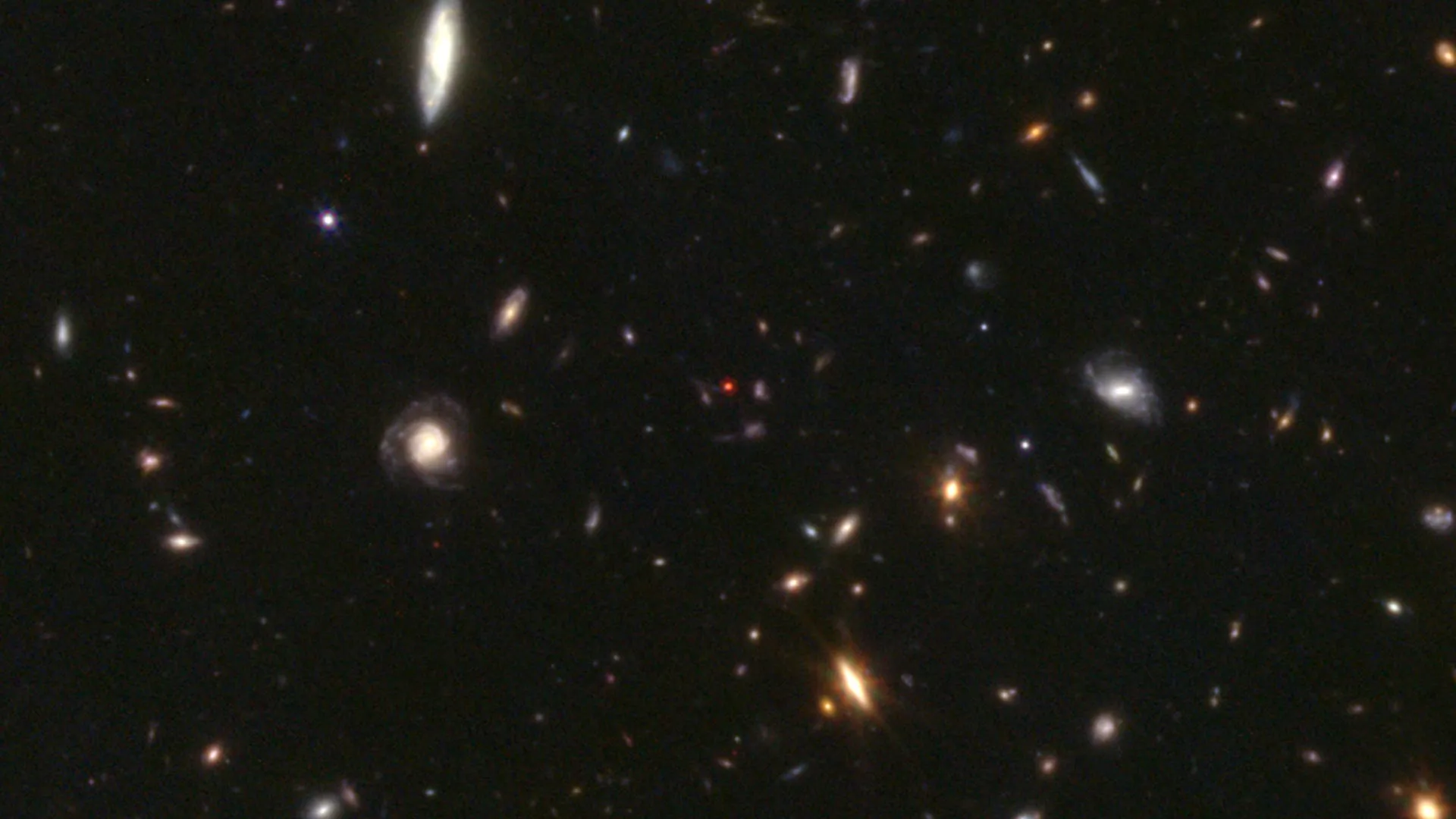
The James Webb Space Telescope (JWST), since commencing its scientific observations, has presented astronomers with a fascinating puzzle: peculiar crimson specks embedded within its high-resolution imagery of the primordial cosmos. Researchers affiliated with the University of Copenhagen have now definitively characterized these previously unidentified celestial phenomena, disclosing a previously hidden epoch of intense astrophysical activity driven by rapidly accreting black holes nestled within dense envelopes of ionized gas. Their seminal findings were formally documented in the prestigious scientific journal Nature on January 14.
Upon the release of the James Webb Space Telescope’s inaugural deep-field observations in December 2021, captured from its orbital vantage point approximately 1.5 million kilometers from Earth, the astronomical community swiftly identified an unexpected and pervasive feature. Dispersed across the vast cosmic tapestry alongside nascent galaxies and stellar nurseries were numerous minute, intensely red points of light. These anomalous emissions defied existing theoretical frameworks and computational models designed to predict the composition and evolution of the early universe, presenting a significant interpretational challenge.
Deciphering a Primeval Cosmic Conundrum
These enigmatic entities, provisionally dubbed "little red dots" by the scientific community, are observed to proliferate during a pivotal era when the universe was merely a few hundred million years old. Intriguingly, their distinctive spectral signature appears to diminish or vanish from detectability roughly a billion years later, suggesting a transient yet profoundly impactful phase in cosmic history. Their ephemeral presence ignited a fundamental inquiry: what astrophysical mechanisms were responsible for these luminous, crimson sources?
Initial hypotheses posited that these red dots might represent exceptionally massive galaxies, possessing sufficient intrinsic brightness to be detectable across a vast cosmic expanse spanning some 13 billion years of universal evolution. However, this explanation encountered substantial theoretical difficulties. The prevailing understanding of galaxy formation dictates a protracted evolutionary timeline, requiring significant periods for the gravitational accumulation of gas and dust into large-scale stellar systems. The emergence of such colossal galaxies so soon after the Big Bang, therefore, presented a fundamental inconsistency with established cosmological paradigms.
Black Holes: The Engine Within Gaseous Incubators
Following an intensive two-year period of rigorous data analysis leveraging the unparalleled capabilities of the Webb telescope, researchers at the Niels Bohr Institute’s Cosmic Dawn Centre arrived at a profoundly different and compelling conclusion. The observed red dots are not massive galaxies, but rather the energetic manifestations of super-accreting black holes, the most gravitationally extreme objects known to exist within the cosmos. These unprecedented observations provide a rare and invaluable glimpse into the formative stages and initial rapid growth of the universe’s earliest black holes.
Professor Darach Watson, a principal author of the groundbreaking investigation, elucidated the nature of these objects: "These discrete crimson loci are nascent black holes, possessing masses approximately two orders of magnitude less than what was previously conjectured for such early-universe phenomena. They are ensconced within dense cocoons of ionized gas, which they are actively consuming to fuel their rapid volumetric expansion. This vigorous accretion process generates immense thermal energy, which subsequently radiates outward, penetrating the surrounding gaseous envelope. It is this distinctive radiation, filtered and redshifted by the intervening gas, that imparts the unique red coloration to these objects." He further emphasized the parsimonious nature of the discovery, stating, "Their significantly lower inferred masses obviate the necessity of invoking entirely novel or exotic astrophysical events to account for their existence and luminosity." The profound implications of this discovery underscored its importance, leading to its prominent publication on the front page of Nature, widely recognized as one of the world’s foremost scientific journals.
The Dynamics of Black Hole Accretion: "Messy Eaters" Reimagined
Astronomers have now successfully identified several hundred of these "little red dots," each confirmed as a young, actively growing black hole. While these objects rank among the least massive black holes detected in the early universe, their scale remains immense by terrestrial standards, typically ranging up to 10 million times the solar mass and spanning an approximate diameter of ten million kilometers.
The fundamental mechanism driving black hole growth involves the gravitational capture and infall of proximate gas and dust. Due to the comparatively compact nature of their event horizons, material drawn into the black hole’s gravitational well undergoes extreme compression and acceleration, generating prodigious heat and luminosity prior to crossing the point of no return. This highly energetic process releases more radiant energy than virtually any other known physical phenomenon in the universe. Paradoxically, the sheer intensity of this radiation exerts a powerful outward pressure, expelling a substantial fraction of the incoming material back into space rather than permitting its complete ingestion.
Darach Watson provided further mechanistic detail: "As gaseous matter spirals inward towards a black hole, it coalesces into a flattened, rotating accretion disk, or a funnel-like structure, descending towards the vicinity of the black hole’s event horizon. The extreme velocities and densities attained within this region generate temperatures reaching millions of degrees, causing the material to glow intensely. However, only a minute fraction of this gas is ultimately swallowed by the black hole. The majority is ejected outwards in powerful bipolar outflows, often referred to as jets, along the rotational axis of the black hole. This dynamic process illustrates why black holes are often colloquially described as ‘inefficient’ or ‘messy’ accretors."
Resolving the Enigma of Rapid Supermassive Black Hole Formation
Every large galaxy, including our own Milky Way, harbors a supermassive black hole (SMBH) at its galactic nucleus. The central black hole of the Milky Way, designated Sagittarius A*, possesses a mass approximately four million times that of the Sun. Despite their pervasive presence and profound influence on galactic evolution, the precise mechanisms underlying the formation and astonishingly rapid growth of these colossal objects during the early stages of cosmic history remain a significant area of active research and theoretical debate.
The new findings from the JWST directly address a critical gap in our understanding of SMBH evolution. They offer a compelling explanation for the observed existence of supermassive black holes just 700 million years after the Big Bang, some of which had already attained masses billions of times greater than the Sun. The direct observation of these young black holes during an intense, gas-shrouded growth phase provides a crucial missing chapter in the narrative of cosmic evolution, illuminating how they acquired such immense proportions so early.
"We have successfully captured these nascent black holes in the midst of an unprecedented growth spurt, a developmental stage that had previously eluded direct observation," stated Darach Watson. "The exceptionally dense cocoon of gas surrounding them serves as the abundant fuel reservoir necessary to sustain their remarkably rapid accretion and expansion." This discovery not only confirms theoretical predictions of such an early growth phase but also provides empirical evidence for the specific conditions – namely, dense gas envelopes – that facilitate such accelerated development.
This research has profound implications for our understanding of the "seed problem" in supermassive black hole formation. Prior to this, models struggled to explain how black holes could grow from stellar-mass seeds (the remnants of massive stars) to supermassive behemoths in such a short cosmological timeframe. The discovery of these "little red dots" as actively feeding, moderately massive black holes, enveloped in dense gas, suggests a mechanism for accelerated growth, potentially bridging the gap between stellar-mass black holes and the supermassive variety observed in the early universe. This rapid growth phase, fueled by abundant primordial gas, would have been crucial for establishing the foundation of galactic nuclei that would later host the immense supermassive black holes we observe today.
Future observations with the JWST and other next-generation observatories will undoubtedly seek to further characterize these objects, delving into their spectral properties, distribution, and evolutionary pathways. By scrutinizing these cosmic engines of growth, astronomers aim to refine our understanding of galaxy formation, the reionization of the universe, and the intricate co-evolution of black holes and their host galaxies from the earliest epochs of cosmic existence. The "little red dots" have transformed from an unexplained anomaly into a pivotal clue, unlocking a deeper comprehension of the universe’s formative years.



 Lisa Mariana
 Aura Kasih



 Ridwan Kamil